
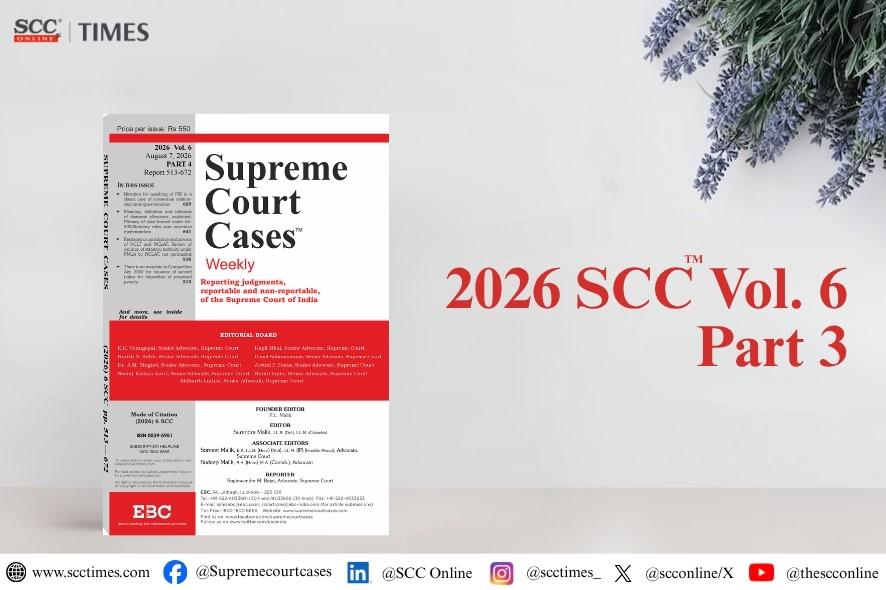
Supreme Court: Latest Cases on Companies Act, IBC, CRPC, Negotiable Instruments
Summary
- The Supreme Court has issued key rulings in 2026 SCC Vol. 6 Part 3 on share capital, quashing of proceedings or complaint, committee of creditors, and more.
- These decisions have significant implications for companies operating under the Companies Act and for individuals dealing with disputes governed by the Bharatiya Nagarik Suraksha Sanhita (BNSS) and IBC.
- The court's rulings may impact company law compliance strategies, dispute resolution approaches, and insolvency procedures.
Supreme Court Rulings in 2026 SCC Vol. 6 Part 3
The Supreme Court has issued several key rulings in the latest volume of its annual report, 2026 SCC Vol. 6 Part 3.
The Supreme Court has issued several key rulings in the latest volume of its annual report, 2026 SCC Vol. 6 Part 3. These decisions have significant implications for companies operating under the Companies Act and for individuals dealing with disputes governed by the Bharatiya Nagarik Suraksha Sanhita (BNSS) and the Insolvency and Bankruptcy Code (IBC). One notable ruling concerns the quashing of proceedings or complaint against a company, highlighting the importance of timely and proper legal action. The court's decisions also shed light on the role of committees of creditors in insolvency proceedings, underscoring the need for effective communication and cooperation between stakeholders.
Relevant Legal Context
The Companies Act, Bharatiya Nagarik Suraksha Sanhita (BNSS), and IBC are three critical pieces of legislation that govern company law compliance and dispute resolution in India. The Companies Act regulates corporate governance, shareholder rights, and mergers and acquisitions, while the BNSS provides a framework for dealing with criminal offenses and disputes. The IBC, on the other hand, offers a structured approach to insolvency and bankruptcy proceedings. These laws are designed to promote transparency, accountability, and fairness in business dealings, but their application can be complex and nuanced. Recent Supreme Court cases have clarified certain aspects of these laws, providing valuable guidance for lawyers and companies navigating the intricacies of Indian company law.
Why It Matters
The implications of these recent Supreme Court cases on Companies Act, BNSS, and IBC are far-reaching. Lawyers should be aware of the court's rulings on share capital, quashing of proceedings or complaint, committee of creditors, and other key issues. These decisions may impact company law compliance strategies, dispute resolution approaches, and insolvency procedures. By staying informed about these developments, lawyers can better advise their clients and ensure that they remain compliant with changing regulatory requirements. In addition, the court's rulings may also influence the development of new laws and regulations, shaping the future of Indian company law.
Practical Implications
Lawyers should watch for the implications of these recent Supreme Court cases on Companies Act, CrPC, and IBC, which may impact company law compliance and dispute resolution strategies.
Source
Source: Original reporting via SCC Times
How does this affect you?
Get an AI analysis of this article grounded in your jurisdictions, practice areas, and any policy documents you've uploaded to Wansom.
Wansom is AI and can make mistakes.