
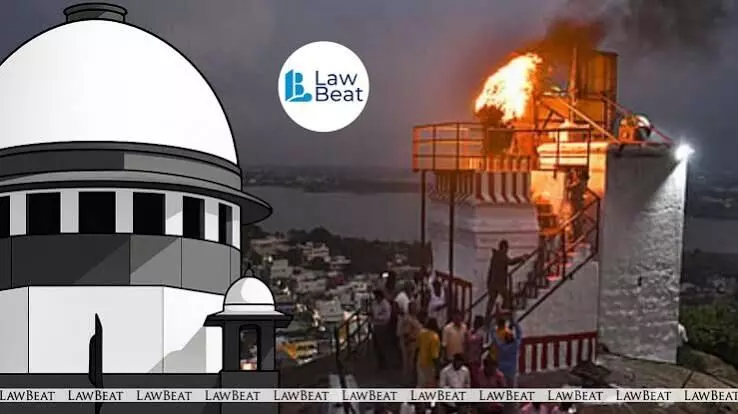
Supreme Court: One-Time Karthigai Deepam Lighting at Thirupparankundram
Summary
- The Supreme Court permitted a one-time lighting of the Karthigai Deepam at Thirupparankundram Deepathoon on November 24.
- This permission explicitly does not recognize any customary or religious right and is not a precedent.
- The Court stayed relevant findings of the Madras High Court's judgment from January 6, 2026.
- The interim order was granted due to the festival's immediate proximity, preventing an irrecoverable loss.
- All broader questions regarding religious freedom, custom, and temple administration remain open for future adjudication, including those under Articles 25 and 26 of the Constitution.
Interim Relief for Karthigai Deepam
The opportunity to perform the ceremony on that particular day, if denied, cannot be restored by any subsequent adjudication.
The India Supreme Court recently issued an interim directive, granting permission for the ceremonial lighting of the Karthigai Deepam at the Deepathoon pillar, situated near a Dargah atop the Thirupparankundram hill in Madurai. This specific allowance, issued for November 24, stipulated that only a limited team from the Devasthanam could carry out the lighting. Crucially, the Court underscored that this was a strictly one-time permission, not establishing any precedent or acknowledging any customary or religious rights.
Concurrently, the bench, comprising Justices Aravind Kumar and Vipul M. Pancholi, stayed paragraphs 1 to 140 of the Madras High Court's judgment from January 6, 2026. This stay applies specifically to those portions relevant to the current appeals, pending further orders from the apex court. The Supreme Court's intervention was prompted by the imminent date of the festival, recognizing that denying the ceremony on that particular day would result in an irrecoverable loss.
No Precedent, No Rights Established
The Supreme Court's rationale for this interim arrangement was rooted in the immediate and exceptional circumstances presented by the festival's timing. The Justices reasoned that "The opportunity to perform the ceremony on that particular day, if denied, cannot be restored by any subsequent adjudication." However, the Court was meticulous in clarifying that this temporary measure does not signify an endorsement of any competing claims or an opinion on the correctness of the Madras High Court's earlier findings. The arrangement was an independent assessment, and it neither affirms nor revives any operative directions from the High Court's judgments, which remain subject to final adjudication.
The Court explicitly stated that this one-time permission does not constitute a finding that the Deepathoon has historically been a site of customary religious observance, nor does it decide whether lighting the lamp there is an essential religious practice. Furthermore, the ruling does not establish whether any individual, religious denomination, or institution possesses an enforceable right to conduct such a ceremony. The permission for the Karthigai Deepam Thirupparankundram lighting cannot be relied upon as evidence of an established custom, religious usage, a customary right, an entitlement to access, or any alteration to the existing legal position.
Broader Legal Questions Remain Open
This interim order carries significant weight not for what it decides, but for what it explicitly leaves open for future determination. The Supreme Court emphasized that all fundamental questions concerning title, possession, usage, religious entitlement, temple administration, and access remain entirely unresolved. The Court also clarified that this specific arrangement cannot serve as an independent basis for seeking similar permissions in future years, reinforcing its non-precedential nature.
The appeals themselves are poised to address critical questions concerning the scope of religious freedom, the enforceability of asserted religious practices, the authority of temple administration over observances, and the appropriate boundaries of judicial involvement in such matters. The Court also drew attention to the fact that broader constitutional questions under Articles 25 and 26 of the Constitution of India in the Sabarimala reference have had their verdict reserved by a nine-judge Constitution Bench, indicating the complex legal landscape surrounding these issues. The nature of the alleged custom, the legal character of the disputed site, previous judicial orders, and the statutory authority of the institutions involved will all undergo scrutiny at the appropriate stage, with the appeals scheduled to be heard in the second week of January 2027.
Practical Implications
This interim order from the Supreme Court explicitly states that the one-time permission to light the Karthigai Deepam does not establish a precedent, recognize any customary or religious right, or alter the existing legal position. Lawyers should advise clients that this ruling cannot be relied upon to assert or defend claims related to religious customs, access rights, or temple administration, as all such questions remain open for final adjudication, including broader constitutional issues under Articles 25 and 26.
Source
How does this affect you?
Get an AI analysis of this article grounded in your jurisdictions, practice areas, and any policy documents you've uploaded to Wansom.
Finish Reading the Full Story and the Expert Analysis.
Get the latest legal & regulatory intelligence in India
Wansom is AI and can make mistakes.