
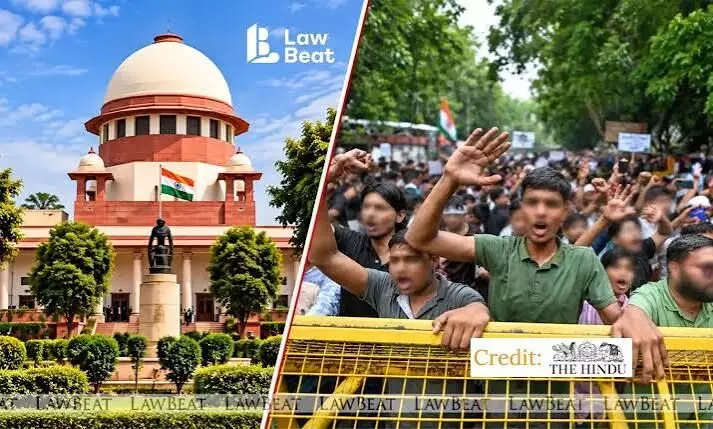
Supreme Court: Affidavit Mandated for Jantar Mantar De-notification Challenge
Summary
- The Supreme Court mandated that all factual assertions in written submissions for the Jantar Mantar de-notification challenge must be supported by an affidavit.
- The bench, including CJI Surya Kant, emphasized that someone must take responsibility for the correctness of these facts.
- Solicitor General Tushar Mehta questioned factual assertions in the petitioner's submissions on November 20, 2026.
- Senior Advocate Mukta Gupta contended that her submissions contained legal propositions, not factual averments.
- This ruling highlights the Supreme Court's focus on accountability and evidentiary support for claims made in court.
Court Mandates Affidavit for Factual Claims
The Court's insistence on an affidavit stems from the principle that someone must explicitly assume responsibility for the accuracy and correctness of any factual claims made.
The Supreme Court of India recently issued a significant directive, emphasizing that all factual assertions presented in written submissions must be formally supported by an affidavit. This ruling emerged during a hearing on November 20, 2026, concerning the ongoing challenge to the de-notification of Jantar Mantar, a prominent public space in New Delhi. The Court's bench, comprising Chief Justice of India Surya Kant, Justice Joymalya Bagchi, and Justice V Mohana, underscored the critical need for accountability regarding the veracity of information placed before it.
The Court's insistence on an affidavit stems from the principle that someone must explicitly assume responsibility for the accuracy and correctness of any factual claims made. This measure aims to bolster the integrity of judicial proceedings, particularly in cases of public interest and constitutional significance. The directive specifically addresses the submissions made in the context of the Jantar Mantar de-notification challenge affidavit, highlighting the rigorous standards expected from litigants and their legal representatives.
Solicitor General Questions Submissions
During the proceedings, Solicitor General Tushar Mehta raised concerns regarding certain factual assertions contained within the written submissions circulated on behalf of the petitioner. His questioning prompted the Court's immediate intervention, leading to the clear mandate for evidentiary backing. This exchange underscores the judiciary's proactive role in scrutinizing the foundations of arguments presented, ensuring that legal discourse is grounded in verifiable facts.
In response to the Solicitor General's challenge, Senior Advocate Mukta Gupta, representing the petitioner, maintained that the submissions primarily contained legal propositions rather than factual averments. This distinction is crucial, as legal arguments, while requiring logical coherence and statutory basis, do not typically necessitate the same form of sworn factual attestation as direct claims about events or circumstances. Nevertheless, the Supreme Court's ruling clarifies that whenever factual elements are present, even within broader legal arguments, they must be substantiated through an affidavit.
Elevating Accountability in Supreme Court Filings
This directive from the Supreme Court, particularly in the context of the Jantar Mantar de-notification challenge affidavit, sets a clear precedent for all future filings before the apex court. It reinforces the paramount importance of meticulous verification and formal attestation for any factual assertions affidavit India lawyers present. The Court's stance, articulated by CJI Surya Kant and the bench, signals a heightened focus on ensuring that all information influencing judicial decisions is unimpeachable and carries the weight of personal responsibility.
For legal practitioners, this development emphasizes the need for an even more rigorous approach to drafting and submitting documents to the Supreme Court Jantar Mantar case. It serves as a reminder that while legal arguments are central, they must be built upon a foundation of facts that are not only accurate but also formally sworn to. This measure ultimately aims to prevent unsubstantiated claims from influencing judicial outcomes, thereby upholding the sanctity and efficacy of the judicial process.
Practical Implications
Lawyers must ensure all factual assertions made in written submissions to the Supreme Court are explicitly backed by an affidavit, as the Court is emphasizing the need for accountability and evidentiary support for such claims, particularly in significant public interest litigation.
Source
How does this affect you?
Get an AI analysis of this article grounded in your jurisdictions, practice areas, and any policy documents you've uploaded to Wansom.
Finish Reading the Full Story and the Expert Analysis.
Get the latest legal & regulatory intelligence in India
Wansom is AI and can make mistakes.