
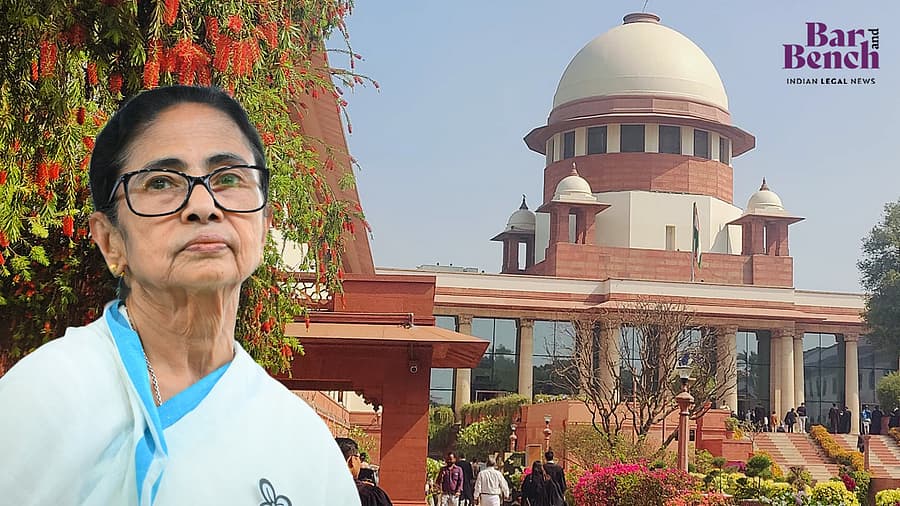
Supreme Court: ECI Must Set Trinamool Congress Symbol Timeframe
Summary
- The Supreme Court urged the Election Commission of India (ECI) to provide a reasonable timeframe for resolving the All India Trinamool Congress (TMC) name and symbol dispute.
- The case involves a challenge by former West Bengal Chief Minister Mamata Banerjee against an ECI interim order freezing the TMC's name and 'flowers & grass' symbol.
- CJI Surya Kant, presiding over the bench, emphasized the need for a fair opportunity for evidence without prolonged delays.
- The dispute originated from rival factions led by Mamata Banerjee and Ritabrata Banerjee, both claiming the party's identity and control.
- The ECI's interim order, issued on September 17, prevents both factions from using the TMC name and symbol for upcoming West Bengal Assembly by-elections, with Mamata Banerjee's faction temporarily allotted the name 'Mama'.
Supreme Court Urges Timely Resolution in Trinamool Congress Symbol Dispute
The court's insistence on a 'reasonable timeframe' for the Election Commission's decision-making process is particularly noteworthy.
The Supreme Court of India recently pressed the Election Commission of India (ECI) to accelerate its adjudication of the ongoing dispute surrounding the All India Trinamool Congress (TMC) party's name and its distinctive 'flowers & grass' symbol. A judicial bench, comprising Chief Justice of India (CJI) Surya Kant alongside Justices Joymalya Bagchi and V Mohana, heard a petition filed by former West Bengal Chief Minister Mamata Banerjee, who challenged an interim directive issued by the ECI.
The Court specifically acknowledged Ms. Banerjee's concerns regarding the protracted nature of the ECI's proceedings in this matter. Emphasizing the need for efficiency, the bench requested the ECI to propose a practical and reasonable timeframe within which a definitive resolution could be reached. CJI Kant articulated the court's expectation for a process that allows all parties ample opportunity to present their evidence without unduly prolonging the overall decision-making period, while also ensuring the ECI has sufficient time for thorough consideration.
Background of the All India Trinamool Congress Name and Symbol Dispute
The contentious issue at the heart of the Supreme Court's intervention stems from a power struggle between two factions within the Trinamool Congress. One faction is led by Mamata Banerjee, while the other is headed by Ritabrata Banerjee, who serves as the Leader of Opposition in West Bengal. Both groups have laid claim to the official Trinamool Congress name, its electoral symbol, and the broader organizational control of the party.
In response to this internal conflict, the Election Commission of India issued an interim order on September 17. This directive effectively froze the use of the 'All India Trinamool Congress' name and its associated symbol, preventing both rival factions from utilizing them in the upcoming West Bengal Assembly by-elections. As a temporary measure, the faction led by Mamata Banerjee has been provisionally assigned the name 'Mama' for electoral purposes.
Judicial Expectation for Expedited Election Commission Adjudication
The Supreme Court's direct engagement with the Election Commission of India regarding a specific timeframe for resolving the Trinamool Congress symbol dispute underscores a significant judicial expectation for promptness in such electoral matters. This intervention highlights the judiciary's role in ensuring that the ECI, as the primary adjudicatory body for political party recognition and symbols, operates with both fairness and efficiency.
The court's insistence on a 'reasonable timeframe' for the Election Commission's decision-making process is particularly noteworthy. It signals that while due process and the presentation of evidence are crucial, these procedures should not lead to indefinite delays, especially when they impact electoral participation and the democratic process. This directive could set a precedent for how future disputes concerning party names and symbols are handled by the ECI, encouraging a more structured and timely approach to adjudication.
Implications for Future Election Law and Party Disputes
The Supreme Court's emphasis on a defined timeframe for the Election Commission to decide on the All India Trinamool Congress name and symbol dispute carries broader implications for election law and the resolution of political party conflicts. Lawyers advising political parties or involved in election law should observe this development closely, as it indicates a clear judicial preference for expedited resolution in such sensitive matters.
The court's stance, particularly CJI Surya Kant's direct questioning about a 'realistic' timeframe, suggests that future challenges to ECI decisions or requests for intervention might increasingly focus on the timeliness of the commission's adjudicatory processes. The next hearing in this West Bengal political party dispute before the Supreme Court is scheduled for September 28, which will likely provide further clarity on the ECI's proposed timeline and the court's ongoing oversight.
Practical Implications
Lawyers advising political parties or involved in election law should observe the Supreme Court's emphasis on the Election Commission of India (ECI) providing a reasonable timeframe for resolving party name and symbol disputes. This indicates a judicial expectation for expedited resolution in such matters, potentially influencing future strategies for challenging or defending ECI decisions.
Source
How does this affect you?
Get an AI analysis of this article grounded in your jurisdictions, practice areas, and any policy documents you've uploaded to Wansom.
Finish Reading the Full Story and the Expert Analysis.
Get the latest legal & regulatory intelligence in India
Wansom is AI and can make mistakes.