
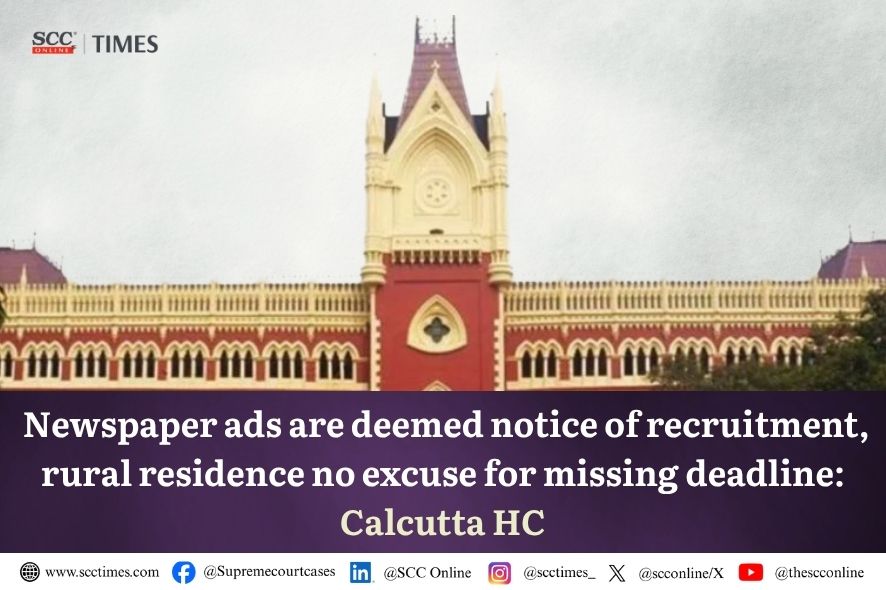
Calcutta High Court: Newspaper Ad Is Valid Recruitment Notice, No Rural Excuse
Summary
- Newspaper advertisements are legally considered sufficient notice for recruitment processes.
- The Calcutta High Court ruled that rural residence is not a valid excuse for missing recruitment deadlines.
- Reopening an application portal solely for corrections does not create a new opportunity for those who missed the original deadline.
- The ruling clarifies the responsibilities of both recruiting bodies and applicants regarding public notices in India.
The Court's Ruling
This ruling specifically addressed the common argument that individuals residing in rural areas might miss such announcements, stating unequivocally that a rural address does not serve as a valid excuse for failing to meet application deadlines.
The Calcutta High Court recently delivered a definitive ruling clarifying the legal adequacy of public notices in recruitment processes, specifically affirming that advertisements placed in newspapers constitute legally sufficient notice for informing potential applicants. This significant judicial pronouncement directly addressed the argument that individuals residing in rural areas might be disadvantaged or unaware of such announcements. The court unequivocally stated that a rural address does not serve as a valid or acceptable excuse for failing to meet established application deadlines for recruitment opportunities. This decision from the Calcutta High Court recruitment notice case underscores the fundamental expectation that all prospective candidates bear the responsibility of actively seeking out and staying informed about available positions and their associated timelines.
Furthermore, the High Court meticulously distinguished between administrative actions intended to facilitate existing applications and those that would create new opportunities. The court clarified that if a recruitment portal is reopened solely for the purpose of allowing candidates who have already applied to make corrections or amendments to their submitted applications, this action does not, under any circumstances, create a fresh window or a new opportunity for individuals who had previously missed the original application deadline. This distinction is paramount for upholding the integrity, predictability, and finality of recruitment schedules, preventing an indefinite extension of the application period based on late application assistant teacher scenarios or similar circumstances.
Legal Context and Rationale
The Calcutta High Court's ruling on the Calcutta HC recruitment ad notice reinforces a well-established legal principle concerning the dissemination of public information and the concept of due diligence expected from citizens. By unequivocally declaring newspaper advertisements as an adequate and legally binding form of public notice, the court acknowledges their widespread reach and traditional role as a primary medium for announcing public recruitment drives. This judicial perspective places a clear onus on applicants to diligently monitor such notices, rather than imposing an impractical burden on recruiting authorities to ensure individual, personalized notification across diverse and often remote geographical locations within India. The court's decision effectively solidifies the legal framework around how public bodies can effectively communicate recruitment deadlines.
The judgment implicitly addresses the practical complexities inherent in large-scale recruitment efforts, particularly in a country with a vast and varied population. Ensuring that every single potential candidate is personally aware of a specific recruitment deadline would be an administrative impossibility. Consequently, the use of widely circulated newspapers is deemed a reasonable, accessible, and legally sound method for fulfilling the requirement of public notification. The court's firm rejection of rural residence as a legitimate excuse for a missed recruitment deadline further entrenches the principle that general public notices, once properly issued through channels like newspaper advertisement legal notice, are universally applicable and binding on all potential applicants, irrespective of their geographical location.
Implications for Recruitment
This recent judgment from the Calcutta High Court carries substantial implications for both organizations conducting recruitment and for individuals seeking employment, particularly in public sector roles. For entities managing recruitment processes, it provides robust legal affirmation for their continued reliance on traditional newspaper advertisements as a definitive and legally recognized means of communicating critical information, including recruitment deadlines. This clarity can help streamline administrative procedures, reduce the likelihood of legal challenges predicated on claims of insufficient notice, and reinforce the strict adherence to published timelines. It underscores that the recruitment deadline excuse India often faces due to various reasons is not always legally viable.
For aspiring candidates, especially those eyeing positions such as assistant teacher roles, the ruling serves as a crucial reminder of their personal and proactive responsibility to diligently monitor official recruitment announcements. It emphatically states that ignorance of a deadline, even if attributed to factors like rural residence or lack of immediate access to information, will not be accepted as a valid reason for submitting a late application. This judicial clarity helps to establish clear expectations for all stakeholders within the recruitment ecosystem, ensuring that established procedures and the principle of timely application are consistently respected and upheld across the board.
Practical Implications
Lawyers advising clients on recruitment processes must emphasize that newspaper advertisements constitute legally sufficient notice, even for applicants in rural areas. This ruling from the Calcutta High Court reinforces the strict adherence to published deadlines and the legal adequacy of common advertising methods.
Source
Source: Original reporting via SCC Times
How does this affect you?
Get an AI analysis of this article grounded in your jurisdictions, practice areas, and any policy documents you've uploaded to Wansom.
Finish Reading the Full Story and the Expert Analysis.
Get the latest legal & regulatory intelligence in India
Wansom is AI and can make mistakes.