
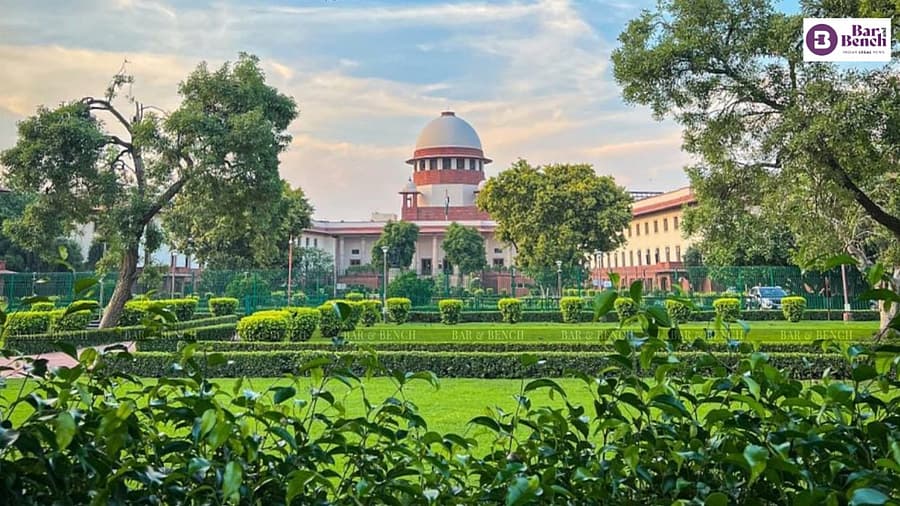
Supreme Court: UGC Fake Institutions Advisory Directed
Summary
- The Supreme Court has directed the University Grants Commission and all regulatory authorities to issue public advisories.
- These advisories will instruct the public to verify educational institutions before seeking admission.
- The directive was issued by Justices Ahsanuddin Amanullah and NV Anjaria following a report on a fake medical college in Uttar Pradesh.
- The fake institution, run by an illiterate tea-seller, operated from a dilapidated farmhouse in Etah district.
- The Central government is also tasked with monitoring the compliance of regulatory authorities with these new directions.
Judicial Mandate for Verification
The Supreme Court of India has issued a significant directive to the University Grants Commission (UGC) and all other regulatory bodies, instructing them to release public advisories, urging individuals to thoroughly verify educational institutions before enrolling.
The Supreme Court of India has issued a significant directive to the University Grants Commission (UGC) and all other regulatory bodies, instructing them to release public advisories, urging individuals to thoroughly verify educational institutions before enrolling. This crucial order, delivered by a Bench comprising Justices Ahsanuddin Amanullah and NV Anjaria, aims to safeguard prospective students from fraudulent entities operating within the education sector.
This judicial intervention was prompted by an Indian Express report that brought to light the existence of a counterfeit medical college. The illicit institution was found operating out of a dilapidated farmhouse situated in Mahmoodpur Nagaria village, located in Uttar Pradesh’s Etah district. Further details from the report indicated that this fraudulent college was being run by an individual identified as an illiterate tea-seller, highlighting the severe lack of oversight in certain areas.
Case Origin and Regulatory Expansion
The Supreme Court's October 9 order, which included the directive for a Supreme Court UGC fake institutions advisory, originated from the case of Ayesha Jain v. Amity University, Noida and Others. Initially, the petition was filed by Ayesha Jain against Amity University in Noida, concerning the institution's handling of her name change in its records and the subsequent academic repercussions she claimed to have suffered.
As the proceedings evolved, the Court broadened the scope of the case beyond the initial dispute. This expansion allowed the judiciary to address more pervasive issues within the educational landscape, ultimately leading to the directive for enhanced public awareness. Additional Solicitor General (ASG) KM Nataraj, representing the Uttar Pradesh government, played a pivotal role by suggesting that the UGC should explicitly caution the public against engaging with unverified institutions, a suggestion the Court found useful and subsequently adopted.
Enhancing Educational Regulatory Compliance
The Supreme Court's acceptance of the ASG's suggestion resulted in a clear mandate: "We find the suggestion to be useful and accordingly, a direction is issued to the UGC and all the regulatory authorities to issue such public advisory to act accordingly." This statement underscores the judiciary's intent to bolster India education regulatory compliance and protect the integrity of the academic system. The directive specifically targets the University Grants Commission public advisory mechanism as a primary tool for this purpose.
Furthermore, the Court did not limit its oversight to the regulatory bodies alone. It also instructed the Central government to actively monitor the compliance of these regulatory authorities with the new directions. This dual-layered approach ensures that not only are advisories issued, but their implementation and effectiveness are also subject to governmental scrutiny, reinforcing the importance of the Supreme Court direction educational institutions must now contend with indirectly through increased public scrutiny and regulatory vigilance.
Practical Implications
Lawyers advising educational institutions or compliance officers within them should anticipate new public advisories from the UGC and other regulators regarding institutional verification. This mandates a review of institutional transparency and public-facing information to ensure clear legitimacy and avoid regulatory scrutiny or public confusion.
Source
How does this affect you?
Get an AI analysis of this article grounded in your jurisdictions, practice areas, and any policy documents you've uploaded to Wansom.
Finish Reading the Full Story and the Expert Analysis.
Get the latest legal & regulatory intelligence in India
Wansom is AI and can make mistakes.