
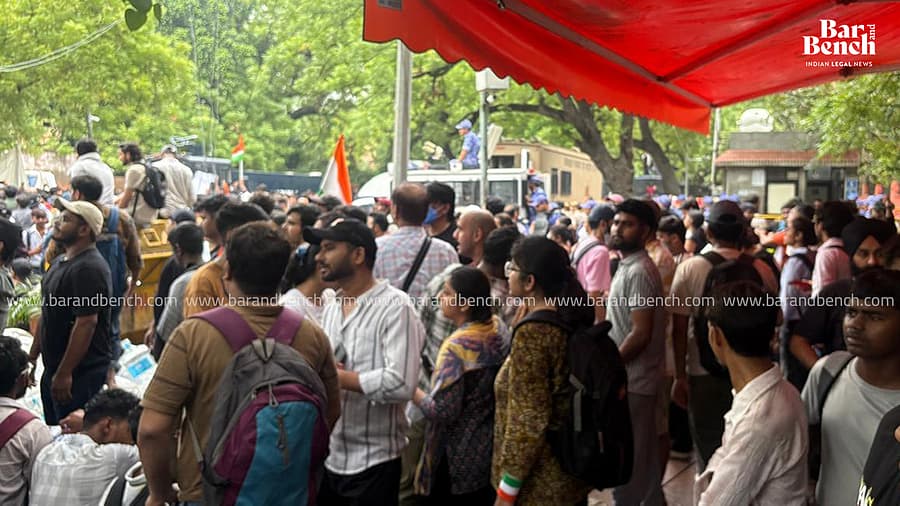
Supreme Court: Delhi Protests Video Preservation Order Issued
Summary
- The Supreme Court issued notices to the Union government and Delhi Police concerning petitions related to recent Delhi protests.
- Petitions address alleged police excesses, restrictions on public movement, and the de-notification of Jantar Mantar as a protest site.
- A bench comprising CJI Surya Kant and Justice Joymalya Bagchi ordered law enforcement agencies to preserve all CCTV footage and digital recordings.
- Private parties are also permitted to preserve any digital material they collected related to the protests.
- The Court appealed to the Bar to avoid filing new petitions and requested nodal counsels to manage the existing 46 cases efficiently.
What Happened
The Court underscored the importance of this evidence by also stating that private entities possessing such material were at liberty to preserve it, ensuring a comprehensive collection of visual and digital records.
The Supreme Court of India recently intervened in the ongoing legal challenges stemming from the Delhi protests, issuing notices to both the Union government and the Delhi Police. This action came in response to a series of petitions that raised critical concerns, including allegations of excessive force by law enforcement, restrictions imposed on public movement, and the controversial de-notification of Jantar Mantar as a designated protest venue. The Court's immediate focus was on securing crucial evidence related to these events.
A significant directive from the bench, comprising Chief Justice of India (CJI) Surya Kant and Justice Joymalya Bagchi, mandated the preservation of all relevant digital material. This order specifically instructed law enforcement agencies to safeguard CCTV footage and any other recordings they had collected concerning the protests. The Court underscored the importance of this evidence by also stating that private entities possessing such material were at liberty to preserve it, ensuring a comprehensive collection of visual and digital records. This initial step by the Supreme Court sets the stage for a thorough examination of the issues presented by the petitioners.
The Court's Directive on Evidence
The Supreme Court's order on Thursday, while not issuing any other major directions at this preliminary stage, placed a strong emphasis on the preservation of evidence. The directive explicitly stated that "All law enforcement agencies are directed to preserve the CCTV footage or any other digital material collected by them." This comprehensive instruction covers a wide array of potential evidence that could shed light on the conduct of both protestors and authorities during the recent demonstrations.
Furthermore, the Court extended this principle to non-state actors, clarifying that "Similarly, such material collected by private parties, they shall also be at liberty to preserve." This ensures that a broader spectrum of evidence, potentially including footage from private security cameras, mobile phone recordings, or other digital artifacts held by individuals or organizations, remains available for future scrutiny. The bench, led by CJI Surya Kant and Justice Joymalya Bagchi, recognized the critical role such digital records play in establishing facts and accountability in complex public order situations.
Managing the Legal Landscape
Beyond the immediate preservation order, the Supreme Court also outlined a strategy for managing the substantial volume of litigation surrounding the Delhi protests. Chief Justice Kant noted the existence of numerous overlapping petitions and proposed a streamlined approach. The Court requested the Solicitor General's office to designate a nodal counsel to represent the respondents, while also asking the petitioners to appoint their own nodal counsel. These appointed representatives would be tasked with consolidating the various petitions, identifying common issues, and pinpointing areas of overlap, thereby facilitating a more organized judicial process.
The Court issued notices in all these cases, requiring the respondents to submit their replies. In a notable appeal, the Supreme Court urged members of the Bar to refrain from filing additional petitions related to the protests, indicating a desire to manage the existing caseload efficiently. With forty-six petitions already before the Court, this call reflects an effort to prevent further fragmentation of the legal proceedings and to focus judicial resources on the already extensive body of work. The preservation of video evidence, including CCTV footage, will be central to the resolution of these complex matters.
Practical Implications
Lawyers representing parties involved in the Delhi protests should be aware of the Supreme Court's explicit order for the preservation of all digital evidence, including CCTV footage, by both state agencies and private entities. This mandates that such evidence must be secured and could be critical for future litigation, defense strategies, or compliance investigations related to the events.
Source
How does this affect you?
Get an AI analysis of this article grounded in your jurisdictions, practice areas, and any policy documents you've uploaded to Wansom.
Finish Reading the Full Story and the Expert Analysis.
Get the latest legal & regulatory intelligence in India
Wansom is AI and can make mistakes.