
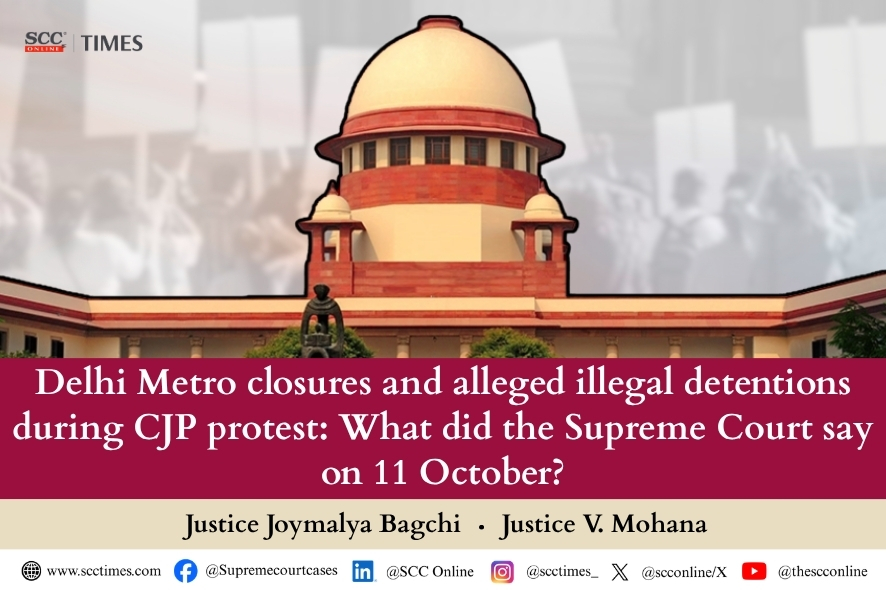
Supreme Court: Delhi Metro Closures, Illegal Detentions During CJP Protest 2026
Summary
- The Supreme Court convened an urgent hearing on Sunday, October 11, to address specific applications.
- These applications alleged that Delhi Police violated a prior court order and illegally detained numerous individuals on October 10, 2026.
- The allegations arose in the context of Delhi Metro closures and a CJP protest.
- The Court's swift intervention underscores its commitment to upholding judicial directives and protecting civil liberties.
What Happened
This immediate judicial intervention signals the Court's commitment to upholding its own directives and protecting citizens from potential overreach by law enforcement agencies.
The Supreme Court of India convened an urgent session on Sunday, October 11, to address critical applications brought before it. These applications specifically detailed allegations concerning the Delhi Police's actions on the preceding day, October 10, 2026. The core of the complaints centered on two significant issues: the alleged violation of a prior directive issued by the Court itself, and the reported illegal detention of a substantial number of individuals.
This swift judicial response underscores the gravity with which the Court viewed the unfolding situation. The context for these allegations included Delhi Metro closures and a protest organized by the CJP, which reportedly led to the events on October 10, 2026, prompting the immediate judicial review.
Legal Context of the Allegations
The applications presented to the Supreme Court on Sunday, October 11, raised serious questions regarding adherence to judicial authority and fundamental civil liberties. The allegation of a 'violation of its earlier order' suggests that the Delhi Police's actions on October 10, 2026, may have directly contravened specific instructions or injunctions previously issued by the apex court. Such a breach, if proven, represents a direct challenge to the judiciary's mandate and the principle of rule of law.
Concurrently, the claim of 'alleged illegal detention of a large number of individuals' points to potential infringements on the constitutional right to personal liberty, a cornerstone of India's legal framework. These detentions, reportedly carried out by the Delhi Police, would need to be justified under established legal procedures, failing which they could be deemed unlawful. The broader context of these events, including Delhi Metro closures and a CJP protest, frames the allegations within the discourse of public order management and the right to peaceful assembly.
Why It Matters
The Supreme Court's decision to hold an urgent hearing on Sunday, October 11, regarding the alleged actions of the Delhi Police on October 10, 2026, carries significant weight for civil liberties and the enforcement of judicial authority in India. This immediate judicial intervention signals the Court's commitment to upholding its own directives and protecting citizens from potential overreach by law enforcement agencies.
The outcome of these applications will establish crucial precedents concerning the scope of police powers during public demonstrations, particularly when such actions involve alleged illegal detentions and disruptions like Delhi Metro closures. Furthermore, the Court's pronouncements will clarify the accountability mechanisms for state actors accused of violating judicial orders, reinforcing the judiciary's role as a guardian of constitutional rights. This case will be closely watched for its implications on the balance between maintaining public order and safeguarding the fundamental right to protest.
Practical Implications
Lawyers should closely monitor the Supreme Court's pronouncements on state actions like metro closures and detentions during protests, as these rulings establish crucial precedents regarding civil liberties, the scope of police power, and the enforcement of judicial orders in public order situations.
Source
How does this affect you?
Get an AI analysis of this article grounded in your jurisdictions, practice areas, and any policy documents you've uploaded to Wansom.
Finish Reading the Full Story and the Expert Analysis.
Get the latest legal & regulatory intelligence in India
Wansom is AI and can make mistakes.