
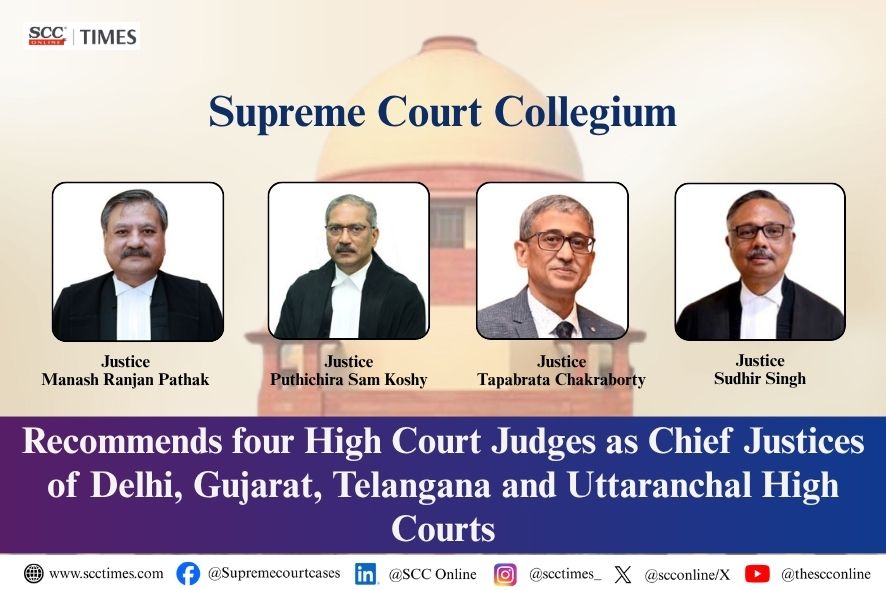
Supreme Court Collegium: Recommends 4 High Court Chief Justices
Summary
- The Supreme Court Collegium recommended four High Court Judges for Chief Justice positions on October 26, 2026.
- Justice Manash Ranjan Pathak is recommended for Gujarat, Justice Puthichira Sam Koshy for Delhi, Justice Tapabrata Chakraborty for Telangana, and Justice Sudhir Singh for Uttaranchal.
- These recommendations follow recent elevations of three High Court Chief Justices to the Supreme Court earlier in October.
- Justice Pathak and Justice Koshy were already discharging Chief Justice duties in Gujarat and Telangana, respectively, prior to these recommendations.
- Each nominee brings extensive judicial and legal experience from various High Courts and prior legal roles.
Key Recommendations from the Collegium
Lawyers practicing in the Delhi, Gujarat, Telangana, and Uttaranchal High Courts should note the impending change in judicial leadership, as new Chief Justices can influence court administration, case listing, and potentially the judicial approach to certain matters within their respective jurisdictions.
The Supreme Court Collegium, in a significant decision made during its meeting on October 26, 2026, has put forth recommendations for the appointment of four High Court Judges to the esteemed positions of Chief Justice. These nominations aim to fill crucial leadership roles within the Gujarat, Delhi, Telangana, and Uttaranchal High Courts, signaling a notable shift in judicial administration across these jurisdictions. The Collegium's selections include Justice Manash Ranjan Pathak for the Gujarat High Court, Justice Puthichira Sam Koshy for the Delhi High Court, Justice Tapabrata Chakraborty for the Telangana High Court, and Justice Sudhir Singh for the Uttaranchal High Court.
These recommendations come on the heels of a series of judicial movements earlier in October 2026, which saw three sitting High Court Chief Justices elevated to the Supreme Court. This created vacancies and necessitated interim arrangements in several High Courts. The Collegium's latest pronouncements are designed to establish permanent leadership in these key judicial institutions, ensuring continuity and stability in their operations. The process underscores the ongoing dynamic nature of judicial appointments and elevations within India's higher judiciary.
Profiles of the Nominees
Justice Manash Ranjan Pathak, slated to become the Chief Justice of the Gujarat High Court, commenced his judicial service as an Additional Judge of the Gauhati High Court on May 22, 2013, achieving permanent status on November 12, 2018. His career prior to elevation included serving as Standing Counsel for the State of Tripura and the Education Department of the Government of Assam. After a transfer to the Orissa High Court in July 2025, Justice Pathak joined the Gujarat High Court in September 2026. He was already discharging the duties of Chief Justice there since October 5, 2026, following Justice Sunita Agarwal's elevation to the Supreme Court.
For the Delhi High Court, the Collegium has recommended Justice Puthichira Sam Koshy, who currently serves as a Judge of the Telangana High Court and is fulfilling the duties of its Chief Justice. Justice Koshy began his legal career as an advocate in 1991, practicing initially at the Madhya Pradesh High Court in Jabalpur and later at the Chhattisgarh High Court in Bilaspur, where he also held roles as Government Advocate and Deputy Advocate General. He was appointed an Additional Judge of the Chhattisgarh High Court in September 2013, becoming a permanent Judge in March 2016. His transfer to the Telangana High Court occurred in July 2023, and he assumed the interim Chief Justice duties after Justice Aparesh Kumar Singh's elevation to the Supreme Court on October 5, 2026.
Justice Tapabrata Chakraborty, a current Judge of the Calcutta High Court, has been proposed to lead the Telangana High Court. Enrolling as an advocate in May 1991, he dedicated approximately 22 years to practice primarily before the Calcutta High Court. His judicial journey began as an Additional Judge of the Calcutta High Court in October 2013, and he was confirmed as a permanent Judge in March 2016. He is now set to take over the leadership of the Telangana High Court, where Justice P. Sam Koshy is presently serving in an acting capacity.
Finally, Justice Sudhir Singh, a Judge of the Patna High Court, has been recommended for the position of Chief Justice of the Uttaranchal High Court. Justice Singh enrolled as an advocate in 1991, gaining extensive experience before the Patna High Court in various capacities, including Central Government Counsel, Railway Advocate for the Ministry of Railways, Additional Standing Counsel for the Indian Audit and Accounts Department, and Assistant Solicitor General of India. He joined the Bench of the Patna High Court as an Additional Judge.
Significance of the Appointments
The appointment of Chief Justices to High Courts across India carries substantial weight, influencing not only the administrative efficiency of these courts but also the broader legal landscape within their respective states. A Chief Justice plays a pivotal role in managing court dockets, allocating cases, and guiding the judicial approach to various legal matters. The Supreme Court Collegium's October 2026 recommendations for the Gujarat, Delhi, Telangana, and Uttaranchal High Courts are therefore critical for the functioning of justice delivery in these regions.
Lawyers practicing in the Delhi, Gujarat, Telangana, and Uttaranchal High Courts should note the impending change in judicial leadership, as new Chief Justices can influence court administration, case listing, and potentially the judicial approach to certain matters within their respective jurisdictions. These appointments ensure that these High Courts, which recently experienced interim leadership due to elevations to the Supreme Court, will now have permanent heads to steer their operations. The careful selection process by the Supreme Court Collegium aims to ensure experienced and capable leadership for these vital judicial institutions.
Practical Implications
Lawyers practicing in the Delhi, Gujarat, Telangana, and Uttaranchal High Courts should note the impending change in judicial leadership, as new Chief Justices can influence court administration, case listing, and potentially the judicial approach to certain matters within their respective jurisdictions.
Source
Source: Original reporting via SCC Times
How does this affect you?
Get an AI analysis of this article grounded in your jurisdictions, practice areas, and any policy documents you've uploaded to Wansom.
Finish Reading the Full Story and the Expert Analysis.
Wansom is AI and can make mistakes.