
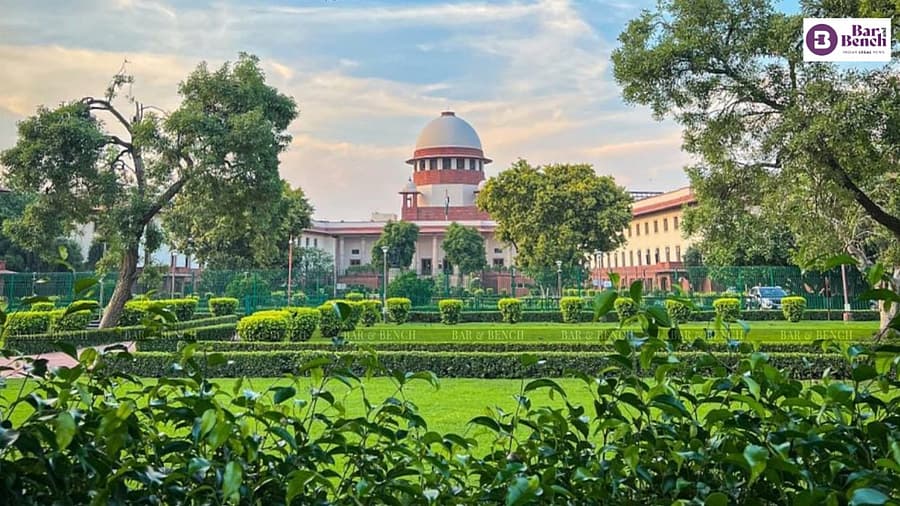
Supreme Court: Denies Anticipatory Bail in Ranchi Ear Bite Case
Summary
- The Supreme Court denied anticipatory bail to Rajiv Ranjan Kumar in a case involving a violent assault where he allegedly bit off a neighbor's ear.
- Justices JB Pardiwala and K Vinod Chandran emphasized the severity of the injury, questioning how a bitten ear could be replaced.
- Kumar's appeal challenged a February 2026 Jharkhand High Court order that had also refused him pre-arrest protection.
- The defense argued the incident was an escalation of a neighborhood dispute during a festive night, with cross-FIRs filed.
- The Court prioritized the egregious nature of the injury over arguments about the incident's context or other parties receiving bail.
The Supreme Court's Stance
The Court's emphasis on the irreparable damage, as highlighted by its rhetorical question about replacing a bitten-off ear, indicates a low tolerance for granting pre-arrest protection in such circumstances, irrespective of attempts to contextualize the incident.
The Supreme Court of India recently delivered a stern message regarding anticipatory bail applications in cases involving severe violence, particularly when egregious injuries are inflicted. In a notable hearing, Justices JB Pardiwala and K Vinod Chandran presided over an appeal concerning an incident where a man allegedly bit off a portion of his neighbor's ear during a street altercation. Justices JB Pardiwala has been serving as a judge of the Supreme Court of India since May 2022, and Justice K Vinod Chandran was elevated as a Judge of the Supreme Court of India on January 16, 2025. The bench, employing a degree of judicial wit, directly questioned the accused's expectation of pre-arrest protection given the nature of the alleged act, remarking, "You ate his ear, how do we replace it?" This pointed query underscored the Court's disinclination to grant relief in circumstances marked by such extreme physical harm.
The case involved Rajiv Ranjan Kumar, who sought anticipatory bail following a violent clash that occurred in Ranchi. The incident, which led to the severe injury, had previously resulted in the denial of anticipatory bail by the Jharkhand High Court. Kumar's appeal to the apex court challenged the February 2026 order issued by the High Court, which had refused to grant him pre-arrest protection. The Supreme Court's immediate focus on the gravity of the injury signaled a clear judicial perspective on the limits of anticipatory bail, especially when confronted with allegations of brutal assault.
Defense Arguments and Judicial Scrutiny
During the proceedings, counsel for Rajiv Ranjan Kumar attempted to frame the incident as an unfortunate escalation of a long-standing neighborhood dispute. The defense argued that the violent confrontation in Ranchi was not an isolated act but rather the culmination of ongoing tensions between neighbors, which regrettably spiraled out of control on a festive night. Specifically, it was submitted that the incident occurred during Janmashtami celebrations, a time when people were engaged in festivities, and that stone-pelting had been involved. Furthermore, the counsel highlighted that cross-FIRs had been registered following the clash, and that the opposing party in the dispute had successfully secured anticipatory bail, while Kumar's application had been denied.
Despite these arguments, the Supreme Court bench remained unconvinced by the contextual explanations. The Justices did not allow the narrative of a "routine neighborhood feud" or the festive backdrop to overshadow the central allegation of severe bodily harm. The Court's remarks, including a direct reference to an allegation of a firearm ("You first took out a pistol, then held his ear and ate it"), indicated a deep concern over the level of violence described. This judicial scrutiny demonstrated a clear prioritization of the nature of the injury over the mitigating circumstances presented by the defense, reinforcing the principle that certain acts of violence may preclude pre-arrest bail.
Implications for Anticipatory Bail
This ruling by Justices JB Pardiwala and K Vinod Chandran carries significant implications for future applications seeking anticipatory bail, particularly in cases involving violent assault where severe injuries are alleged. The Supreme Court's firm stance in the Rajiv Ranjan Kumar anticipatory bail matter, focusing intensely on the "ear bite" incident, suggests a heightened judicial threshold for granting pre-arrest protection when the alleged act involves disfigurement or other grievous harm. The Court's refusal to be swayed by arguments concerning cross-FIRs or the characterization of the event as a mere neighborhood dispute underscores a policy against trivializing serious acts of violence.
The denial of anticipatory bail in this Ranchi ear biting incident serves as a crucial precedent. It signals that even if an incident arises from a protracted dispute or occurs amidst chaotic circumstances, the severity and nature of the injury inflicted will be a paramount consideration for the judiciary. Lawyers advising clients on anticipatory bail applications, especially in India, must recognize that the Supreme Court will heavily weigh the egregious nature of the alleged violence. The Court's emphasis on the irreparable damage, as highlighted by its rhetorical question about replacing a bitten-off ear, indicates a low tolerance for granting pre-arrest protection in such circumstances, irrespective of attempts to contextualize the incident.
Practical Implications
Lawyers advising clients on anticipatory bail applications, particularly in India, should note that the Supreme Court will heavily weigh the severity and nature of the alleged violence, even in cases presented as neighborhood disputes. The Court's focus on the egregious injury (e.g., biting off an ear) indicates a low tolerance for granting pre-arrest protection in such circumstances, regardless of arguments about cross-FIRs or the incident's context.
Source
How does this affect you?
Get an AI analysis of this article grounded in your jurisdictions, practice areas, and any policy documents you've uploaded to Wansom.
Finish Reading the Full Story and the Expert Analysis.
Get the latest legal & regulatory intelligence in India
Wansom is AI and can make mistakes.