
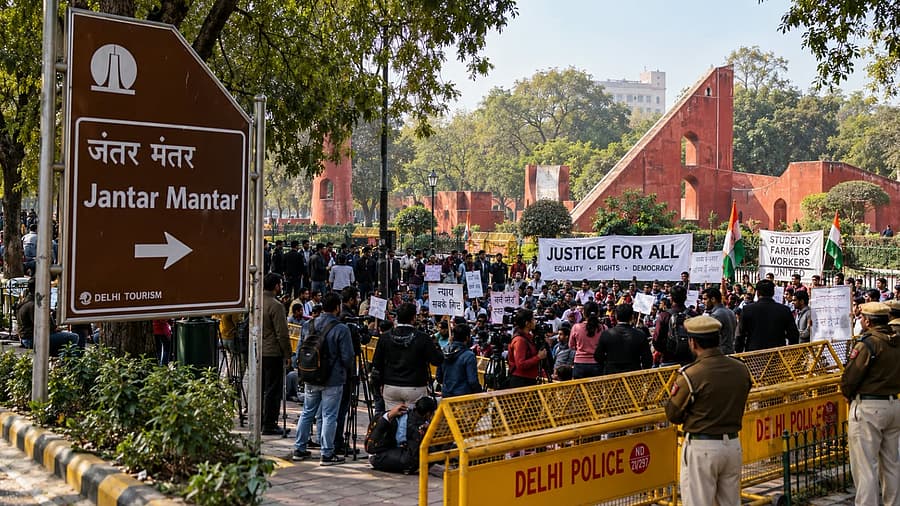
Supreme Court: Jantar Mantar Protest Site De-notification Challenged
Summary
- The Delhi Police de-notified Jantar Mantar as a protest site on October 11, designating three alternative venues.
- The decision followed recommendations from a Union Ministry of Home Affairs committee.
- Advocate Swaty Singh has filed a petition in the Supreme Court, challenging the order.
- The petition argues the ban violates fundamental rights to freedom of speech and peaceful assembly under Articles 19(1)(a) and 19(1)(b).
- The Delhi Police previously justified the move in High Court, citing a Supreme Court order from October 9.
Jantar Mantar De-notified as Protest Venue
The legal filing acknowledges the state's prerogative to regulate these fundamental rights, particularly when necessary to maintain public order.
The Delhi Police issued a significant order on October 11, officially de-notifying Jantar Mantar as a designated site for public protests in the capital. This directive, a standing order from Delhi Commissioner of Police Anurag Kumar, effectively implemented a ban on demonstrations at the historically significant location. In its place, three alternative venues were identified for future protests: Ramlila Ground, Burari Ground, and CBD Ground in East Delhi.
This decision by the Delhi Police was not made in isolation. It followed recommendations from a committee established by the Union Ministry of Home Affairs. The committee's mandate was to explore and suggest alternative locations suitable for citizens to conduct protests and demonstrations, indicating a broader governmental review of public assembly spaces within the city.
Constitutional Challenge to the Ban
In response to the Jantar Mantar protest site de-notification, advocate Swaty Singh has lodged a petition with the Supreme Court of India. The challenge specifically targets the Delhi Police's October 11 order, arguing that it infringes upon fundamental rights guaranteed by the Indian Constitution. The petition asserts violations of both Article 19(1)(a), which protects freedom of speech and expression, and Article 19(1)(b), which safeguards the right to assemble peacefully without arms.
The legal filing acknowledges the state's prerogative to regulate these fundamental rights, particularly when necessary to maintain public order. However, it critically contends that such regulation cannot be so extensive as to amount to an outright prohibition or to render the exercise of these constitutional rights meaningless and illusory. The Supreme Court is expected to hear the matter shortly after the petition's filing.
Police Justification and Prior Rulings
The Delhi Police had previously defended its decision to de-notify Jantar Mantar before the High Court in a separate case initiated by the Indian Youth Congress. In those proceedings, the police articulated that their action was directly informed by a Supreme Court order issued on October 9. This suggests the police viewed the de-notification as a necessary measure aligned with judicial guidance, though the specifics of the October 9 Supreme Court order and its direct applicability to Jantar Mantar's status remain central to the current challenge.
The police's reliance on a prior Supreme Court directive highlights a complex interplay between executive action, judicial pronouncements, and the constitutional rights of citizens to protest. The current Swaty Singh Supreme Court petition will likely delve into whether the Delhi Police's interpretation and implementation of any such prior order were consistent with the spirit and letter of fundamental rights, especially concerning the availability of accessible and meaningful protest venues like the Ramlila Ground protest site alternative.
Implications for Freedom of Assembly
This Supreme Court challenge carries significant weight for the future of freedom of assembly rights in Delhi and across India. The outcome will clarify the permissible boundaries of state power in regulating public demonstrations versus the constitutional protection afforded to citizens' rights to express dissent and gather peacefully. The petition's core argument—that regulation cannot equate to prohibition—underscores a crucial aspect of democratic functioning.
Should the Supreme Court uphold the petition's arguments, it could set an important precedent regarding the state's responsibility to provide adequate and accessible spaces for protest, rather than merely relocating them to less prominent or convenient locations. Conversely, a ruling in favor of the Delhi Police could reinforce the state's authority to manage public spaces, potentially impacting the visibility and effectiveness of future protests.
Practical Implications
Lawyers advising on public demonstrations, fundamental rights, or constitutional law in India should closely monitor this Supreme Court challenge, as its outcome will clarify the permissible extent of state regulation on protest sites and the scope of freedom of speech and assembly under Article 19.
Source
How does this affect you?
Get an AI analysis of this article grounded in your jurisdictions, practice areas, and any policy documents you've uploaded to Wansom.
Finish Reading the Full Story and the Expert Analysis.
Get the latest legal & regulatory intelligence in India
Wansom is AI and can make mistakes.