
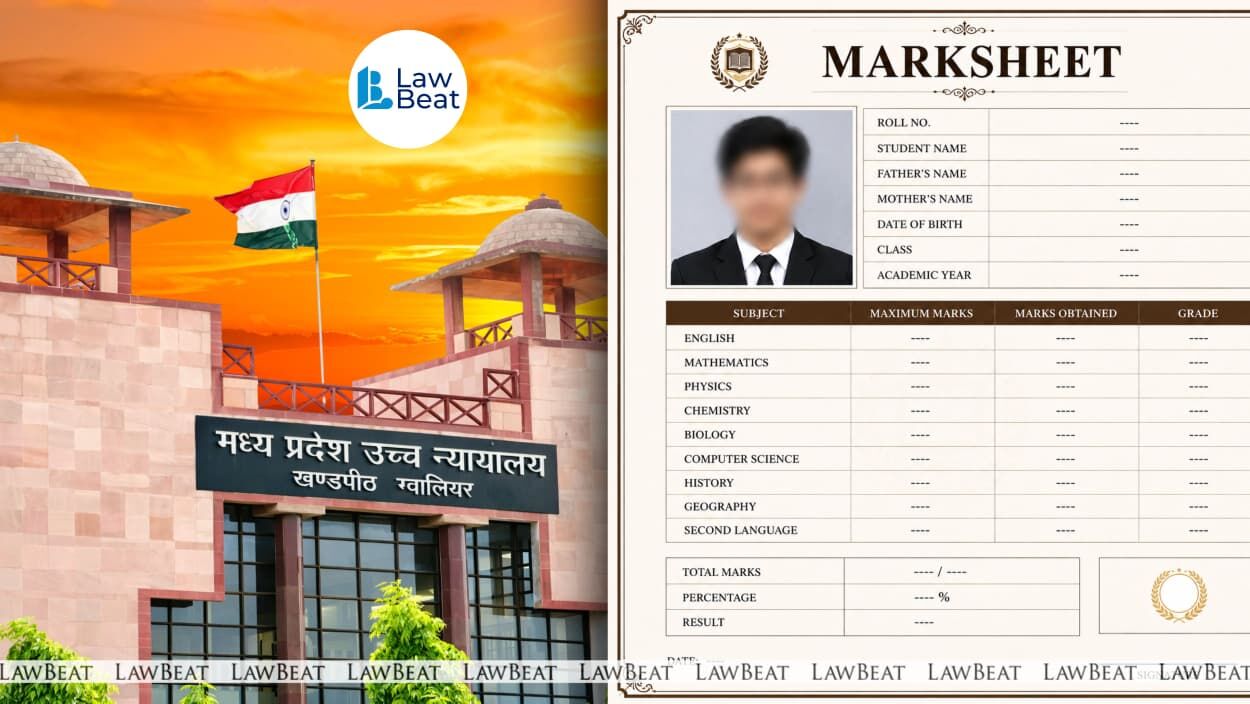
Student Can't Suffer For Clerical Error: MP High Court Quashes Order Denying Photo Correction In Marksheets
Summary
- The Madhya Pradesh High Court quashed an order denying a GNM student's request to correct a wrongly uploaded photograph on her marksheets.
- The court ruled that a student cannot be made to suffer for a clerical error committed by examination authorities.
- Petitioner Roopa Yadav's correct photograph was on her admission form, but an incorrect photo appeared on her admit card and subsequent marksheets due to an online registration error.
- The Council had rejected Yadav's request, arguing delay and lack of statutory procedure for correction after a lapse of time.
- The High Court found no evidence of fraud or misrepresentation by the student and determined the error originated with the authorities.
High Court Overturns Marksheet Photo Error Denial
The court concluded that the student cannot suffer for authority error, particularly a clerical or technical mistake committed during the online registration process, especially when the original institutional records clearly corroborated her identity.
The Madhya Pradesh High Court recently intervened in a case concerning a significant clerical error on a student's academic records, emphasizing that an examination authority clerical mistake student cannot be penalized for. The Gwalior Bench of the Madhya Pradesh High Court quashed an order that had denied a General Nursing and Midwifery (GNM) student's request for a marksheet photo correction. This decision, delivered by Justice Milind Ramesh Phadke, firmly established that a student cannot be made to suffer due to administrative oversights.
The ruling specifically addressed the case of Roopa Yadav, whose writ petition challenged a rejection by the Madhya Pradesh State Nurses Registration Council. The Council's order, dated October 24, 2025, had refused to rectify an incorrect photograph appearing on Yadav's marksheets for three academic years. The court's stance underscores a critical principle: a student cannot be held accountable for a clerical error originating with the authorities themselves.
A Persistent Error in Student Records
The issue began when Roopa Yadav enrolled in the GNM course for the 2019-20 session at a college recognized by the Council. At the time of her admission, she submitted her correct photograph, which was properly affixed to both her admission form and the college's register. However, a significant discrepancy emerged when her first-year admit card was issued following online registration: it displayed someone else's photograph instead of her own.
Despite the college assuring Yadav that the error would be rectified, she was permitted to sit for her examination with the incorrect photograph on her admit card. This initial oversight unfortunately compounded, as the same mismatched image subsequently appeared on her first, second, and third-year marksheets. The college made multiple attempts to resolve the issue, writing to the Council in October 2021 and again in August 2022 to request rectification. Further efforts included Yadav filing another representation in June 2024 and seeking information under the Right to Information Act, but she received no relief. Having previously approached the court and been directed to file a fresh representation, she returned to the High Court after the Council ultimately rejected this subsequent request.
Conflicting Arguments on Responsibility
Representing the petitioner, Shri Jitendra Kumar Sharma, assisted by Ms Krati Sachdev, argued that Roopa Yadav had never been accused of any form of fraud, misrepresentation, or impersonation. They contended that the error was solely attributable to the authorities during the online data upload process, not to the student. Furthermore, they submitted that the Council could not reasonably refuse to correct a clerical error after having permitted Yadav to appear for all three years of examinations, evaluated her papers, and officially declared her results.
Conversely, the Council asserted that the writ petition was delayed, noting that Yadav had been aware of the photographic discrepancy since 2020 but had only approached the court five years later. The Council also maintained that its marksheets were generated strictly based on data uploaded by the college, and its internal records showed consistency between the enrolment photograph and the marksheets. They argued that no statutory procedure existed for altering a photograph on official records after such a significant passage of time, suggesting any error lay with the college or the petitioner, not the Council itself.
Court Affirms Student Cannot Suffer for Authority Error
The Madhya Pradesh High Court, after a thorough review of the submitted records, rejected the Council's arguments. The court specifically noted that the petitioner's original, correct photograph was consistently present in the admission register and application form maintained by the college, even though the incorrect image had somehow been uploaded into the online system during the enrolment process. This finding was crucial in establishing the origin of the clerical mistake.
Crucially, the bench observed that "the respondents have not alleged anywhere that the petitioner had indulged in impersonation, fraud, or any malpractice," and that no inquiry into her identity had ever been conducted despite the discrepancy being repeatedly brought to their attention. The court concluded that the student cannot suffer for authority error, particularly a clerical or technical mistake committed during the online registration process, especially when the original institutional records clearly corroborated her identity. This ruling by the Madhya Pradesh High Court student records error case sets a clear precedent against penalizing students for administrative lapses.
Practical Implications
This ruling establishes a precedent that authorities cannot penalize students for their own clerical errors, particularly in academic records, if no fraud or misrepresentation is alleged. Lawyers advising students or educational institutions should be aware of this principle when challenging or defending administrative decisions related to record corrections, emphasizing the authority's responsibility for its own mistakes.
Source
Source: Original reporting via Live Law
How does this affect your business?
Get an AI analysis of this article grounded in your jurisdictions, practice areas, and any policy documents you've uploaded to Wansom.
Wansom is AI and can make mistakes.