
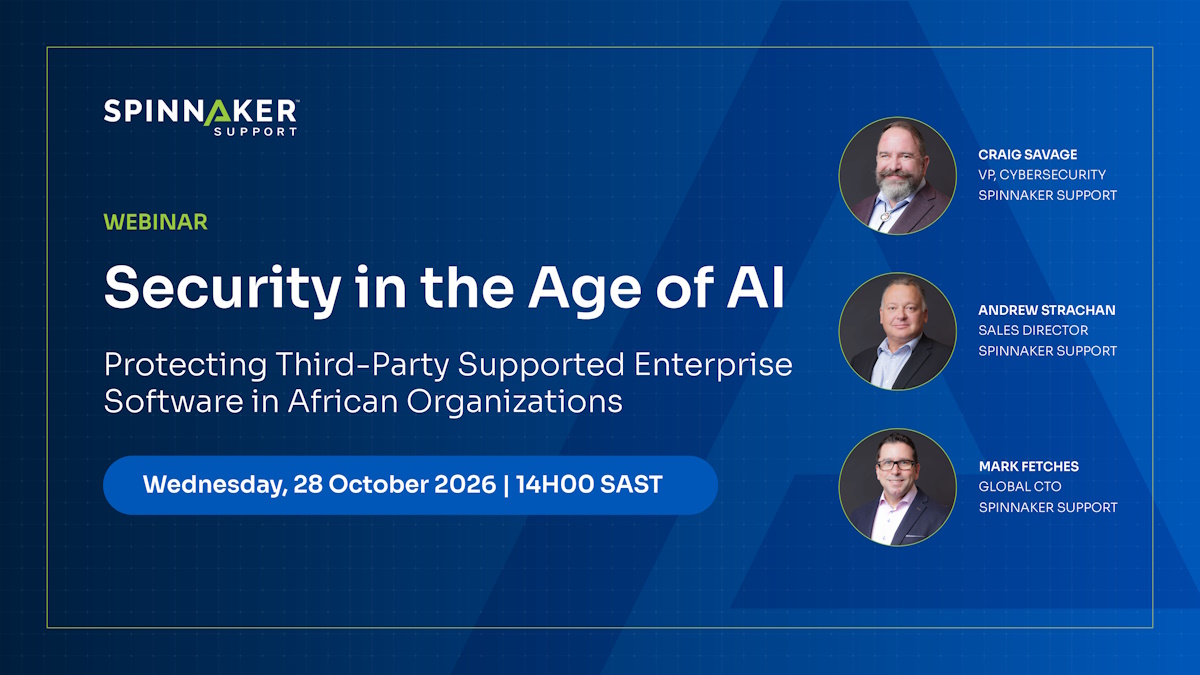
Spinnaker Support AI Cybersecurity: Africa Priorities Outlined
Summary
- Spinnaker Support executives advised African organizations to combine layered security, clear AI governance, and tested recovery plans to protect enterprise systems against AI-driven vulnerabilities.
- The webinar emphasized that patching alone is insufficient, recommending identity controls, network segmentation, continuous monitoring, and effective recovery plans as core components of a robust security strategy.
- Organizations must establish clear rules for AI tool usage, define permissible business data input, and educate employees on the risks of unauthorized platforms.
- For South African entities handling personal information, AI governance and data privacy measures must align with Section 19 of the Protection of Personal Information Act (POPIA).
- A risk-based approach should guide security investments, and experienced technical specialists are crucial for maintaining secure environments, especially for legacy systems and third-party supported software.
Navigating AI Cybersecurity Challenges in Africa
The core message for African organizations was to integrate layered security controls, establish clear AI governance frameworks, and implement thoroughly tested recovery plans to safeguard their enterprise systems effectively.
Executives from Spinnaker Support recently outlined critical cybersecurity priorities for African organizations, emphasizing the need to adapt security strategies in response to the evolving landscape of artificial intelligence. During a Spinnaker Support cybersecurity webinar titled “Security in the Age of AI: Protecting Third Party Supported Enterprise Software in Africa,” speakers highlighted how AI is fundamentally altering the discovery and exploitation of software vulnerabilities. The core message for African organizations was to integrate layered security controls, establish clear AI governance frameworks, and implement thoroughly tested recovery plans to safeguard their enterprise systems effectively.
Andrew Strachan, Sales Director for Spinnaker Support South Africa, facilitated the discussion, which featured insights from Craig Savage, Vice-President of Cyber Security, and Mark Fetches, Global Chief Technology Officer. The experts examined how established security principles can be applied to address AI-related threats, particularly concerning legacy enterprise software and the dynamic nature of security requirements. This proactive approach is crucial for organizations seeking to bolster their Spinnaker Support AI cybersecurity Africa posture against sophisticated, AI-driven attacks.
Essential AI Governance and Data Protection
A significant focus of the discussion centered on the imperative for organizations to establish explicit guidelines for the utilization of AI tools. This includes defining precisely what business data is permissible for input into these platforms and educating employees about the inherent risks associated with using unauthorized AI services. Addressing the broader implications of AI risks African organizations face, the webinar also delved into critical aspects of data sovereignty and privacy, such as where information is stored, who maintains access, and how AI platforms process and utilize this data.
These considerations are particularly pertinent for entities operating across various African markets, as they must navigate diverse data protection requirements specific to each jurisdiction. The experts underscored that technology decisions should be driven by an assessment of business risk, security imperatives, and operational resilience, rather than being solely dictated by vendor upgrade cycles. This strategic perspective is vital for maintaining robust data protection in an increasingly AI-driven environment.
Regulatory Compliance in the AI Era
For organizations managing personal information within South Africa, the issues surrounding AI governance and data privacy are directly linked to existing legal obligations. Specifically, Section 19 of the Protection of Personal Information Act (POPIA) mandates that responsible parties implement appropriate and reasonable technical and organizational measures to ensure the integrity and confidentiality of personal information. This legal framework also requires organizations to identify foreseeable risks and continuously review their safeguards as these risks evolve, a requirement that becomes even more critical with the advent of AI.
Therefore, achieving POPIA Section 19 AI compliance necessitates a proactive and adaptive approach to cybersecurity and data management. The need to understand and adhere to data protection requirements extends beyond South Africa, as organizations operating across the continent must be cognizant of the specific regulations in each country where they conduct business. This complex regulatory landscape demands diligent attention to ensure legal adherence while leveraging AI technologies.
Modernizing Enterprise Security Strategies
While traditional patching remains an important security measure, the Spinnaker Support executives clarified that it is insufficient on its own to fully protect an enterprise environment. They advocated for a comprehensive, layered security approach that incorporates identity controls, network segmentation, continuous monitoring, and robust recovery plans. For organizations utilizing legacy systems that no longer receive vendor patches, strategies such as restricting access, isolating exposed systems, and enhancing threat detection capabilities are crucial for reducing exposure.
Adopting a risk-based approach enables organizations to strategically allocate security investments based on the criticality of each system, available resources, and the potential operational impact of a security incident. The discussion also highlighted the indispensable role of experienced technical specialists in maintaining secure and dependable environments, particularly for organizations operating outside traditional vendor support models. These third-party support cybersecurity specialists are vital for ensuring business continuity and optimizing enterprise software security AI.
Practical Implications
Compliance officers and legal counsel must ensure their organizations, especially those handling personal information in South Africa, are updating cybersecurity measures and AI governance frameworks to meet evolving risks, as required by Section 19 of POPIA. This includes establishing clear rules for AI tool usage, addressing data sovereignty, and implementing layered security controls to protect against AI-driven software vulnerabilities.
Source
How does this affect you?
Get an AI analysis of this article grounded in your jurisdictions, practice areas, and any policy documents you've uploaded to Wansom.
Finish Reading the Full Story and the Expert Analysis.
Get the latest legal & regulatory intelligence in South Africa
Wansom is AI and can make mistakes.