
South Sudan Media Groups Demand End to Journalist Killings Impunity
Summary
- Four South Sudanese media organizations called on the government to investigate and prosecute those responsible for attacks against journalists.
- At least 12 journalists, including 11 South Sudanese and one foreigner, have been killed in the country since 2012, with no cases resulting in justice.
- The killing of reporter Marko Agei Makor in 2020 remains unresolved, despite his case reportedly being under investigation since 2024.
- Media groups urged the full implementation of the Right of Access to Information Act and the Media Authority Act to protect journalists' ability to report freely.
- The United Nations considers ending impunity for crimes against journalists a critical challenge for guaranteeing freedom of expression and public access to information.
A Call for Justice Amidst Unresolved Killings
The persistent failure to bring perpetrators to justice in South Sudan thus poses a significant threat to the democratic principles of transparency and public discourse, undermining the very foundation of a free and informed society.
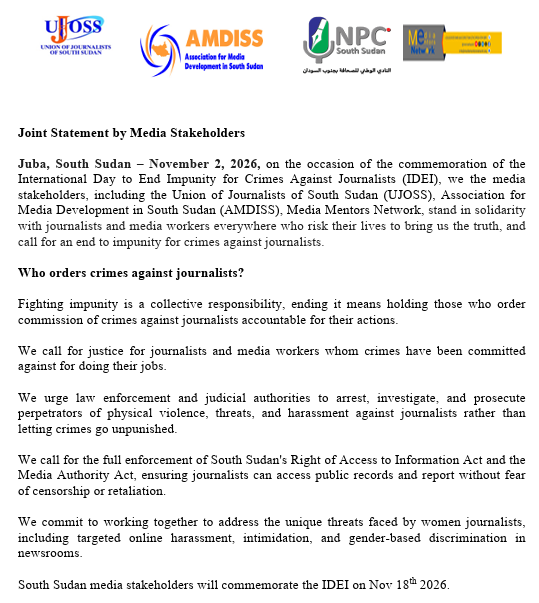
Four prominent South Sudanese media organizations recently issued a unified plea to the government, demanding thorough investigations and prosecutions for individuals responsible for attacks against journalists. The Union of Journalists of South Sudan (UJOSS), the Association for Media Development in South Sudan (AMDISS), the National Press Club of South Sudan (NPC-SS), and the Media Mentors Network (MeMN) released a joint statement coinciding with the International Day to End Impunity for Crimes Against Journalists. This annual observance, established by the UN General Assembly Resolution A/RES/68/163 in memory of two French journalists slain in Mali on November 2, 2013, highlights the global struggle against unchecked violence targeting media professionals. While the international day is marked on November 2 each year, South Sudanese media stakeholders plan their commemoration for November 18, 2026.
The collective statement underscored the critical need to hold accountable not only those who perpetrate crimes against journalists but also those who order such acts. This urgent appeal comes against a backdrop of deep concern regarding numerous unresolved killings of journalists within the country. A stark example is the case of Marko Agei Makor, a 24-year-old reporter for Door (Peace) 99.9 FM in Tonj. Makor was tragically shot and killed by unidentified assailants on July 1, 2020, while en route from Tonj town to visit his family in a nearby village. Despite his killing reportedly being under investigation since 2024, no one has yet faced justice for his death.
Systemic Impunity and Unenforced Laws
The lack of accountability for Makor's death is not an isolated incident but rather indicative of a broader pattern of impunity. According to records maintained by UJOSS, at least twelve journalists have been killed since 2012, comprising eleven South Sudanese nationals and one foreigner. Disturbingly, none of these cases have resulted in justice being served. The majority of these fatalities were reportedly at the hands of unknown gunmen, further complicating efforts to identify and prosecute perpetrators. The UJOSS highlights that the only instance where the government initiated an investigation was into the death of American-British journalist Allen Christopher, who perished in crossfire between government and opposition forces in Kaya.
A government report released in March 2024 concluded that Christopher died as a result of the crossfire. However, UJOSS asserts that this particular probe was only launched due to significant pressure from Western governments and Christopher's family. Beyond the calls for justice in specific cases, the media organizations also advocate for the full and proper implementation of the Right of Access to Information Act and the Media Authority Act. These legislative frameworks are intended to guarantee journalists unimpeded access to public information and the freedom to report without fear of censorship, intimidation, or retaliatory actions. Furthermore, the groups have committed to enhancing collaboration to address the unique challenges faced by women journalists, including online harassment, intimidation, and gender-based discrimination within newsrooms.
The Imperative of Protecting Press Freedom
Media stakeholders emphasize that governmental action must extend beyond mere investigations; it must encompass the identification, prosecution, and punishment of those responsible for crimes against journalists. They argue that safeguarding journalists is fundamental not only for upholding press freedom but also for ensuring governmental accountability and protecting the public's inherent right to information. The United Nations underscores the global significance of this issue, stating that ending impunity for crimes against journalists represents one of the most crucial and intricate challenges of the contemporary era.
The UN further posits that eradicating impunity is an indispensable prerequisite for guaranteeing freedom of expression and universal access to information for all citizens. The persistent failure to bring perpetrators to justice in South Sudan thus poses a significant threat to the democratic principles of transparency and public discourse, undermining the very foundation of a free and informed society.
Practical Implications
Lawyers advising media organizations or journalists in South Sudan must be aware of the systemic impunity for crimes against journalists and the non-enforcement of the Right of Access to Information Act and Media Authority Act. This creates significant legal risks for media operations, potential for human rights litigation, and highlights the need for robust advocacy strategies to ensure accountability and press freedom.
Source
How does this affect you?
Get an AI analysis of this article grounded in your jurisdictions, practice areas, and any policy documents you've uploaded to Wansom.
Wansom is AI and can make mistakes.