
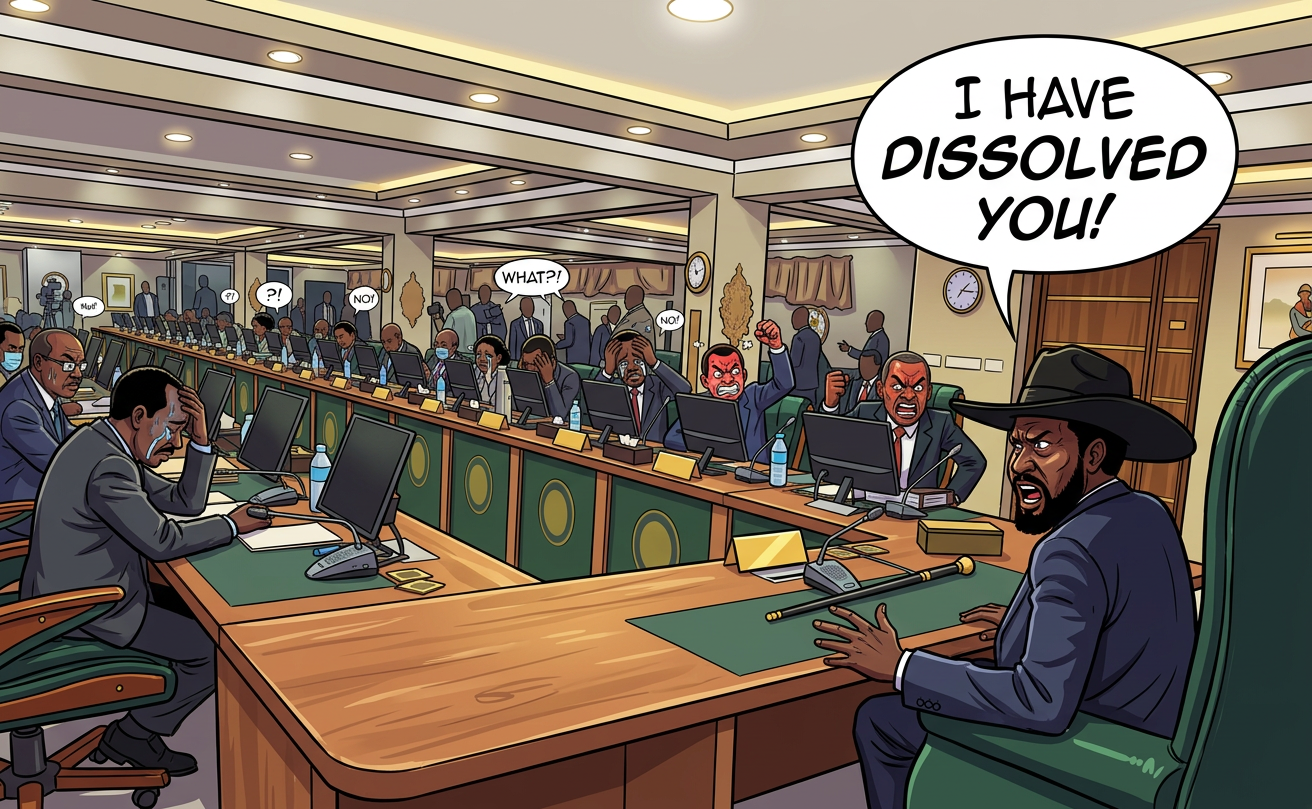
Juol Nhomngek: South Sudan Transition Accountability Demands Peace Deal Implementation
Summary
- South Sudan's transitional government was dissolved, leading to new administrative arrangements and a constitutional debate.
- A key argument asserts that dissolving the government does not fulfill the implementation of the peace agreement.
- The September order removed vice-presidents and dissolved legislatures, while retaining the president and establishing caretaker authorities.
- International bodies like the African Union have called for December elections alongside peace agreement implementation and reforms.
- Concerns persist regarding accountability for unfinished transitional responsibilities and the potential for the transition to be bypassed.
The Dissolution of South Sudan's Transitional Government
Without that accounting, the departure of leaders can overshadow the disappearance of the institutions through which citizens were promised reform.
The recent dissolution of South Sudan's transitional government has sparked significant debate regarding its constitutional validity and implications for the nation's peace process. Juol Nhomngek Daniel, in response to a prior article, articulated a crucial constitutional argument: the dismantling of the transitional government cannot serve as a substitute for the comprehensive implementation of the peace agreement. The author of the original piece concurs with this fundamental legal position, clarifying that their previous analysis aimed to scrutinize the administration's dissolution, not to endorse it. The core concern revolves around the displacement of transitional institutions while numerous critical responsibilities remain unaddressed and unresolved.
The September order marked a substantial political shift, systematically removing vice-presidents and dissolving both national and state legislatures. Simultaneously, the president was retained, and new caretaker authorities were established to manage governmental operations. This new administrative machinery now functions as the operational government, representing a profound change irrespective of its constitutional justification. While it would be an overstatement to suggest that every removed official has remained silent, and silence itself does not automatically imply consent—as it could stem from insecurity, restricted opportunities, ongoing negotiations, or uncertainty—the critical question is whether those originally tasked with upholding the transitional settlement have mounted an effective, collective, and publicly accountable response to this institutional displacement.
Constitutional Scrutiny and Unresolved Mandates
The author's initial article explicitly differentiated between the termination of an institution and the fulfillment of its mandate, a distinction crucial for understanding the current situation in South Sudan. That analysis questioned the ongoing continuation of presidential authority, cautioned against the unchecked expansion of executive discretion, and unequivocally called for accountability regarding outstanding commitments. It also characterized the reorganization and concentration of executive authority amidst financial instability as a perpetuation of that concentration, rather than its cessation. These nuances are vital, as Mr. Nhomngek's response mistakenly attributed support for the dissolution to an argument that was, in fact, primarily engaged in its critical examination.
The central constitutional and political question that persists is whether South Sudan has genuinely completed its transition, or if the entire transitional process has been circumvented through the establishment of these new administrative arrangements. This query is underscored by three key observations: the limited practical resistance encountered during the institutional displacement, the ambiguous nature of international reactions to these developments, and the increasing divergence between preparations for upcoming elections and the numerous unfulfilled obligations of the transitional period. Former officeholders, in particular, bear a responsibility to the citizenry to provide a clear accounting of which obligations were left unfinished, what efforts they undertook to implement them, and how these vital responsibilities will now be safeguarded in the absence of the original transitional structures. Without that accounting, the departure of leaders can overshadow the disappearance of the institutions through which citizens were promised reform.
International Engagement and Accountability Gaps
The conduct of international actors in response to these changes warrants careful and thorough scrutiny. The suggestion that the new caretaker arrangement might appease external frustrations over repeated extensions of the transitional period is a plausible political interpretation. However, this does not constitute proof that international partners collectively requested, endorsed, or welcomed this specific administrative configuration. Furthermore, diplomatic engagement with the current administration, by itself, does not signify approval of every measure that led to its formation. A notable example is the African Union's Peace and Security Council (AUPSC), which in August called for credible elections in December.
Crucially, the AUPSC simultaneously demanded inclusive dialogue, the full implementation of the peace agreement, comprehensive security-sector reform, and transitional justice mechanisms. This position clearly combined the urgency for elections with substantive conditions, indicating that it cannot be fairly reduced to a mere demand for polling at any cost. The author's primary concern lies in the evident disparity between such stated international commitments and their practical enforcement.
International partners are urged to publicly articulate how their ongoing engagement with the caretaker authorities will actively protect the obligations they previously championed. If the priority shifts solely to an election date, at the expense of eroding critical safeguards, their actions could inadvertently undermine their declared principles, a possibility that demands rigorous examination rather than simple assumption.
Practical Implications
Lawyers and compliance officers in South Sudan must scrutinize the legal validity and operational impact of decisions made by the new administrative arrangements following the dissolution of the transitional government, particularly regarding the continuity of legal obligations, the enforcement of the peace agreement, and potential challenges to executive authority, to advise clients on navigating the evolving political and legal landscape and mitigating associated risks.
Source
Source: Based on expert commentary
How does this affect you?
Get an AI analysis of this article grounded in your jurisdictions, practice areas, and any policy documents you've uploaded to Wansom.
Finish Reading the Full Story and the Expert Analysis.
Get the latest legal & regulatory intelligence in South Sudan
Wansom is AI and can make mistakes.