
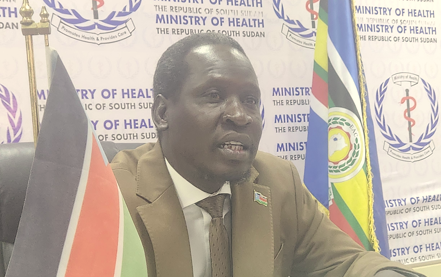
South Sudan Health Minister: Rejects NPHI Director Appointment Dispute Claims
Summary
- South Sudan's Health Minister Luke Thompson Thoan Teny rejected claims that the NPHI executive director is a presidential appointee.
- The minister stated that the National Public Health Institute Act of 2023 mandates the minister to appoint the director based on a board recommendation.
- The NPHI board, appointed by President Kiir in January 2026, withdrew its recommendation for the executive director on June 26.
- Minister Teny acted on the board's decision on August 6, after two months of unsuccessful attempts to persuade them to reverse it.
- Teny denied allegations that his decision was linked to the former director's refusal to provide vehicles, calling it an administrative decision.
The Deepening Leadership Dispute
He has openly invited any party challenging his determination to pursue legal redress through the courts.
South Sudan's Health Minister, Luke Thompson Thoan Teny, has publicly addressed a growing leadership dispute at the National Public Health Institute (NPHI), firmly rejecting claims that the institute's executive director is a direct presidential appointee. Speaking in Juba, Minister Teny clarified that the appointment process is governed by the National Public Health Institute Act of 2023, which stipulates that the minister is responsible for appointing the executive director based on a recommendation from the NPHI's board. He emphasized that President Salva Kiir does not directly appoint this position.
The controversy escalated following a decision by the NPHI board, which President Kiir appointed in January 2026. On June 26, 12 of the 19 board members convened and voted to retract their earlier recommendation for the executive director's appointment. This decision was communicated to Minister Teny on the same day. The minister revealed that he spent approximately two months engaging with board members, attempting to persuade them to reverse their withdrawal. However, after these efforts, he proceeded to act on the board's decision on August 6, asserting that his actions were solely based on the institute's governing legal framework and were free from political motives or personal animosity towards the former director.
Minister Teny also addressed and denied allegations that his motivation for seeking the former NPHI executive director's removal stemmed from a refusal to provide vehicles to his office. He explained that the Health Ministry had requested temporary vehicle support from the NPHI to aid in supervisory visits, monitoring, coordination, and other official activities crucial for Ebola virus disease preparedness and response. Initially, a letter dated June 5 requested three vehicles, but the minister subsequently cancelled this request, instructing his executive director to instead seek two vehicles for official duties. He explicitly rejected any suggestion that this vehicle request contributed to the ongoing leadership dispute.
Statutory Authority and Judicial Redress
Central to the **South Sudan NPHI director appointment dispute** is the interpretation of the **National Public Health Institute Act 2023**. Minister Luke Thompson Thoan Teny has underscored that this legislation clearly outlines the procedure for selecting the institute's executive head, vesting the ultimate appointment authority in the Health Minister, contingent upon a recommendation from the NPHI board. This statutory framework, according to Teny, explicitly precludes direct presidential appointment, a point he stressed to ensure clarity regarding the legal basis of his decision.
The minister characterized his action as an "administrative decision," firmly stating it was not influenced by political considerations. He has openly invited any party challenging his determination to pursue legal redress through the courts. Teny articulated that the judicial system is the appropriate forum to ascertain whether he acted within the powers granted to him under the **South Sudan public health law**. This stance highlights a critical legal pathway for resolving disputes arising from administrative decisions within public institutions.
The NPHI's Critical Role and Future Challenges
The current disagreement unfolds against the backdrop of the government's efforts to bolster the institutional capacity of the NPHI. Established under the 2023 law, the institute is tasked with assuming crucial public health functions previously managed by the Health Ministry, signifying its vital role in the nation's health infrastructure. The **South Sudan NPHI executive director removal** and the subsequent **NPHI board recommendation withdrawal** therefore touch upon the very operational integrity of this key body.
Minister Teny reiterated that the entire dispute, including the **Luke Thompson Thoan Teny NPHI** decision, should be resolved strictly within the legal framework governing the institute. He affirmed the right of any individual to challenge the decision through the judicial system, reinforcing the principle that administrative actions are subject to legal scrutiny. The former NPHI executive director, when approached for comment by Radio Tamazuj, chose not to speak on the matter, leaving the potential for legal challenge as the primary avenue for further developments in this significant public health governance issue.
Practical Implications
This story highlights the critical need for lawyers to accurately interpret statutory provisions governing appointments within South Sudan's public institutions, specifically the NPHI Act 2023. It also establishes that challenges to administrative decisions based on statutory powers are expected to be pursued through the judicial system, providing a potential precedent for legal redress in similar disputes.
Source
How does this affect you?
Get an AI analysis of this article grounded in your jurisdictions, practice areas, and any policy documents you've uploaded to Wansom.
Wansom is AI and can make mistakes.