
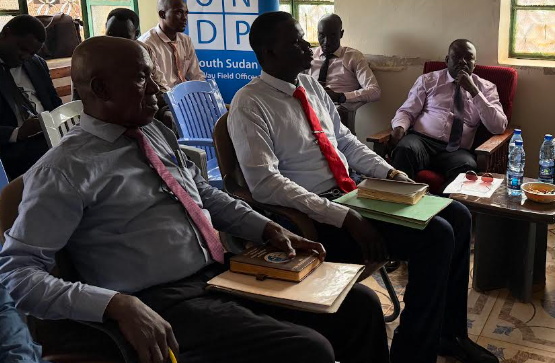
South Sudan Mobile Court W. Bahr el Ghazal: Initiative Launched to Clear Backlog
Summary
- The UNDP, in partnership with South Sudan's Judiciary, launched a 30-day mobile court in Wau and Raja counties of Western Bahr el Ghazal.
- This initiative aims to reduce a backlog of over 200 criminal remand cases and address prolonged pre-trial detention.
- Justice Andrew Joshua Lado highlighted the mobile court as a practical solution for improving access to justice given limited judges.
- The program seeks to strengthen victims' rights, promote accountability, and enhance the rule of law across the state.
- This is the first mobile court initiative of its kind in Western Bahr el Ghazal State this year.
New Mobile Court Initiative Launched in Western Bahr el Ghazal
The mobile court, therefore, is designed to bridge this critical gap, ensuring citizens can access timely and equitable judicial processes regardless of their geographic location or personal circumstances.
A significant 30-day Mobile Court Initiative has commenced in South Sudan, specifically targeting the Wau and Raja counties within Western Bahr el Ghazal State. This crucial undertaking is a collaborative effort, spearheaded by the United Nations Development Programme (UNDP) in partnership with the Judiciary of South Sudan and the Directorate of Legal Administration and Public Prosecution. The primary goal of this initiative is to address critical issues within the justice system, including the substantial backlog of criminal cases and the pervasive problem of prolonged pre-trial detention.
Beyond merely processing cases, the initiative also aims to bolster the protection of victims' rights, foster greater accountability, and reinforce the rule of law, thereby expanding access to justice across the state. Justice Andrew Joshua Lado, who serves as the President of the Court of Appeal for the Bahr el Ghazal Circuit, characterized the mobile court as an effective mechanism for delivering judicial services directly to communities. He highlighted its dual benefit of making the justice system more accessible in Western Bahr el Ghazal while simultaneously alleviating overcrowding in correctional facilities.
Addressing Systemic Justice Challenges
The introduction of the South Sudan Mobile Court W. Bahr el Ghazal directly confronts long-standing systemic challenges that have impeded effective justice administration. Justice Lado underscored that, given the limited number of available judges, mobile courts present a practical and viable solution for enhancing access to justice and strengthening the rule of law. He specifically noted the urgent need to clear cases that have languished without trial, citing the presence of over 200 remand cases currently in prisons that demand immediate attention.
Mr. Felix Cassim, representing the UNDP, further elaborated on the obstacles faced by many communities in remote areas. He explained that factors such as vast distances, underdeveloped justice-sector infrastructure, and resource limitations consistently obstruct access to essential judicial services. These challenges are direct contributors to delays in the administration of justice and the widespread issue of prolonged pre-trial detention. The mobile court, therefore, is designed to bridge this critical gap, ensuring citizens can access timely and equitable judicial processes regardless of their geographic location or personal circumstances.
Broader Impact and Collaborative Commitment
This mobile court represents the first such initiative to be established in Western Bahr el Ghazal State this year, marking a significant step forward in the region's judicial development. Justice Dudu Jackson Jejen, President of the High Court in Western Bahr el Ghazal State, expressed strong support for the program, emphasizing its potential to enable judicial officers to reach underserved communities where access to legal services has historically been constrained.
The Wau Raja mobile court launch event itself drew a wide array of senior state officials, including Lt. Gen. Elia Kosta Faustino, the A/IGP-State Commissioner for Police; Maj. Gen. Pidele Majok, the State Director of Prisons Service; and Molana Awad Haroun Andal, the State Director for Legal Administration in the Ministry of Justice. Representatives from the Bar Association, local community leaders, and other key stakeholders were also in attendance, underscoring the broad collaborative commitment to this UNDP South Sudan justice initiative. This effort is integral to ongoing broader endeavors aimed at strengthening access to justice, building public confidence in the judicial system, and advancing the rule of law throughout South Sudan.
Practical Implications
Lawyers practicing or with clients in Western Bahr el Ghazal, particularly Wau and Raja counties, should note the launch of this mobile court initiative. It is designed to significantly reduce criminal case backlogs and address prolonged pre-trial detention, which could lead to an acceleration of case processing and require adjustments to legal strategies and client advising regarding timelines and potential outcomes in these jurisdictions.
Source
How does this affect you?
Get an AI analysis of this article grounded in your jurisdictions, practice areas, and any policy documents you've uploaded to Wansom.
Wansom is AI and can make mistakes.