
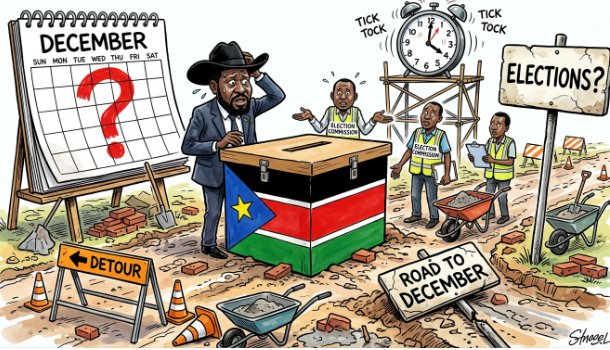
South Sudan: 2026 Elections Cancelled, Raising Legitimacy Concerns
Summary
- South Sudan's government postponed elections originally scheduled for December 2026 to February 2027.
- President Salva Kiir's administration has systematically undermined the 2018 Revitalized Peace Agreement through various actions.
- In September 2026, the transitional unity government was dissolved and replaced by a caretaker administration.
- Amendments to the National Elections Act removed key prerequisites for elections, including a permanent constitution and a national census.
- These developments have deepened political divisions and raised significant questions about the country's political future and legitimacy.
South Sudan's Electoral Reversal
This signals profound political instability in South Sudan, with the government undermining the Revitalized Peace Agreement and manipulating electoral frameworks.
South Sudan's government recently announced the postponement of elections that were initially slated for December 2026 to February 2027. This decision follows a period where President Salva Kiir's administration had indicated its intention to proceed with the vote, even as prominent opposition figures, including former First Vice President Dr. Riek Machar, who was removed from his position in September 2026 and remains under house arrest facing trial, faced legal challenges widely regarded by ordinary South Sudanese as politically motivated. The abrupt postponement of the planned elections has cast a stark light on the nation's political landscape, exposing the inherent fragility of its electoral ambitions and raising profound questions about the country's future direction.
Elections are frequently presented as the cornerstone of democratic governance, yet their efficacy in conferring legitimate political authority hinges on more than just the act of voting. True democracy necessitates a foundation of political freedom, robust institutional accountability, genuine political competition, and unwavering respect for constitutional frameworks. When electoral processes unfold within an environment characterized by repression, political exclusion, and the deliberate manipulation of state institutions, they risk becoming mere instruments for authoritarian regimes to project a facade of legitimacy, rather than serving as a pathway to genuine democratic progress. The postponement of the South Sudan elections 2026 underscores this critical distinction.
Erosion of the Revitalized Peace Agreement
The current political instability in South Sudan is deeply rooted in the systematic undermining of the September 2018 Revitalized Peace Agreement by President Kiir's government. Since its inception, the agreement, designed to facilitate a peaceful political transition, has been consistently weakened through various actions. These include inadequate financial support for crucial peace implementation mechanisms, the imposition of unilateral political decisions, and the removal or replacement of opposition-nominated officials without adhering to the consultative and consensus-based processes mandated by the accord.
Such actions have progressively dismantled the very framework intended to guide the nation towards stability and inclusive governance. By eroding the foundational principles of the Revitalized Peace Agreement, the government has created an environment ripe for a South Sudan political legitimacy crisis, where trust in political institutions and processes is severely diminished, paving the way for further uncertainty and potential conflict.
Legislative Maneuvers and Institutional Control
Further exacerbating the political landscape, President Kiir's government undertook significant legislative and institutional changes in September 2026. This included the dissolution of the transitional unity government, which was subsequently replaced by a caretaker administration. Concurrently, crucial amendments were made to the National Elections Act, effectively removing several important prerequisites for holding elections.
Among the eliminated requirements were the completion of a permanent constitution and the undertaking of a national census. These South Sudan National Elections Act amendments are not perceived as steps towards advancing peace or democratic elections; rather, they are widely interpreted as indicative of authoritarian practices designed to consolidate power and circumvent democratic safeguards. The South Sudan transitional government dissolution and subsequent legislative changes have profound implications for the rule of law and the enforceability of future agreements.
Heightened Instability and Legal Uncertainty
The postponement of the December 2026 elections, coupled with the preceding legislative and institutional manipulations, signals profound political instability in South Sudan, with the government undermining the Revitalized Peace Agreement and manipulating electoral frameworks. This decision, far from resolving the underlying political disagreements that plagued the electoral process, has instead plunged the nation into renewed uncertainty regarding the trajectory and duration of its political transition. It raises critical questions about the original intent behind the transition and whether genuine electoral preparations were ever prioritized over the fundamental commitments enshrined in the peace agreement.
Moreover, the capacity and readiness of institutions tasked with organizing credible elections are now under intense scrutiny. The government's apparent determination to pursue an electoral outcome without first addressing deep-seated political and institutional weaknesses has exposed a fundamental contradiction that existed long before the recent postponement. This situation risks deepening existing political divisions, escalating insecurity, and exacerbating ethnic tensions, creating a volatile environment where the enforceability of agreements and the overall rule of law are severely compromised.
Practical Implications
This development signals profound political instability in South Sudan, with the government undermining the Revitalized Peace Agreement and manipulating electoral frameworks. Lawyers advising clients on investments, contracts, or operations in South Sudan should be aware of the heightened political risk, potential for legal uncertainty, and the erosion of institutional safeguards, which could impact the enforceability of agreements and the overall rule of law environment.
Source
How does this affect you?
Get an AI analysis of this article grounded in your jurisdictions, practice areas, and any policy documents you've uploaded to Wansom.
Finish Reading the Full Story and the Expert Analysis.
Get the latest legal & regulatory intelligence in South Sudan
Wansom is AI and can make mistakes.