
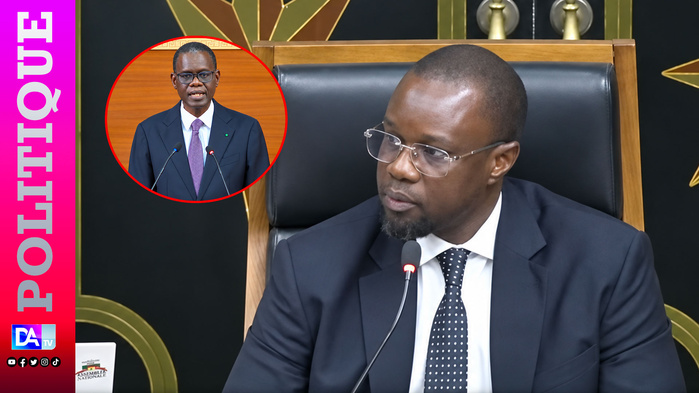
Sonko Révèle Une Gestion De La Dette Confiée À Cinq Personnes, Hors Conseil
Summary
- Ousmane Sonko revealed that only five officials managed Senegal's debt during his time as head of government, bypassing the Council of Ministers.
- The restricted group included the Prime Minister, Ministers of Finance and Economy, and Al Aminou Lo (then Secretary-General).
- Meetings on debt initially occurred at the Primature before moving to the Presidency under the Head of State.
- Sonko's account contrasts with Abdourahmane Diouf's September 2026 claim that Sonko had approved debt restructuring in the Council of Ministers.
- Sonko stated the country's economic situation demands collective effort and that the National Assembly holds the final decision on debt.
Revelations on Debt Management
Crucially, Sonko revealed that the comprehensive debt dossier was never brought before the Council of Ministers for examination, raising questions about the breadth of governmental involvement in such critical financial decisions.
Ousmane Sonko, speaking at the National Assembly, recently disclosed details concerning the oversight of Senegal's public debt during his tenure as head of government. He asserted that a highly restricted group of only five officials was involved in discussions and exchanges related to the nation's debt. Crucially, Sonko revealed that the comprehensive debt dossier was never brought before the Council of Ministers for examination, raising questions about the breadth of governmental involvement in such critical financial decisions.
According to reports from Dakaractu, Sonko specified some of the key individuals within this exclusive group. He cited the Prime Minister, the Minister of Finance, the Minister of Economy, and Al Aminou Lo, who at the time served as Secretary-General before his elevation to Minister of State. Sonko emphasized that, apart from these five, no other government official participated in the work surrounding the debt management, suggesting a highly centralized and limited process for handling Senegal's public debt.
Meetings concerning this vital financial matter initially convened at the Primature, the official residence and office of the Prime Minister. Subsequently, these discussions transitioned to the Presidency, where they continued under the direct oversight of the Head of State. This progression of meeting locations further underscores the concentrated nature of the debt management process as described by Sonko, highlighting a structure where key decisions were seemingly confined to a very small circle rather than undergoing broader ministerial review.
Conflicting Accounts and Context
These revelations by Ousmane Sonko present a stark contrast to a previous statement made by Abdourahmane Diouf in September 2026. Diouf had claimed that Sonko, prior to his departure from the Primature, had actually validated the principle of a debt restructuring plan during a Council of Ministers meeting. This discrepancy introduces a significant point of contention regarding the historical process and transparency surrounding the government's approach to debt management, particularly concerning the involvement of the Council of Ministers.
Sonko's statements were made during his intervention at the National Assembly, specifically during the General Policy Statement delivered by Prime Minister Al Aminou Lo. Sonko affirmed that he had thoroughly reviewed the Prime Minister's memorandum, which was presented as being structured around five core pillars. These pillars reportedly ranged from initiatives aimed at strengthening public finance management to efforts focused on improving the national statistical system, providing a broader context to the government's financial strategy.
While Sonko acknowledged the existence and structure of Prime Minister Lo's memorandum, his primary focus remained on the alleged circumvention of the Council of Ministers in past debt management practices. This highlights a potential tension between the stated policy objectives and the operational mechanisms for critical financial oversight, particularly concerning the role of key figures like Al Aminou Lo in the broader framework of Sénégal gestion dette.
Implications for Governance and Oversight
The disclosures by Ousmane Sonko regarding the restricted management of the nation's debt underscore significant concerns about governance and transparency within the Senegalese financial administration. His assertion that the debt dossier bypassed the Council of Ministers suggests a potential lack of collective governmental scrutiny over crucial economic decisions, which could have far-reaching implications for public trust and accountability. The target keyword phrase, Sonko révèle gestion dette hors Conseil ministres, encapsulates the core of these concerns.
Sonko himself acknowledged the gravity of the country's economic and financial situation, emphasizing the necessity for a collective effort to address these challenges. He indicated that various discussions were already underway, with agreements nearing finalization. This perspective suggests a recognition of the need for broader engagement, even as he critiqued past practices.
Ultimately, Sonko reminded the Assembly that the final decision on debt-related matters would rest with the Assemblée nationale Sénégal dette. This statement reinforces the legislative body's critical role in ensuring financial oversight and democratic accountability, particularly in light of the transparency concerns raised by the former head of government. The call for collective effort and the emphasis on parliamentary approval highlight the ongoing debate surrounding Transparence financière gouvernement Sonko and the mechanisms for robust public finance management.
Practical Implications
This article highlights potential governance and transparency concerns regarding Senegal's public debt management, specifically the alleged circumvention of the Council of Ministers. Lawyers advising on public finance, investment, or government contracts in Senegal should note these revelations as they may impact the perceived legitimacy and future scrutiny of past and ongoing debt-related decisions.
Source
Source: Original reporting via dakaractu
How does this affect you?
Get an AI analysis of this article grounded in your jurisdictions, practice areas, and any policy documents you've uploaded to Wansom.
Finish Reading the Full Story and the Expert Analysis.
Wansom is AI and can make mistakes.