
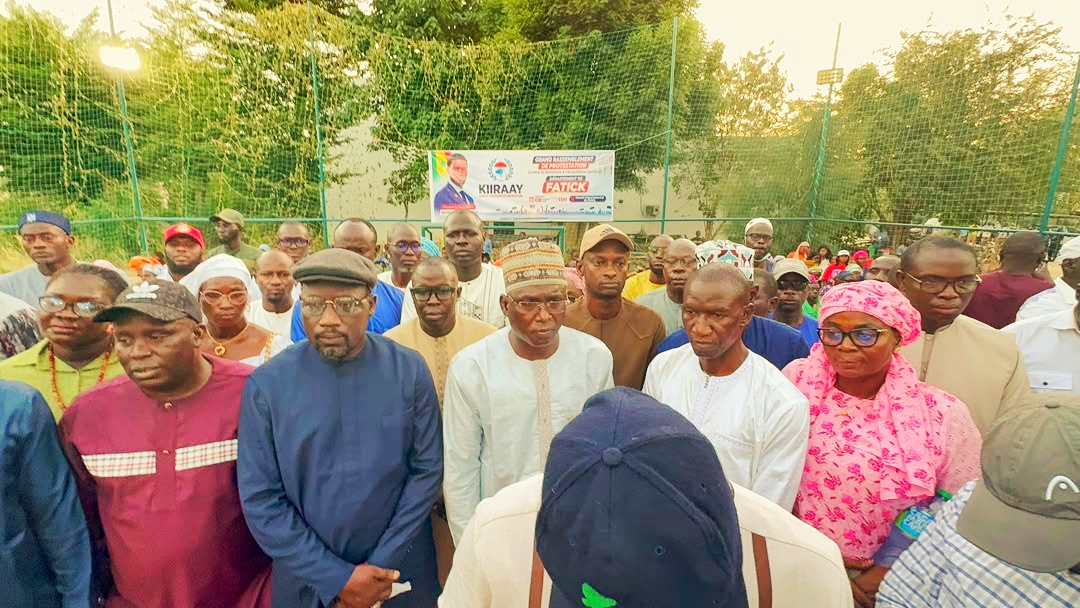
Fatick Mobilisation: Rejet Lois Finances Sénégal Draws Opposition
Summary
- A mobilization in Fatick, Senegal, led by the KIIRAAY movement and Djidiack Faye, protested the rejection of the Rectified Finance Law (LFR) and Initial Finance Law (LFI).
- Participants from 17 communes believe these finance laws are crucial for funding infrastructure, agriculture, youth employment, health, and education.
- The National Assembly's Finance Committee rejected the draft LFR 2026 on October 23, but the Rectified Finance Law (LFR) for 2026 was definitively rejected by the National Assembly on November 3, 2026, while the Initial Finance Law (LFI) for 2026 has been adopted.
- The gathering also expressed support for President Bassirou Diomaye Faye and highlighted PRODAC as a key program for youth employment and agricultural development.
- Community leaders emphasized specific needs, such as seeds for farmers, jobs for youth, and support for women, which depend on the approval of these financial bills.
Community Response to Legislative Action
The finance laws, particularly the Sénégal Loi de finances rectificative and the Sénégal Loi de finances initiale, are foundational to the government's ability to implement its agenda and fund public services.
In Fatick, Senegal, a significant political gathering took place on a recent Sunday, spearheaded by the KIIRAAY movement. This mobilization saw political leaders and activists from all 17 communes within the Fatick department convene, united in their opposition to the recent rejection of key financial legislation. The event was notably coordinated by Djidiack Faye, who also serves as the national coordinator for the Programme des Domaines Agricoles Communautaires (PRODAC).
The central focus of the assembly was to voice strong disagreement with the decision to reject both the Rectified Finance Law (LFR) and the Initial Finance Law (LFI). Those present articulated a firm belief that these legislative instruments are indispensable for securing the necessary funding across critical national sectors. They highlighted the essential role these laws play in financing infrastructure development, bolstering agricultural initiatives, creating employment opportunities for the youth, and supporting vital services in health and education. The collective sentiment underscored the perceived urgency and necessity of these financial frameworks for the nation's progress.
The Legislative Process and its Implications
The mobilization in Fatick directly responded to a prior legislative development that occurred on October 23. On that date, the Finance and Budget Control Committee of the National Assembly made a decision to reject the draft 2026 Rectified Finance Law (LFR). It is important to note, however, that a rejection at the committee level does not constitute a definitive rejection by the entire Parliament. This procedural nuance means that while the Initial Finance Law (LFI) for 2026 has been adopted, the Rectified Finance Law (LFR) for 2026 was definitively rejected by the National Assembly on November 3, 2026, following its initial setback at the committee level.
The finance laws, particularly the Sénégal Loi de finances rectificative and the Sénégal Loi de finances initiale, are foundational to the government's ability to implement its agenda and fund public services. The protestors' concerns underscore the potential impact rejet LFR LFI could have on various development projects. The committee's action has thus triggered a public response, emphasizing the perceived critical nature of these financial bills for the nation's economic and social stability. The ongoing debate surrounding the Assemblée nationale Sénégal budget reflects broader societal interests in how public funds are allocated and managed.
Vision for Development and Political Support
Beyond contesting the legislative rejection, the gathering also served as a platform to express robust political support for President Bassirou Diomaye Faye and the government's overarching vision of sovereignty and rupture. Leaders representing the 17 communes explicitly affirmed their backing for the current administration's direction. A significant part of the discussion centered on the role of Djidiack Faye, not only as a coordinator for KIIRAAY but also in his capacity leading the Programme des Domaines Agricoles Communautaires, or PRODAC.
PRODAC was highlighted as a crucial instrument for national development, specifically championed as a key lever for fostering youth employment and advancing agricultural progress across Senegal. An official from the movement elaborated on PRODAC's structure, describing it as a program that integrates agricultural perimeters with opportunities for both employment and training. The urgency of these initiatives was underscored by a KIIRAAY leader, who articulated specific community needs: the farmer in Niakhar anticipating essential seeds, the young person in Diofior seeking an employment opportunity, and the woman in Fimela requiring vital support. This emphasis on PRODAC Sénégal financement and its direct impact on citizens illustrates the tangible stakes involved in the approval of the national finance laws.
Practical Implications
The rejection of the Rectified Finance Law (LFR) and Initial Finance Law (LFI) by the National Assembly's Finance Committee, though not final, signals potential delays or alterations in government spending and project funding across key sectors like infrastructure, agriculture, and social services. Lawyers advising clients on public contracts, government tenders, or projects reliant on state funding in Senegal should closely monitor the legislative process of these finance bills to anticipate potential impacts on project timelines, funding availability, and contractual obligations.
Source
How does this affect you?
Get an AI analysis of this article grounded in your jurisdictions, practice areas, and any policy documents you've uploaded to Wansom.
Finish Reading the Full Story and the Expert Analysis.
Get the latest legal & regulatory intelligence in Senegal
Wansom is AI and can make mistakes.