
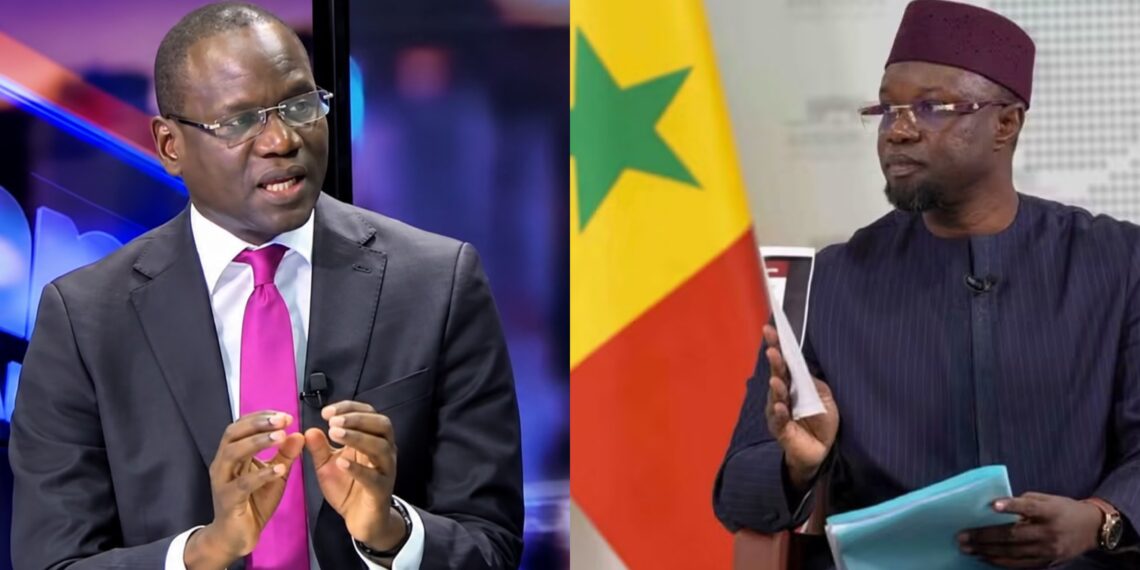
Senegal: Diouf Confirms Sonko Approved Debt Restructuring Plan
Summary
- Senegal's Minister of Energy and Petroleum, Abdourahmane Diouf, claims Ousmane Sonko, currently President of the National Assembly and former Prime Minister, approved debt restructuring in principle before leaving office.
- Diouf stated this approval occurred during a Council of Ministers meeting, following a technical agreement between Senegal and the International Monetary Fund (FMI).
- These remarks contradict Sonko's previous public statements, where he rejected 'savage' restructuring and asserted Senegal was not in default of payment.
- Diouf indicated his aim was to 'restore the facts' without engaging in political games.
- The disclosure has reignited debate over Sonko's actual stance on Senegal's debt restructuring efforts.
Minister Diouf's Revelation
This recent disclosure directly challenges previous public statements by Sonko, who had explicitly rejected any 'savage' restructuring and maintained that Senegal was not in default of payment.
Abdourahmane Diouf, Senegal's Minister of Energy and Petroleum, has recently made a significant public statement regarding the nation's debt restructuring efforts. According to Diouf, Ousmane Sonko, currently President of the National Assembly and former Prime Minister, had, in principle, approved a debt restructuring plan before he left his position at the Primature. This disclosure comes in the wake of a technical agreement reached between Senegal and the International Monetary Fund (FMI), adding a new dimension to the ongoing discussions surrounding the country's economic strategy.
Speaking in an interview with EvenProd Média, which was subsequently relayed by Senegal7, Minister Diouf explicitly stated that Sonko's approval for the restructuring was granted during a Council of Ministers meeting. Diouf quoted, "In the Council of Ministers, he gave his agreement for restructuring before leaving the government." The Minister emphasized that his intention behind these remarks was to "restore the facts" rather than to engage in political maneuvering, aiming to clarify the historical record concerning the former Prime Minister's stance on this critical economic issue.
Contrasting Public Stances
Minister Diouf's recent assertions stand in stark contrast to previous public declarations made by Ousmane Sonko himself. Sonko had previously articulated a clear position against what he termed "savage" restructuring of Senegal's debt. Furthermore, he had consistently maintained that Sénégal was not in a state of payment default, implying a different approach to managing the nation's financial obligations.
This recent disclosure directly challenges previous public statements by Sonko, who had explicitly rejected any 'savage' restructuring and maintained that Senegal was not in default of payment. The discrepancy between these narratives has reignited public and political debate regarding Ousmane Sonko's true position on the sensitive matter of debt restructuring, particularly in light of the technical accord with the FMI and the broader Politique économique Sénégal.
Implications for Senegal's Economic Policy
The conflicting accounts from key political figures like Abdourahmane Diouf and Ousmane Sonko carry significant implications for Senegal's economic trajectory and its relationship with international financial institutions. The revelation about Sonko's alleged approval in a Council of Ministers meeting, juxtaposed with his public disavowal of certain restructuring approaches, could introduce uncertainty into the future direction of the nation's financial policies.
Such divergent statements regarding the Sénégal restructuration dette FMI could impact investor confidence and the stability of future economic agreements. As the country navigates its financial landscape, particularly following the accord technique Sénégal FMI, clarity and consensus on sovereign debt management are crucial. The ongoing debate surrounding Ousmane Sonko's position dette underscores the complex political dynamics influencing Senegal's economic decisions.
Practical Implications
Lawyers advising clients on sovereign debt, investment, or financial transactions in Senegal should monitor the evolving political consensus on debt restructuring. Conflicting statements from key political figures like Sonko and Diouf could signal future policy shifts or legal challenges to economic agreements, impacting investor confidence and contractual stability.
Source
How does this affect you?
Get an AI analysis of this article grounded in your jurisdictions, practice areas, and any policy documents you've uploaded to Wansom.
Finish Reading the Full Story and the Expert Analysis.
Wansom is AI and can make mistakes.