
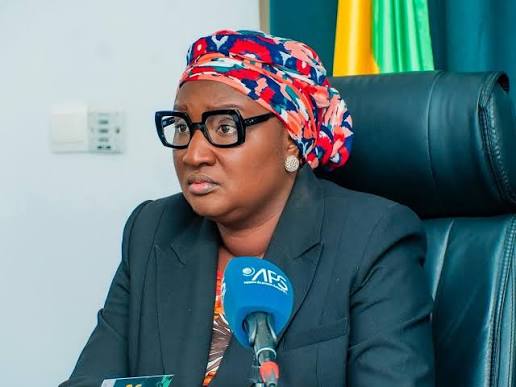
Senegal: Khady Diène Gaye Refutes Sonko Dette Sénégal Claims
Summary
- Minister of Youth and Sports Khady Diène Gaye publicly refuted Minister of Energy and Petroleum Abdourahmane Diouf's claim that Ousmane Sonko supports debt restructuring.
- Gaye dismissed Diouf's statements as "grotesque lies," intensifying a broader debate on Senegal's national debt.
- Discussions are fueled by Cour des comptes findings on "hidden debt" and ongoing exchanges with the International Monetary Fund regarding potential restructuring.
- The controversy reveals internal disagreements within the ruling majority concerning economic policy and the interpretation of budgetary data.
- Gaye also criticized Diouf's past professional attempts, highlighting the personal nature of the political dispute.
Political Clash Over National Debt
The outcome of these internal debates could significantly shape Senegal's approach to its fiscal challenges.
A significant political dispute has erupted in Senegal concerning the nation's public debt, drawing in prominent figures and highlighting deep divisions. Minister of Youth and Sports Khady Diène Gaye recently challenged statements made by Minister of Energy and Petroleum Abdourahmane Diouf regarding the potential restructuring of Senegal's debt. Diouf had reportedly asserted that Ousmane Sonko, the current President of the National Assembly, who previously served as Prime Minister, supported such a restructuring.
Khady Diène Gaye vehemently rejected Diouf's characterization of Sonko's position, dismissing the claims as "grotesque lies." Her intervention underscores the intense scrutiny surrounding Senegal's financial health and the differing views on how to manage its obligations. This public disagreement is not an isolated incident but rather a prominent episode within an ongoing, extensive debate about the true extent of the state's indebtedness.
The controversy surrounding Ousmane Sonko's alleged stance on debt restructuring is particularly sensitive given his influential role in the current administration. Gaye's insistence that Diouf's portrayal does not accurately reflect Sonko's views adds a layer of political intrigue to the already complex discussions surrounding the nation's financial future. The outcome of these internal debates could significantly shape Senegal's approach to its fiscal challenges.
The "Hidden Debt" Controversy and Official Responses
Central to the broader discussion on Senegal's financial situation are the findings from the Cour des comptes, which have fueled concerns about "dette cachée Sénégal." These findings brought to light instances of untraced debt or financial commitments contracted outside the standard budgetary circuit, prompting widespread discussion about the transparency and accountability of public finance management. The existence of such unrecorded obligations complicates an accurate assessment of the nation's true financial liabilities.
However, the interpretations of these critical findings have not gone unchallenged. Amadou Ba, another key political figure, has publicly disputed the conclusions drawn from the Cour des comptes report, injecting both technical and political dimensions into the ongoing dialogue. His counter-arguments suggest that the actual scale of Senegalese debt might be perceived differently depending on the analytical framework employed, further muddying the waters for a clear consensus.
This intricate debate over the extent and nature of Senegal's debt is not confined to domestic political circles. It forms a crucial part of the ongoing exchanges between Senegal and the International Monetary Fund (FMI), particularly concerning the possibility of a "restructuration dette Sénégal FMI." The prospect of such a restructuring hinges not only on future financial decisions but also on how existing contractual obligations are accurately established and transparently presented to international partners.
Implications for Senegal's Economic Policy
The recent public exchange, particularly Khady Diène Gaye's strong rebuttal, illuminates significant divergences within the ruling majority regarding the presentation of economic choices, especially in the context of international financial discussions. This internal discord extends to the interpretation of data used to evaluate Senegal's budgetary situation, suggesting a lack of unified messaging on critical economic matters. Gaye's call for greater rigor in the debate on state financial choices underscores the perceived need for more disciplined and transparent discourse.
Beyond the immediate political sparring, the discussions surrounding "Abdourahmane Diouf dette publique" and "Ousmane Sonko position dette" carry substantial weight for Senegal's future "politique économique Sénégal." The potential for debt restructuring, as well as the management of existing obligations, will be directly influenced by the clarity and consensus achieved in these high-level debates. The manner in which the government addresses issues of transparency and accountability will be critical for maintaining investor confidence and securing international financial support.
Adding a personal dimension to the political fray, Khady Diène Gaye also critiqued Abdourahmane Diouf's professional background. She referenced an unsuccessful attempt by Diouf to pass the bar exam between 2007 and 2008, and questioned his subsequent pivot to politics. This personal attack highlights the intensity of the political climate and the stakes involved in shaping the narrative around Senegal's financial stability. Gaye concluded her message with a rallying cry to "Patriots of all stripes, just focus, for a sovereign, prosperous, and just Senegal," framing the debt debate within a broader vision for national development.
Practical Implications
This political debate signals potential shifts in Senegal's economic policy and public finance management, particularly concerning national debt and transparency. Lawyers advising on sovereign risk, public-private partnerships, or international finance in Senegal should monitor these discussions for implications on financial stability and future government contractual obligations.
Source
Source: Original reporting via Xalima
How does this affect you?
Get an AI analysis of this article grounded in your jurisdictions, practice areas, and any policy documents you've uploaded to Wansom.
Finish Reading the Full Story and the Expert Analysis.
Wansom is AI and can make mistakes.