
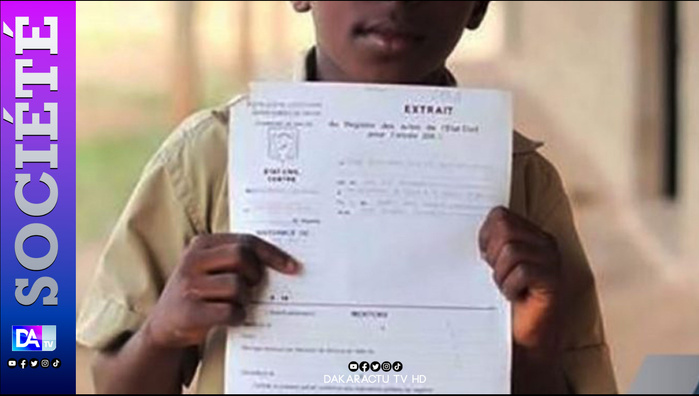
Sénégal: 54,462 CFEE Candidats Sans Acte Naissance Impact Exam Access
Summary
- Over 54,000 CFEE candidates in Senegal, along with thousands of BFEM and baccalaureate candidates, lack essential civil status documents like birth certificates.
- One in five children in Senegal does not possess a birth certificate, leading to disruptions in education and travel.
- Legal provisions in the Family Code, such as Article 196 and Article 52, create barriers to paternal filiation and birth registration for children born out of wedlock.
- Challenges include poor archive conservation, fraudulent practices, and parallel registers, particularly in border areas.
- The National Civil Status Agency is digitizing services and expanding platforms like 'Sama État civil,' but funding and legal framework updates are crucial for full implementation.
Widespread Civil Status Documentation Deficiencies in Senegal
One in five children throughout Senegal lacks a birth certificate, and the implications of this absence extend far beyond academic pursuits, leading to severe disruptions in individuals' lives.
A significant number of students across Senegal are facing educational hurdles due to the absence of essential civil status documents, particularly birth certificates. Recent data, unveiled at the inaugural National Forum dedicated to civil status issues, highlighted the scale of this challenge. Specifically, 54,462 candidates for the Certificat de Fin d'Études Élémentaires (CFEE) presented themselves for examinations without the required documentation. The problem extends to higher educational levels, with 7,823 candidates for the Brevet de Fin d'Études Moyennes (BFEM) and 98 baccalaureate candidates similarly affected.
This issue, which impacts exam processes, is part of a broader national concern: one in five children throughout Senegal lacks a birth certificate. The implications of this absence extend far beyond academic pursuits, leading to severe disruptions in individuals' lives. Reports indicate that some students have been forced to discontinue their education, while others have abandoned travel plans, all due to problems with identity papers. These figures were presented by Me Fatou Babou, president of the National Organization for the Promotion of Civil Status, and were also reported by Dakaractu, underscoring the urgency of addressing the absence acte de naissance Sénégal.
Systemic and Legal Obstacles to Civil Registration
The difficulties in obtaining civil status documents often stem from complex administrative procedures and an outdated legal framework. When births are not declared within the mandatory timeframe, families are compelled to initiate a late registration process, which can be cumbersome. Furthermore, specific provisions within the Code de la famille Sénégal introduce significant challenges, particularly concerning filiation. Article 196, for instance, prevents a child born outside of marriage from seeking paternal filiation, while Article 52 mandates the physical presence of the father to have his name recorded on a birth certificate.
Even when legal judgments authorize registration, the process is not always seamless; some rulings are not accurately retranscribed into official registers. This administrative lapse can lead to long-term consequences, as affected individuals may struggle years later to acquire other vital documents, such as a certificate of nationality. The structural fragility of the Senegalese system was starkly illustrated by the 'Bébé Diène' case, revealing how deficiencies in declarations, registers, or verification can impact individuals from their schooling through administrative procedures and even international travel. Before the September 23rd Forum, neighborhood delegates were recognized as key local civil status contacts, yet systemic weaknesses persist.
Challenges in Archiving and Combating Fraud
Beyond legal and procedural hurdles, the conservation of civil status archives presents another significant obstacle. Cheikh Samba Ndiaye, former Mayor of Ndoffane and a former representative of the Association of Mayors of Senegal, highlighted issues such as the existence of old registers, inadequate storage conditions, and lost references. These problems severely complicate the retrieval and verification of documents, adding layers of difficulty for citizens seeking to confirm their identity or lineage.
Moreover, the Forum brought to light troubling reports of fraudulent practices and the operation of parallel registers, particularly prevalent in certain border regions. Testimonies implicated intermediaries and some civil status agents in these illicit activities, raising concerns about the potential for creating fictitious identities or identity usurpation. These issues underscore the critical need for robust oversight and modernization to ensure the integrity and reliability of the civil registration system.
Modernization Efforts and Funding Constraints
In response to these pervasive issues, the Agence nationale de l'état civil Sénégal is actively implementing a comprehensive digitization program aimed at modernizing its services. This initiative, which represents a significant reform of the état civil Sénégal, currently encompasses 483 out of 629 centers, achieving an announced coverage of 77%. A key component of this effort is the gradual expansion of the 'Sama État civil' platform to various communes, enabling citizens to request and receive copies of documents remotely, thereby streamlining access and reducing administrative burdens.
The agency is also developing a system for the pre-declaration of births within health facilities, aiming to capture vital information at the earliest possible stage. However, the full operationalization of these digital tools and the broader numérisation état civil Sénégal hinges on the evolution of the existing legal framework. Furthermore, financial constraints pose a significant challenge to these modernization efforts. Ibrahima Etia, an official within the agency, reported that the institution had not received any investment resources for the current year. Despite these funding limitations, 3,473 civil status agents and officers have undergone training to support the ongoing reforms.
Practical Implications
Lawyers advising clients in Senegal on family law, administrative procedures, or identity verification should be aware of the systemic challenges in civil status record-keeping, including issues with birth certificates and potential for fraud. The ongoing digitization efforts and proposed legal reforms may impact future procedures for late registration, filiation, and document retrieval, requiring practitioners to adapt their advice and strategies.
Source
How does this affect you?
Get an AI analysis of this article grounded in your jurisdictions, practice areas, and any policy documents you've uploaded to Wansom.
Finish Reading the Full Story and the Expert Analysis.
Get the latest legal & regulatory intelligence in Senegal
Wansom is AI and can make mistakes.