
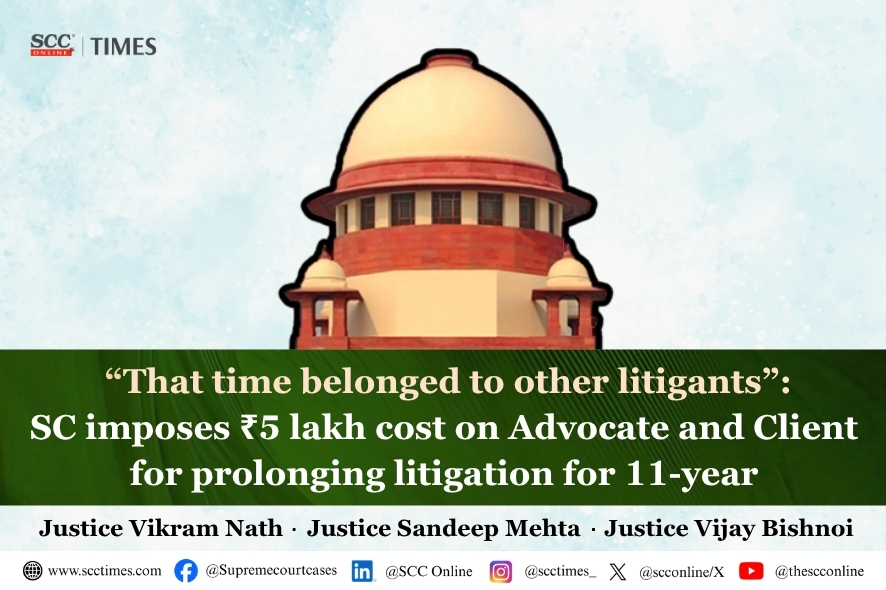
SC India: ₹5 Lakh Prolonged Litigation Cost on Advocate, Client
Summary
- India's Supreme Court imposed a ₹5 lakh penalty on an advocate and their client for prolonging litigation over eleven years.
- The Court stated that the time consumed by this case rightfully belonged to other litigants awaiting justice.
- The prolonged dispute had engaged the Bar Council of India, a High Court, and the Supreme Court itself.
- This ruling signals a stricter judicial stance against protracted legal battles and inefficient use of court resources.
- The decision highlights shared accountability for litigation delays between legal professionals and their clients.
Supreme Court Imposes Significant Costs for Prolonged Litigation
The Court explicitly noted that the eleven years consumed by this particular case diverted judicial attention and resources from other litigants who were genuinely in need of timely relief from the courts.
India's Supreme Court has levied a substantial penalty of ₹5 lakh on both an advocate and their client, citing their collective responsibility for unduly extending a legal dispute over an eleven-year period. This decisive action underscores a growing judicial impatience with protracted legal battles that consume valuable court resources.
The penalty was specifically imposed due to the parties' engagement in litigation that spanned more than a decade, involving multiple judicial and quasi-judicial forums. The case progressed through the Bar Council of India, a High Court, and ultimately reached the Supreme Court itself, each stage contributing to the extensive duration of the proceedings. This ruling highlights a stricter approach by the judiciary to address the issue of SC India 5 lakh prolonged litigation cost.
The imposition of such a significant financial burden on both the legal representative and the litigant signals a clear message regarding accountability for delays. It emphasizes that the responsibility for efficient case management and timely resolution extends beyond the courts to those directly involved in the legal process. This move is poised to influence how legal professionals and their clients approach the duration and conduct of their cases.
Judicial Time as a Public Resource
In its pronouncement, the Supreme Court articulated a fundamental principle: the time occupied by these litigants and their counsel rightfully belonged to countless other individuals awaiting justice. The Court explicitly noted that the eleven years consumed by this particular case diverted judicial attention and resources from other litigants who were genuinely in need of timely relief from the courts.
This perspective frames judicial time not merely as an administrative commodity but as a critical public resource, essential for the functioning of the justice system. The Court's observation serves as a judicial time wastage penalty India, reinforcing the idea that prolonged and arguably unnecessary litigation imposes a direct cost on the broader public and the efficiency of the legal system. The Supreme Court India litigation delay penalty is thus not just a financial sanction but a statement on resource allocation.
The ruling underscores the judiciary's commitment to ensuring equitable access to justice, implying that when one case is unduly prolonged, it inevitably delays others. This principle is central to the Court's rationale for imposing costs, aiming to deter future instances of what it perceives as an inefficient use of judicial infrastructure and personnel. The emphasis is on prioritizing the needs of the collective body of litigants over the individual interests that lead to protracted disputes.
Implications for Legal Practice and Case Management
This judgment sets a significant precedent, signaling a stricter judicial stance on protracted litigation and the associated costs. It places a renewed onus on legal practitioners to proactively manage case timelines and to advise their clients comprehensively on the financial risks associated with unnecessary delays. The concept of Advocate client frivolous litigation costs is brought sharply into focus, suggesting a shared liability for the duration and expense of legal proceedings.
The decision by the SC to impose a 5 lakh cost on the advocate, alongside the client, serves as a powerful reminder of the professional obligations lawyers hold in ensuring the efficient administration of justice. It encourages a more disciplined approach to litigation, where strategies are not only aimed at winning but also at achieving resolution within reasonable timeframes. This ruling will likely prompt legal firms to review their internal case management protocols and client advisory practices.
Furthermore, this ruling contributes to the evolving discourse around Indian courts case management costs. It suggests that courts are increasingly willing to use their powers to impose financial penalties as a tool to enforce efficiency and deter practices that contribute to backlogs. The message is clear: the legal system's resources are finite, and their misuse will incur tangible consequences for all parties involved.
Practical Implications
This ruling signals a stricter judicial stance on protracted litigation, requiring lawyers to proactively manage case timelines and advise clients on the financial risks of unnecessary delays. It sets a precedent for courts to impose significant costs on both advocates and clients for occupying judicial resources.
Source
Source: Original reporting via SCC Times
How does this affect you?
Get an AI analysis of this article grounded in your jurisdictions, practice areas, and any policy documents you've uploaded to Wansom.
Wansom is AI and can make mistakes.