
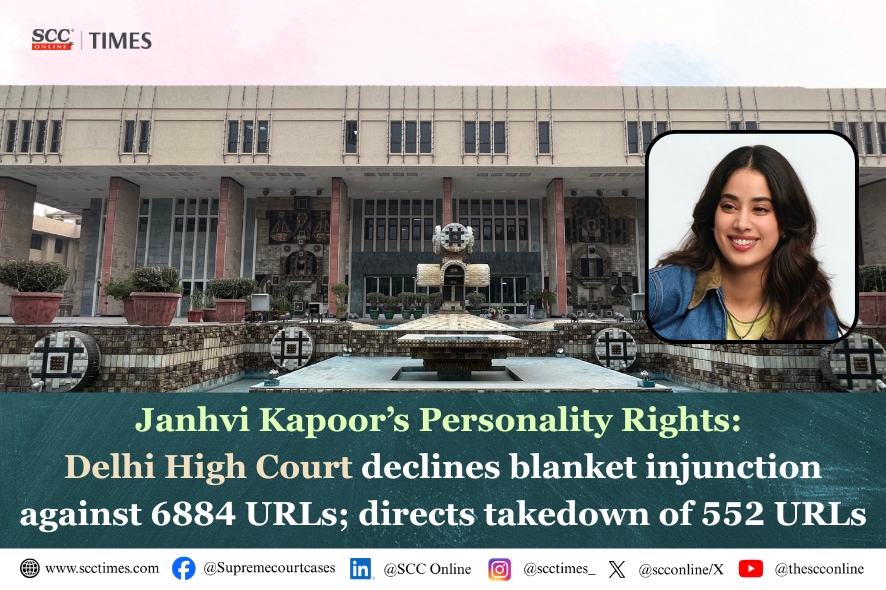
Janhvi Kapoor: Delhi HC Orders Targeted URL Takedown, Denies Broad Injunction
Summary
- The Delhi High Court addressed a case concerning actress Janhvi Kapoor's personality rights.
- The court declined a blanket injunction against 6,884 URLs that Kapoor's legal team sought to remove.
- However, the court ordered the takedown of 552 specific URLs.
- These 552 URLs were found to contain "ex facie pornographic content."
- The ruling highlights a nuanced judicial approach to online content removal in India, favoring targeted actions over broad bans.
The Court's Deliberation on Online Content
This distinction between a general injunction and targeted removal based on content type is central to the court's decision, setting a precedent for how similar cases involving celebrity image rights in India might be handled in the future.
The Delhi High Court recently issued a nuanced ruling in a case concerning the personality rights of actress Janhvi Kapoor, addressing the complex challenges of online content moderation. While the court declined to issue a sweeping blanket injunction that would have targeted a vast number of URLs, it simultaneously ordered the immediate removal of specific infringing material. This decision highlights the judiciary's careful approach to balancing individual rights with the practicalities of internet governance.
Specifically, the court refused to grant a broad injunction against 6,884 URLs that Kapoor's legal representatives had sought to have removed. This refusal underscores a judicial reluctance to issue overly broad directives that could impact a wide array of online content without precise justification. However, a significant portion of the requested removals was indeed granted, demonstrating the court's willingness to act decisively when content clearly violates established legal standards.
The ruling mandates the takedown of 552 distinct URLs. These particular online addresses were identified as containing content that was 'ex facie pornographic,' meaning it was overtly and undeniably pornographic in nature. This distinction between a general injunction and targeted removal based on content type is central to the court's decision, setting a precedent for how similar cases involving celebrity image rights in India might be handled in the future.
Legal Framework for Personality Rights in India
Personality rights, which protect an individual's right to control the commercial use of their name, image, and other identifying features, are increasingly relevant in the digital age. For public figures like Janhvi Kapoor, the proliferation of online platforms and the ease of content dissemination present unique challenges to maintaining control over their public persona. Indian courts have progressively recognized and upheld these rights, acknowledging the potential for misuse and exploitation of celebrity image rights in India.
The digital landscape, however, complicates the enforcement of such rights. The sheer volume of online content, often hosted across various jurisdictions and platforms, makes comprehensive monitoring and removal a formidable task. This environment frequently leads to requests for broad injunctions, where petitioners seek to block access to a large number of URLs or even entire websites to prevent further infringement. Courts must then weigh the individual's right to privacy and control against principles of free speech and the practical limitations of internet regulation.
In India, the legal framework for online content removal is evolving, with courts often navigating between established intellectual property laws and newer considerations related to privacy and digital rights. The Delhi High Court's approach in this instance reflects a judicial preference for specific, evidence-based interventions over blanket bans, particularly when dealing with the vast and often ephemeral nature of internet content. This careful consideration aims to ensure that remedies are proportionate to the harm and do not inadvertently stifle legitimate online expression.
Rationale Behind the Targeted Takedown
The Delhi High Court's decision to differentiate between a sweeping injunction and targeted content removal was rooted in the nature of the infringing material. The court declined the request for a blanket injunction covering 6,884 URLs, likely due to the broad scope of such a directive and the potential for it to encompass content that might not be clearly violative or might even be protected under free speech principles. Blanket injunctions are generally viewed with caution by courts, as they can be difficult to enforce effectively and may lead to over-blocking.
Conversely, the court found sufficient grounds to order the takedown of 552 specific URLs because the content hosted on these sites was explicitly identified as 'ex facie pornographic.' This classification indicates that the material was overtly and undeniably pornographic, leaving no room for ambiguity regarding its nature. Such clear-cut violations often warrant immediate and decisive judicial intervention, as they typically fall outside the purview of protected expression and can cause significant harm to the individual involved, particularly in cases concerning Janhvi Kapoor personality rights.
This targeted approach underscores a judicial preference for precision in online content removal India orders. Rather than issuing a broad directive that might be challenged on grounds of overreach or censorship, the court focused on content that met a clear and unambiguous legal threshold for removal. This distinction is crucial, signaling that while courts are hesitant to grant wide-ranging bans, they are prepared to act swiftly against material that is patently illegal or harmful, especially when it infringes upon an individual's dignity and personality rights in such an egregious manner through ex facie pornographic content takedown.
Implications for Online Content and Celebrity Rights
The Delhi High Court's ruling in the Janhvi Kapoor personality rights case provides important clarity for both celebrities seeking to protect their image and platforms responsible for hosting user-generated content. It establishes a precedent that while courts are unlikely to issue blanket injunctions against thousands of URLs, they will readily order the takedown of specific content that is clearly violative, particularly when it involves ex facie pornographic material. This nuanced stance reflects a pragmatic approach to online content regulation, acknowledging the difficulties of policing the internet while still upholding individual rights.
For individuals and legal practitioners, this decision emphasizes the importance of presenting specific, well-documented evidence of infringement rather than seeking overly broad remedies. The success in securing the removal of 552 URLs containing ex facie pornographic content demonstrates that targeted legal action can be highly effective. This ruling reinforces the idea that online content removal in India will likely continue to be addressed on a case-by-case basis, with a strong emphasis on the nature and clarity of the infringement.
Ultimately, this judgment contributes to the evolving jurisprudence surrounding celebrity image rights in India and the broader challenges of online content governance. It signals that the judiciary is committed to protecting individuals from egregious online harm, such as the unauthorized dissemination of pornographic material, while also exercising restraint against measures that could be seen as disproportionate or overly restrictive of online information flow. The balance struck by the Delhi High Court offers a valuable framework for future disputes concerning Janhvi Kapoor Delhi HC URL takedown actions and similar personality rights claims.
Practical Implications
This ruling clarifies that Indian courts may not grant blanket injunctions for personality rights violations online, but will order takedowns for clearly infringing content, particularly ex facie pornographic material. Lawyers advising clients on intellectual property or media law should note this nuanced approach when seeking or defending against online content removal.
Source
Source: Original reporting via SCC Times
How does this affect you?
Get an AI analysis of this article grounded in your jurisdictions, practice areas, and any policy documents you've uploaded to Wansom.
Wansom is AI and can make mistakes.