
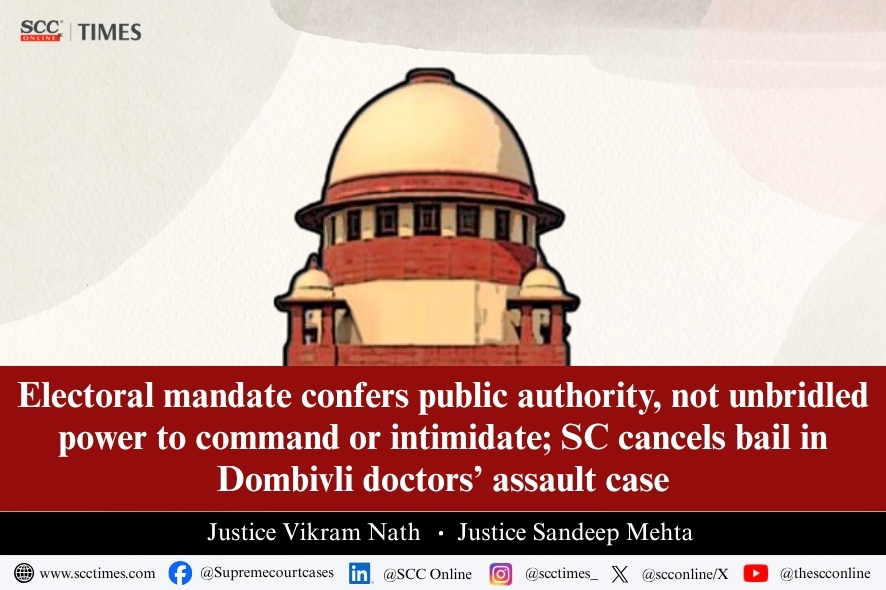
SC Cancels Bail: Dombivli Doctors Assault Accused
Summary
- The Supreme Court cancelled the bail of accused individuals in the Dombivli doctors' assault case.
- The High Court had failed to adequately consider the gravity of allegations and the accused's criminal antecedents.
- Concerns about witness intimidation and the influence of the principal accused were also overlooked by the High Court.
- The Supreme Court emphasized that an electoral mandate grants public authority, not unbridled power to command or intimidate.
- The ruling highlights the wider impact of the assault on the medical fraternity as a critical factor in bail decisions.
Supreme Court Revokes Bail in Dombivli Doctors' Assault Case
The Supreme Court's decision implicitly addressed the notion that an electoral mandate, while conferring public authority, does not grant unbridled power to command or intimidate.
India's Supreme Court recently intervened in a significant case, revoking the bail previously granted to accused individuals involved in the assault of doctors in Dombivli. The apex court's decision highlighted critical oversights by the High Court, which had initially allowed the accused to remain free. This ruling underscores the judiciary's commitment to a thorough evaluation of all relevant factors before granting pre-trial release, especially in cases with broader societal implications.
The High Court's failure to adequately consider several crucial aspects formed the basis of the Supreme Court's intervention. Specifically, the higher court found that the lower court had not properly weighed the gravity of the allegations leveled against the accused, nor had it given due consideration to their criminal antecedents. These factors are fundamental in assessing the potential risk posed by an accused person if released on bail.
Furthermore, the Supreme Court pointed out the High Court's oversight regarding the apprehension of witness intimidation. The potential for accused individuals to influence or threaten witnesses is a serious concern that can undermine the integrity of the judicial process. The influence wielded by the principal accused in this particular case, along with the wider impact of the assault upon the medical fraternity, were also deemed insufficiently considered by the High Court, leading to the Supreme Court's decision to cancel the bail.
Legal Principles Underpinning the Decision
The Supreme Court's judgment reinforces several key legal principles governing bail applications. It emphasized that the gravity of the alleged offenses is a paramount consideration, as serious charges often warrant a more stringent approach to bail. Similarly, the existence of criminal antecedents, or a history of prior offenses, indicates a pattern of behavior that courts must account for when assessing future risks.
The potential for witness intimidation is a critical factor that directly impacts the fairness of a trial. The Supreme Court's ruling makes it clear that courts must actively assess whether an accused, if released, could exert undue influence over witnesses, thereby obstructing justice. This is particularly pertinent when the principal accused holds a position of power or influence, as was implied in this case.
Moreover, the Court's decision implicitly addressed the notion that an electoral mandate, while conferring public authority, does not grant unbridled power to command or intimidate. This principle suggests that individuals in positions of public trust or with significant influence must be held to a higher standard, and their potential to misuse such influence to obstruct justice or harm others must be carefully scrutinized during bail proceedings.
Broader Implications for Justice and Public Trust
This Supreme Court ruling carries significant implications for the administration of justice, particularly in cases involving influential individuals or those that affect specific professional communities. By canceling bail, the Court has sent a strong message about the importance of protecting vulnerable groups, such as the medical fraternity, from assault and intimidation. It reaffirms that the judiciary will not tolerate actions that undermine the safety and ability of professionals to perform their duties without fear.
The decision also serves as a crucial reminder to lower courts regarding the comprehensive nature required for bail considerations. It highlights that a superficial review of facts is insufficient when fundamental rights and the integrity of the justice system are at stake. The Supreme Court's intervention ensures that all relevant factors, including the potential for witness tampering and the broader societal impact, are thoroughly evaluated.
Ultimately, this judgment reinforces public trust in the judicial system by demonstrating that no individual, regardless of their position or influence, is above the law. It underscores that the exercise of public authority comes with responsibilities, and it cannot be used as a shield for criminal behavior or to intimidate others, ensuring that justice is served fairly and impartially.
Practical Implications
Lawyers should note the Supreme Court's reinforcement of factors like the gravity of allegations, criminal antecedents, and potential for witness intimidation as critical grounds for bail cancellation. This decision provides guidance for arguing bail applications, particularly in cases involving public figures or significant public interest where such considerations are paramount.
Source
Source: Original reporting via SCC Times
How does this affect you?
Get an AI analysis of this article grounded in your jurisdictions, practice areas, and any policy documents you've uploaded to Wansom.
Finish Reading the Full Story and the Expert Analysis.
Get the latest legal & regulatory intelligence in India
Wansom is AI and can make mistakes.