
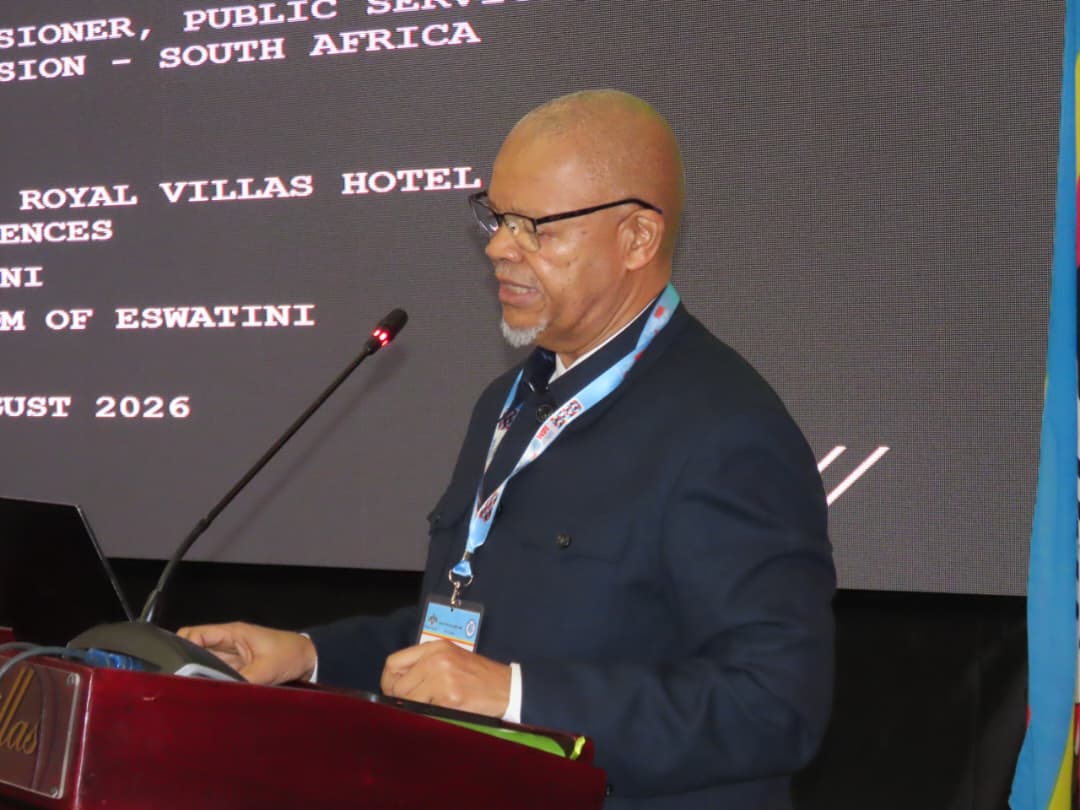
Makhanya: SADC Public Service Reform Accountability Needs Consequence Systems
Summary
- South Africa’s Public Service Commission Commissioner, Professor Mandla Makhanya, stated that strong consequence management systems are essential for public service transformation in the SADC region.
- He emphasized that without these systems, public service reform efforts across the Southern African Development Community cannot succeed.
- Professor Makhanya delivered these remarks during the 3rd Annual General Meeting of the SADC Public Service Commissions.
- The meeting took place on a Saturday at the Royal Villas in Ezulwini.
- The Commissioner's statement highlights that weak accountability is a major impediment stalling public service reform within SADC.
Accountability Crucial for SADC Public Service Reform
Professor Mandla Makhanya, who serves as South Africa’s Public Service Commission Commissioner, recently underscored the critical need for robust consequence management systems to drive successful public service transformation across the Southern African Development Community (SADC) region.
Professor Mandla Makhanya, who serves as South Africa’s Public Service Commission Commissioner, recently underscored the critical need for robust consequence management systems to drive successful public service transformation across the Southern African Development Community (SADC) region. Speaking at the 3rd Annual General Meeting (AGM) of the SADC Public Service Commissions, Commissioner Makhanya emphasized that without these foundational systems, efforts to reform public services within the bloc are destined to falter.
His remarks, delivered on a Saturday at the Royal Villas in Ezulwini, highlighted a significant impediment to progress: the absence of strong mechanisms to ensure accountability. This perspective suggests that while various initiatives for public service improvement may be underway, their ultimate efficacy is severely compromised if there are no clear and consistent consequences for performance, both positive and negative. The Commissioner's statement frames consequence management not merely as a punitive measure, but as an indispensable component for fostering a culture of responsibility and efficiency within the Southern African Development Community public service.
The Imperative of Consequence Management Systems
The core of Professor Makhanya's message centers on the idea that public service transformation, a goal shared by many SADC member states, cannot be achieved in a vacuum of accountability. Strong SADC consequence management systems are presented as the bedrock upon which any meaningful reform must be built. Without them, initiatives aimed at enhancing service delivery, improving governance, or streamlining administrative processes risk becoming ineffective, as there is no clear framework to ensure adherence to new standards or to address deviations.
Weak accountability, therefore, acts as a significant barrier, stalling the very reforms intended to modernize and improve public sector operations. The Commissioner's intervention at the SADC Public Service Commissions AGM serves as a stark reminder that structural changes alone are insufficient; they must be accompanied by a robust framework that holds individuals and institutions responsible for their actions and outcomes. This emphasis on accountability is vital for fostering trust, ensuring transparency, and ultimately delivering better public services to the citizens of the SADC region.
Regional Dialogue on Governance Challenges
The setting for Professor Mandla Makhanya's impactful statement — the 3rd Annual General Meeting of the SADC Public Service Commissions — underscores the regional focus on these governance challenges. This gathering provides a crucial platform for high-level discussions among public service leaders from across the Southern African Development Community, allowing them to collectively address common obstacles to administrative efficiency and reform.
The discussions at such an AGM are instrumental in shaping regional strategies and encouraging member states, including those focused on Eswatini public service reform, to adopt best practices in public administration. By highlighting the critical link between SADC public service reform accountability Makhanya's insights reinforce the notion that effective governance and administrative transformation are interdependent. The collective commitment to strengthening consequence management systems is portrayed as a prerequisite for unlocking the full potential of public services throughout the SADC bloc, ensuring that reform efforts translate into tangible improvements for citizens.
Practical Implications
This commentary signals ongoing challenges in administrative efficiency and governance within SADC public services due to weak accountability. Lawyers advising clients in SADC member states should monitor regional efforts to strengthen consequence management, as this directly impacts regulatory predictability and the reliability of public sector interactions.
Source
How does this affect you?
Get an AI analysis of this article grounded in your jurisdictions, practice areas, and any policy documents you've uploaded to Wansom.
Finish Reading the Full Story and the Expert Analysis.
Wansom is AI and can make mistakes.