
Sénégal Dette Publique: Sonko Alerte sur Informations Dissimulées et Souveraineté
Summary
- Senegal's public debt and its impact on the state's operational flexibility were a central topic at the National Assembly's 2026-2027 ordinary session.
- Ousmane Sonko, President of the National Assembly, stated that a lack of transparency in public finance management could lead to lasting negative consequences.
- Sonko specifically linked opaque financial practices to a potential erosion of Senegal's economic sovereignty.
What Was Said
The concealment of debt information, therefore, poses a direct threat to the nation's ability to govern its own economic destiny.
During the opening address of the National Assembly's singular ordinary session for the 2026-2027 legislative period, a significant portion of the discussion centered on the critical state of Senegal's public debt. The impact of this debt on the government's capacity for independent action and policy implementation was a primary concern raised during this important parliamentary gathering. This session provided a crucial forum for national leaders to deliberate on the country's financial stability and its broader implications.
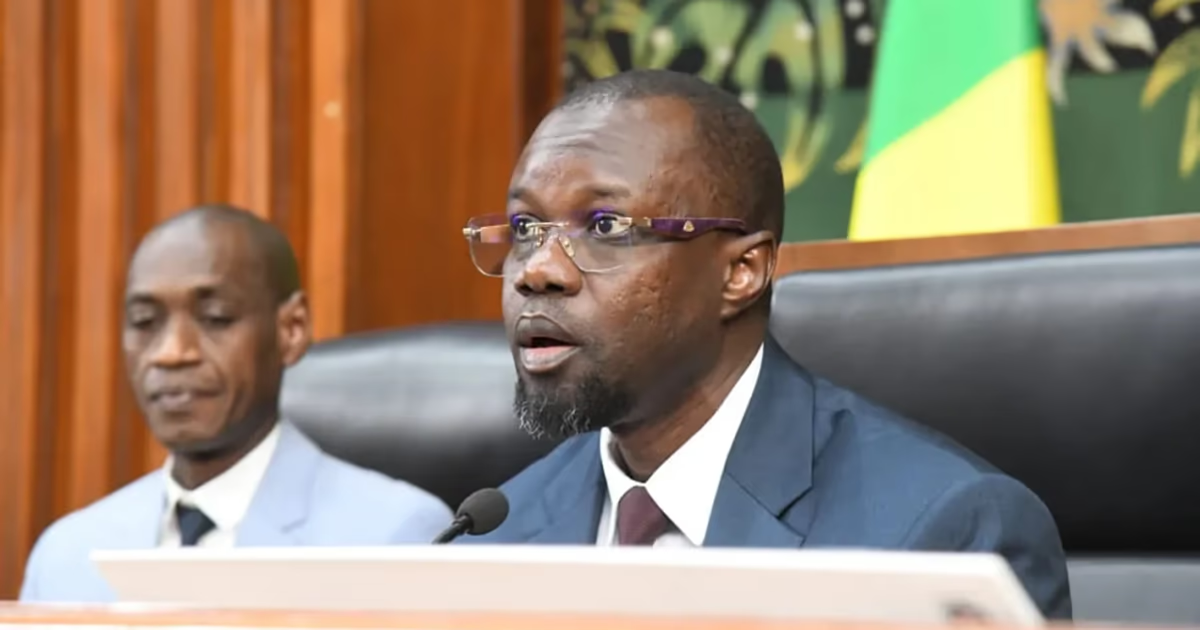
Ousmane Sonko, President of the National Assembly, in his intervention, specifically highlighted the potential for long-lasting negative repercussions that could arise from a lack of transparency in the management of public finances. He drew a direct and serious connection between the obscured handling of state funds and the fundamental ability of Senegal to maintain its economic independence and self-determination on the global stage.
The Weight of Public Debt
The discourse during the session underscored that the current level of national indebtedness in Senegal is not merely an abstract financial metric but a tangible constraint on the state's operational capabilities. A substantial public debt can significantly diminish a government's fiscal flexibility, thereby limiting its capacity to allocate resources effectively towards essential public services, initiate vital infrastructure projects, or mount robust responses to unforeseen economic downturns or national emergencies. This reduction in fiscal space directly impacts the government's ability to fulfill its mandate to the citizenry.
Such financial encumbrances often necessitate difficult budgetary decisions, potentially leading to cuts in social welfare programs, delays in developmental initiatives, and even a compromise of the nation's strategic autonomy. The parliamentary discussion thus brought into sharp focus how the accumulation of public debt directly influences the government's freedom to pursue its national agenda without being unduly influenced by external financial pressures or internal resource scarcity, thereby affecting its sovereignty in practical terms.
Opacity and Economic Sovereignty
A particularly critical point articulated by Ousmane Sonko, President of the National Assembly, revolved around the inherent dangers posed by non-transparent public financial management. He contended that when the intricate details concerning the acquisition, deployment, and eventual repayment of public borrowings are not openly accessible or are intentionally concealed, it fosters an environment susceptible to mismanagement, inefficiency, and potential corruption. This pervasive lack of clarity not only eradicates public trust but also severely impedes the ability of citizens and independent oversight bodies to hold public officials accountable for their financial stewardship and decisions.
Moreover, Sonko stressed that such opacity carries profound and potentially irreversible consequences for Senegal's economic sovereignty. A nation whose financial dealings are shrouded in secrecy becomes inherently vulnerable to external pressures and conditionalities, as international creditors or financial institutions might impose terms that do not align with the country's long-term strategic interests. This situation can severely compromise Senegal's capacity to independently determine its economic trajectory, fostering a reliance on external actors and ultimately undermining its self-determination and control over its own national assets and policy formulation. The concealment of debt information, therefore, poses a direct threat to the nation's ability to govern its own economic destiny.
Practical Implications
Lawyers advising clients on investments or public sector engagements in Senegal should note the stated concerns regarding opacity in public finance management. This could signal increased due diligence requirements and potential risks related to contractual stability or economic policy shifts impacting government-linked projects.
Source
How does this affect you?
Get an AI analysis of this article grounded in your jurisdictions, practice areas, and any policy documents you've uploaded to Wansom.
Finish Reading the Full Story and the Expert Analysis.
Get the latest legal & regulatory intelligence in Senegal
Wansom is AI and can make mistakes.