
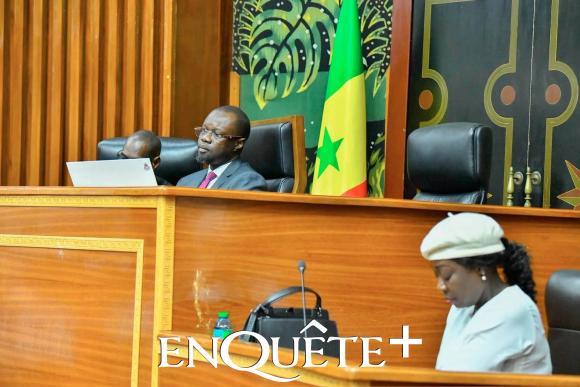
Sénégal Assemblée Nationale: Defers Proposition de loi n°34/2026 Crédits Spéciaux
Summary
- The Senegalese National Assembly postponed a session for Proposition de loi n°34/2026 concerning special credits, after the Constitutional Council declared it inadmissible on August 25, 2026.
- The government challenged the bill, arguing its provisions fall under regulatory, not legislative, power, citing Articles 67 and 76 of the Constitution.
- The Assembly characterized the government's action as "systematic obstruction" but suspended the bill's review for inter-institutional dialogue.
- Aminata Touré highlighted that the dispute, also linked to a 1.7 billion dossier, concerns the separation of powers and the roles of government, Parliament, and the constitutional judge, with the Prime Minister's referral justified under Article 83.
- The Constitutional Council, on August 25, 2026, declared the proposition of law inadmissible, ruling that it encroached upon the regulatory domain.
Legislative Session Postponed Amid Constitutional Challenge
The Council's ruling has provided crucial clarification on the boundaries between legislative and regulatory powers, particularly in the realm of financial legislation, thereby establishing important precedents for future constitutional challenges to parliamentary initiatives.
The Senegalese National Assembly has deferred a crucial session concerning Proposition de loi n°34/2026, which addresses special credits. Originally slated for Wednesday, August 19, at 10 AM, the legislative body opted to postpone its deliberation, after the Constitutional Council declared the proposition of law inadmissible on August 25, 2026. This decision, communicated via an Assembly communiqué and reported by EnQuête+, was justified by the deputies as a commitment to stability, republican elegance, and fostering dialogue between state institutions.
This deferral comes amidst a significant inter-institutional disagreement. The government has formally appealed to the Constitutional Council, challenging specific provisions within the proposed legislation. The executive branch contends that these elements pertain to regulatory authority, falling within the purview of decrees and regulations, rather than the legislative domain. The National Assembly, for its part, characterized the government's move as "a systematic obstruction of the legislative process," though it ultimately chose to suspend its review of the bill despite noting that neither the Constitution nor its own Internal Regulations automatically grant suspensive effect to such a recourse.
The Core of the Dispute: Legislative vs. Regulatory Powers
The heart of the contention emerged during committee discussions. The Executive's preference was for the proposed law to narrowly define special credits, outline their scope of application, and establish the fundamental principle of their control. The practical implementation details, according to the government, should then be elaborated through subsequent decrees. However, amendments put forward by Justice Minister Me Moussa Sarr, reflecting this executive stance, were ultimately rejected by the majority of deputies.
Conversely, the proponents of Proposition de loi n°34/2026 aim for a more comprehensive legislative framework. Their objective is to impose stricter controls on the utilization of special credits and to enhance oversight mechanisms, without advocating for their outright abolition. This fundamental divergence in approach underscores a broader debate regarding the appropriate division of responsibilities in financial legislation between the legislative and executive branches, highlighting a significant conflit exécutif législatif Sénégal crédits spéciaux.
Constitutional Framework and Inter-institutional Dynamics
The government's challenge to the bill is grounded in specific articles of the Constitution of Sénégal. It invokes Articles 67 and 76, which delineate the respective competencies of law and regulation, asserting that the disputed provisions encroach upon the regulatory domain. Aminata Touré, a prominent figure, has indicated that the Prime Minister's referral to the Constitutional Council is justified under Article 83. This particular article empowers the head of government or other cabinet members to declare a parliamentary initiative inadmissible if it does not fall within the legislative sphere.
This constitutional mechanism highlights the critical role of the Conseil constitutionnel Sénégal in arbitrating disputes over legislative competence. The ongoing controversy extends beyond mere financial transparency, as Aminata Touré suggests, encompassing the fundamental séparation pouvoirs Sénégal droit constitutionnel. The debate, therefore, is not solely about the rules governing special credits but also about the distinct roles of the government, Parliament, and the constitutional judiciary in shaping these frameworks. In instances of disagreement between the Executive and the Assemblée nationale Sénégal, the Constitutional Council is mandated to render a decision within an eight-day period.
Broader Implications and Legislative Outlook
The Constitutional Council, on August 25, 2026, declared Proposition de loi n°34/2026 on crédits spéciaux Sénégal inadmissible, thereby concluding the review and preventing further examination of the bill by the National Assembly. This particular legislative dispute is also linked to the broader dossier concerning 1.7 billion, suggesting a wider context of financial scrutiny and accountability. The Council's ruling has provided crucial clarification on the boundaries between legislative and regulatory powers, particularly in the realm of financial legislation, thereby establishing important precedents for future constitutional challenges to parliamentary initiatives.
While the deliberation on the special credits bill is on hold, other legislative activities of the Assemblée nationale Sénégal are proceeding as planned. For instance, work scheduled for Thursday, August 20, remains unaffected. Deputies are expected to ratify resolutions for the establishment of parliamentary inquiry commissions and to review bill n°25/2026, which focuses on the protection of critical information infrastructures and digital security. This indicates that despite the significant constitutional conflict, the broader legislative agenda continues, underscoring the ongoing functions of the Senegalese Parliament.
Practical Implications
The Constitutional Council's upcoming decision on the 'crédits spéciaux' bill will provide critical clarification on the division of legislative and regulatory powers between the Senegalese Parliament and Government, particularly concerning financial legislation. Lawyers and compliance officers should monitor this ruling as it will establish important precedents for constitutional challenges to parliamentary initiatives and the interpretation of articles 67, 76, and 83 of the Constitution, impacting future legislative drafting and governmental oversight.
Source
Source: Original reporting via EnQuête+
How does this affect you?
Get an AI analysis of this article grounded in your jurisdictions, practice areas, and any policy documents you've uploaded to Wansom.
Finish Reading the Full Story and the Expert Analysis.
Wansom is AI and can make mistakes.