
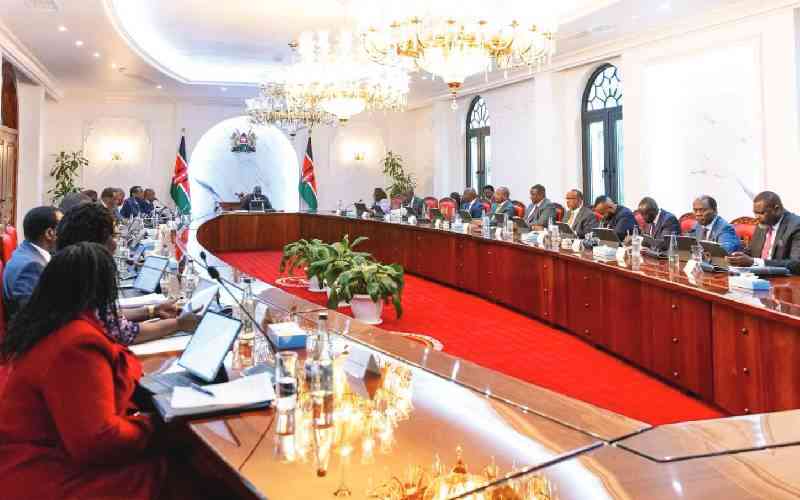
High Court: Ruto Cabinet Gender Requirement Legality Ruled Non-Compliant
Summary
- President William Ruto's Cabinet was reportedly facing dissolution on June 30, 2026, following a High Court ruling.
- The potential dissolution was attributed to the Cabinet's failure to meet gender requirements.
- On October 28, 2026, President Ruto announced the opening of Talanta Stadium, scheduled for January 5, 2027, and featuring a match between Bayern Munich and Ajax Amsterdam.
- The situation raises significant questions about the legality of the current Cabinet's composition and adherence to constitutional gender rules.
Cabinet Under Scrutiny
The reported threat of dissolution stems directly from the Cabinet's alleged non-compliance with a critical gender requirement.
President William Ruto presided over a Cabinet meeting at State House, Nairobi, on June 30, 2026. This gathering occurred at a critical juncture for the administration, as the very composition of the Cabinet was reportedly facing the prospect of dissolution. The gravity of the situation was underscored by the reason cited for this potential upheaval: a failure to adhere to established gender requirements, a matter of significant constitutional and legal import for the President Ruto cabinet composition.
On October 28, 2026, President Ruto engaged in other public duties, announcing the forthcoming opening of Talanta Stadium. This announcement included details of a high-profile football match scheduled for the inauguration on January 5, 2027, featuring European football giants Bayern Munich against Ajax Amsterdam. This juxtaposition highlights the dual focus of the presidency, balancing significant public events with pressing internal governmental challenges related to the legality of its highest executive body.
Legality of Cabinet Composition
The reported threat of dissolution stems directly from the Cabinet's alleged non-compliance with a critical gender requirement. On June 30, 2026, the High Court of Kenya ruled that President William Ruto's Cabinet did not comply with the constitutional two-thirds gender principle and directed the President to reconstitute the Cabinet within 120 days. This situation immediately brings into question the Ruto cabinet gender requirement legality, suggesting that the current composition may not align with the legal or constitutional mandates governing such appointments. The implication is that a specific Kenya cabinet gender rule exists, and its non-fulfillment carries serious repercussions for the executive branch.
Such a constitutional gender requirement Kenya is typically designed to ensure diverse representation within governmental bodies. The fact that the Cabinet was facing dissolution on June 30, 2026, due to this issue indicates a significant legal challenge to the legitimacy of its structure. Adherence to these rules is not merely a matter of policy but a fundamental aspect of constitutional governance, making any deviation a matter of profound legal and political concern.
Implications for Governance
The potential for Cabinet dissolution Kenya over a failure to meet gender requirements sets a notable precedent for future government appointments. It underscores the legal enforceability of diversity mandates within the highest echelons of power, emphasizing that compliance with the Kenya cabinet gender rule is a non-negotiable aspect of executive formation. This scenario highlights that executive appointments are subject to rigorous legal scrutiny, particularly concerning constitutional provisions aimed at ensuring equitable representation and upholding the rule of law.
Should the Cabinet indeed face dissolution or be compelled to reconstitute due to this issue, it would send a clear message about the imperative of upholding constitutional principles in all governmental functions. The ongoing scrutiny of the President Ruto cabinet composition regarding its gender balance will likely influence how future administrations approach cabinet formation, emphasizing the critical role of legal compliance in maintaining governmental stability, public trust, and adherence to the constitutional gender requirement Kenya.
Practical Implications
Lawyers should monitor potential legal challenges to the Ruto cabinet's composition based on constitutional gender requirements, as this could set a precedent for future government appointments and compliance with constitutional mandates regarding diversity and representation.
Source
Source: Original reporting via {source}
How does this affect you?
Get an AI analysis of this article grounded in your jurisdictions, practice areas, and any policy documents you've uploaded to Wansom.
Finish Reading the Full Story and the Expert Analysis.
Wansom is AI and can make mistakes.