
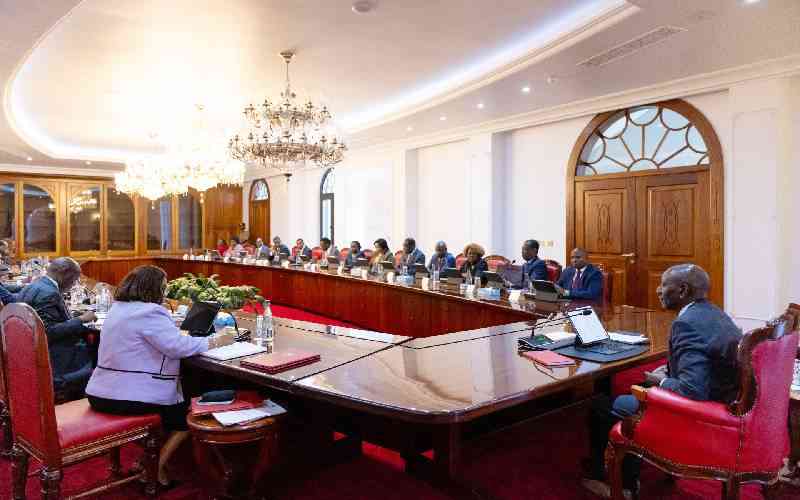
President Ruto: Cabinet Faces Dissolution Over Gender Rule Court Order
Summary
- President William Ruto's Cabinet faced potential dissolution on June 30, 2026, due to alleged non-compliance with a court order.
- The court order pertains to the constitutional two-thirds gender rule for Cabinet appointments in Kenya.
- Despite the looming legal threat, President Ruto made announcements on October 28, 2026, regarding the opening of Talanta Stadium and an international football match.
- The President's reported disobedience of the judicial directive places the legality of current Cabinet appointments at risk.
- Continued non-compliance could lead to the Cabinet's dissolution, potentially invalidating its past and future actions.
What Happened
The President's reported disobedience of a judicial directive concerning the constitutional two-thirds gender rule places the legality of current Cabinet appointments at risk, potentially leading to the body's dissolution.
On June 30, 2026, President William Ruto's Cabinet convened at State House, Nairobi, under the shadow of a significant legal challenge that threatened its very existence. The Cabinet was, on this specific day, facing the imminent prospect of dissolution, a direct consequence of alleged non-compliance with a standing court order related to the constitutional two-thirds gender rule. Despite the gravity of the situation and the legal uncertainty surrounding his executive body, President Ruto later, on October 28, 2026, proceeded with other official announcements. Notably, he publicly disclosed the scheduled opening date for Talanta Stadium. Furthermore, he revealed plans for a high-profile international football match to inaugurate the venue, featuring European giants Bayern Munich against Ajax Amsterdam, signaling a continuation of government functions amidst the legal turmoil.
Legal Context
The core of the legal predicament facing the President's Cabinet stems from the Kenya constitutional gender principle, specifically the two-thirds gender rule enshrined in the nation's supreme law. This principle mandates that no more than two-thirds of members of elective or appointive bodies shall be of the same gender, a provision designed to ensure equitable representation.
A court order had previously been issued, directing compliance with this crucial constitutional requirement in the formation of the Cabinet. However, President Ruto's administration is reportedly in a state of non-compliance with this judicial directive. The President's reported disobedience of a judicial directive concerning the constitutional two-thirds gender rule places the legality of current Cabinet appointments at risk, potentially leading to the body's dissolution. This ongoing defiance of the court order is the direct catalyst for the legal challenge and the looming threat of the Cabinet's invalidation.
Why It Matters
The potential dissolution of the Cabinet due to non-compliance with the two-thirds gender rule carries profound implications for governance and the rule of law in Kenya. Should the Cabinet be declared illegal, the legitimacy of all decisions, policies, and directives issued by its members could be called into question. This would create widespread legal uncertainty, potentially invalidating actions taken by the government and affecting various sectors, from business operations to public services.
The situation highlights a critical tension between the executive branch and the judiciary, with the latter seeking to uphold constitutional principles against alleged executive overreach or disregard. For lawyers and compliance officers in Kenya, this ongoing legal challenge necessitates close monitoring of the Cabinet's status. The risk of the Cabinet's dissolution and the subsequent invalidation of its actions could have significant ramifications for legal certainty and the stability of Kenya government appointments legality.
Practical Implications
Lawyers and compliance officers in Kenya should closely monitor the legal status of the current Cabinet and any decisions or directives it issues, as ongoing non-compliance with the gender rule and a disobeyed court order could lead to its dissolution, potentially invalidating its actions and creating significant legal uncertainty for businesses and individuals.
Source
Source: Original reporting via PCS
How does this affect you?
Get an AI analysis of this article grounded in your jurisdictions, practice areas, and any policy documents you've uploaded to Wansom.
Finish Reading the Full Story and the Expert Analysis.
Wansom is AI and can make mistakes.