
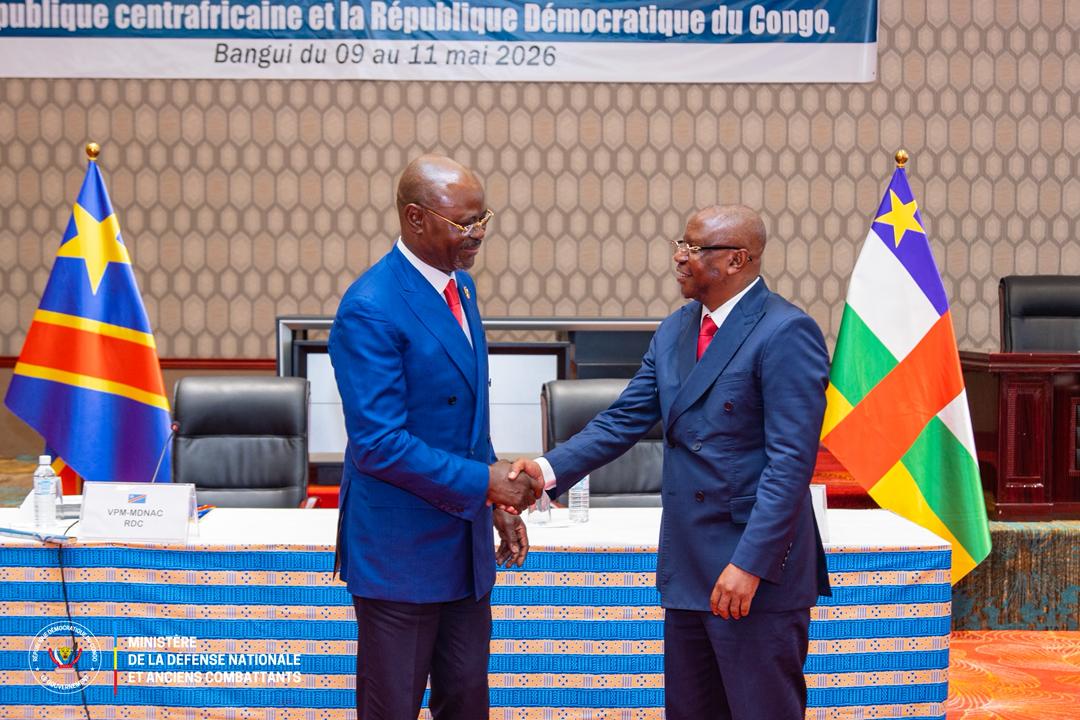
RDC, RCA: Sign RDC RCA Accord Militaire Renseignement 2026 for Border Security
Summary
- The Democratic Republic of Congo and the Central African Republic signed a strategic military and defense cooperation agreement focused on intelligence on August 21, 2026, in Kinshasa.
- The accord was signed by Guy Kabombo Muadiamvita for the RDC and Rameaux-Claude Bireau for the RCA, aiming to secure their over 1,600-kilometer common border.
- Key provisions include real-time intelligence sharing on cross-border movements and joint strategies to secure vulnerable areas like Nord-Ubangi and Bas-Uele provinces.
- The agreement seeks to neutralize rebel movements, including SELEKA, and regulate armed transhumance involving Mbororo herders.
- This 2026 pact implements a broader military cooperation agreement previously signed in Kinshasa on October 18, 2024, reflecting directives from Presidents Félix Tshisekedi and Faustin-Archange Touadéra.
Strategic Defense Pact Signed
This pivotal RDC RCA accord militaire renseignement 2026 was finalized in Kinshasa, underscoring a mutual commitment to bolster security across their extensive shared border, which stretches over 1,600 kilometers.
The Democratic Republic of Congo (RDC) and the Central African Republic (RCA) formally established a significant military and defense cooperation agreement, primarily centered on intelligence sharing, on Friday, August 21, 2026. This pivotal `RDC RCA accord militaire renseignement 2026` was finalized in Kinshasa, underscoring a mutual commitment to bolster security across their extensive shared border, which stretches over 1,600 kilometers.
The accord was officially signed by Guy Kabombo Muadiamvita, the RDC's Vice-Prime Minister responsible for National Defense, and his Central African counterpart, Rameaux-Claude Bireau. Their signatures represent a concrete step towards enhanced `Coopération militaire RDC Centrafrique`, aiming to address persistent security challenges in the region. This initiative reflects a concerted effort by both nations to foster stability and protect their respective territories from various threats.
This `RDC RCA accord défense renseignement` is designed to implement mechanisms for the real-time exchange of strategic and operational intelligence concerning cross-border movements. It also outlines joint strategies specifically aimed at securing vulnerable regions, particularly within the Nord-Ubangi and Bas-Uele provinces of the RDC. These measures are critical for maintaining peace and order in areas frequently affected by instability.
Addressing Regional Instability
A core objective of the newly formalized agreement is to strengthen coordination between Kinshasa and Bangui in their `Lutte mouvements rebelles RDC RCA`. The pact aims to neutralize various insurgent groups and regulate incursions associated with armed transhumance, specifically targeting activities involving Mbororo herders and SELEKA rebels. This comprehensive approach seeks to mitigate the destabilizing impact of these groups on both sides of the frontier.
During the signing ceremony, Rameaux-Claude Bireau, the Central African Minister of National Defense, provided assurances that the RCA would not permit its territory to be used as a staging ground or rear base for forces intent on destabilizing the RDC. This commitment is crucial for building trust and ensuring the effectiveness of the bilateral security efforts. The focus on `Sécurité frontalière RDC RCA` through intelligence sharing is expected to significantly enhance the capacity of both nations to respond to emerging threats.
Broader Context and Future Implications
This strategic `RDC RCA accord militaire renseignement 2026` is not an isolated event but rather forms part of the ongoing implementation of a broader military cooperation agreement. That foundational agreement was initially signed in Kinshasa on October 18, 2024, indicating a sustained and evolving partnership between the two countries. The current pact further solidifies their collaborative framework in defense matters.
According to Guy Kabombo Muadiamvita, the RDC's Vice-Prime Minister, the signing of this agreement marks a significant new phase in consolidating defense cooperation between the two nations. This enhanced partnership aligns directly with the directives issued by their respective heads of state, Félix Tshisekedi of the RDC and Faustin-Archange Touadéra of the RCA, who have both championed closer ties in security and defense. The sustained `Coopération militaire RDC Centrafrique` underscores a shared vision for regional stability and collective security.
Source
Source: Original reporting via {source}
How does this affect you?
Get an AI analysis of this article grounded in your jurisdictions, practice areas, and any policy documents you've uploaded to Wansom.
Wansom is AI and can make mistakes.