
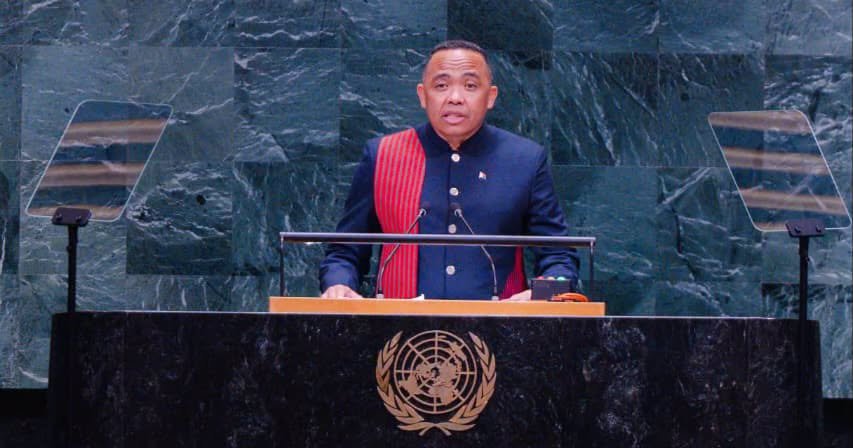
President Randrianirina: Malagasy UN Speech Legality Confirmed by Article 53
Summary
- President Michael Randrianirina delivered his first UN General Assembly speech in Malagasy, sparking discussion.
- The UNGA's rules of procedure, specifically Articles 51 and 52, designate six official languages: English, Arabic, Chinese, Spanish, French, and Russian.
- However, Article 53 permits representatives to speak in any language, provided interpretation into an official UN language is arranged.
- Therefore, the use of Malagasy by President Randrianirina was fully compliant with UN regulations.
- This practice is not uncommon, with other leaders using non-official languages like Turkish or Korean in recent sessions.
What Happened
The clarity surrounding the President Michael Randrianirina Malagasy UN speech legality offers important insights for international legal practitioners and diplomats.
President Michael Randrianirina delivered his inaugural address before the United Nations General Assembly (UNGA) using the Malagasy language. This decision to speak in Madagascar's national tongue at such a prominent international forum garnered considerable attention and discussion. The focus of the ensuing commentary centered on the linguistic choice rather than the substance of his remarks or his personal background.
The use of a language not typically heard in the main assembly hall prompted various reactions across different circles. However, from a procedural standpoint, the pertinent question revolved around whether this linguistic selection aligned with the established regulations governing speeches at the global body. This inquiry specifically addresses the President Michael Randrianirina Malagasy UN speech legality, setting aside any subjective opinions on the appropriateness or impact of the address itself.
UN Language Rules and Article 53
The operational framework for language use within the UN General Assembly is clearly delineated in its internal rules of procedure. Specifically, Articles 51 and 52 define the six official and working languages recognized by the assembly. These designated languages include English, Arabic, Chinese, Spanish, French, and Russian, forming the standard linguistic environment for most proceedings.
However, the UN rules of procedure official languages are not exclusively prescriptive. A critical provision, Article 53 of the same regulatory text, explicitly permits representatives to address the assembly in a language other than these six official tongues. This allowance comes with a specific condition: the representative must ensure that interpretation is provided into one of the General Assembly's official languages or into an official language of the relevant committee. Consequently, President Randrianirina's choice to speak in Malagasy, a Madagascar UN non-official language, was entirely consistent with these established guidelines, provided the necessary interpretation was arranged.
Precedent in International Forums
The instance of a representative speaking in a non-official language at the UNGA is not unique to Madagascar. In fact, the practice is well-established, with numerous precedents demonstrating the flexibility embedded within the UN's procedural rules. Data from the 2024 and 2025 sessions, for example, reveals that several other national leaders opted to deliver their speeches in their respective native languages.
These languages included Turkish, Portuguese, Mongolian, Bengali, Macedonian, Italian, Farsi, Tajik, and Korean. Such instances underscore that the UN General Assembly Article 53 language provision is regularly utilized by member states. While the decision to use a non-official language might be subject to personal preferences or strategic considerations, whether these choices are favorably received or not remains a matter of individual taste, often influenced by ideological or practical viewpoints, rather than a breach of international diplomatic protocol language.
Why This Matters for International Law
The clarity surrounding the President Michael Randrianirina Malagasy UN speech legality offers important insights for international legal practitioners and diplomats. It confirms that the UN General Assembly's rules are designed to accommodate linguistic diversity while maintaining operational efficiency through mandatory interpretation. This procedural allowance is a significant aspect of international diplomatic protocol language, ensuring that member states can express themselves authentically without violating established norms.
For lawyers advising clients involved in international diplomatic engagements or participation in multilateral forums, understanding this specific procedural allowance is crucial. It highlights that while there are designated official languages, the UN's framework explicitly provides for the use of other languages under specific conditions, primarily the provision of interpretation. This flexibility under Article 53 underscores a pragmatic approach to global communication within the United Nations, balancing tradition with the realities of a diverse membership.
Practical Implications
This article clarifies that speaking in a non-official language at the UN General Assembly, as done by Colonel Randrianirina, is permissible under Article 53 of the UNGA's rules, provided interpretation is arranged. Lawyers advising clients on international diplomatic engagements or participation in multilateral forums should note this procedural allowance regarding language use.
Source
How does this affect you?
Get an AI analysis of this article grounded in your jurisdictions, practice areas, and any policy documents you've uploaded to Wansom.
Finish Reading the Full Story and the Expert Analysis.
Get the latest legal & regulatory intelligence in Madagascar
Wansom is AI and can make mistakes.