
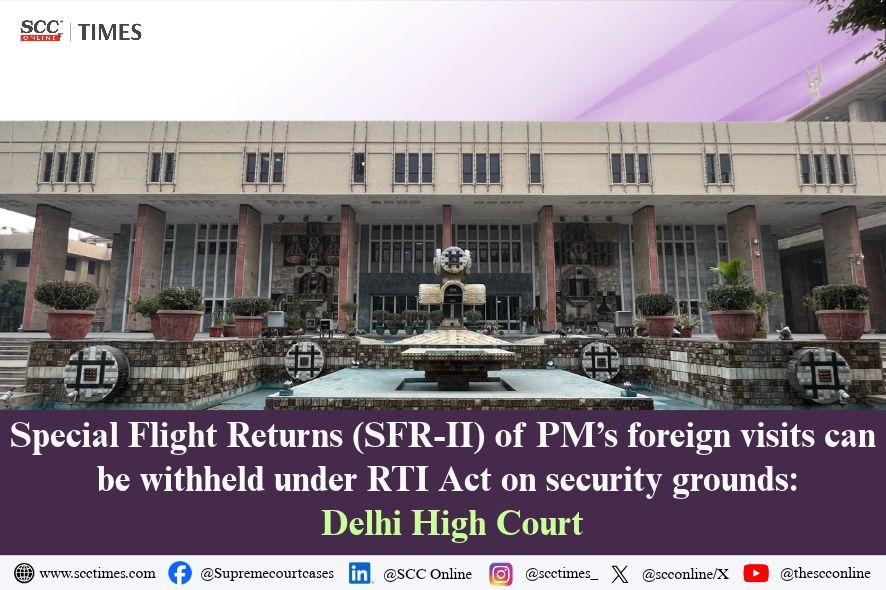
Delhi High Court: PM Special Flight Returns RTI Disclosure Withheld
Summary
- The Delhi High Court ruled that Special Flight Returns (SFRs) for the Prime Minister’s foreign travel can be withheld under the RTI Act.
- The court cited national security and the Prime Minister’s physical safety as grounds for exemption under Sections 8(1)(a) and 8(1)(g) of the RTI Act, 2005.
- This decision overturned a Central Information Commission order that had directed the disclosure of these records.
- The court determined that merely redacting security personnel names would not sufficiently mitigate potential security risks.
- It was emphasized that the expenditure of public funds does not automatically justify disclosure if it compromises security arrangements.
Court Overturns Disclosure Order for PM's Flight Records
The mere fact that public funds are used for the Prime Minister's foreign visits does not, by itself, justify the disclosure of information that could compromise the security arrangements for such trips.
The Delhi High Court recently intervened in a Right to Information (RTI) matter, setting aside an order from the Central Information Commission (CIC) that had mandated the disclosure of Special Flight Returns (SFRs) related to the Prime Minister's foreign air travel. The court's decision, delivered by a Single Judge Bench, concluded that such records could be withheld under specific exemptions within the RTI Act, 2005, primarily due to concerns over national security and the physical safety of the Prime Minister.
The case originated from an RTI request seeking information on foreign visits undertaken by Indian Prime Ministers, specifically Manmohan Singh and Narendra Modi, utilizing Indian Air Force aircraft from April 1, 2013, onwards. The applicant had requested copies of both Part I and Part II of the SFRs for these trips. While some general travel information was provided by the Indian Air Force, the SFRs themselves were withheld, citing their sensitive nature and applicable exemptions under the RTI Act.
Following the initial denial, the first appellate authority upheld the Air Force's decision. However, the Central Information Commission, in an order dated July 8, 2020, subsequently directed the Indian Air Force to furnish certified copies of the available and relevant SFR-II records. This directive prompted the Central Public Information Officer to challenge the CIC's order before the Delhi High Court, leading to the recent ruling that reversed the disclosure requirement.
Legal Framework and Exemptions Cited
The Delhi High Court's judgment hinged on the interpretation and application of Sections 8(1)(a) and 8(1)(g) of the Right to Information Act, 2005. Section 8(1)(a) exempts information whose disclosure would prejudicially affect India's sovereignty and integrity, security, strategic, scientific or economic interests, relations with foreign states, or lead to the incitement of an offense. Concurrently, Section 8(1)(g) provides an exemption for information that, if disclosed, would endanger the life or physical safety of any person.
The court acknowledged that while the RTI Act aims to foster transparency and accountability within public authorities, the right to information is not absolute. It must be carefully balanced against other significant public interests, particularly the confidentiality of sensitive information and national security. In support of this balanced approach, the court referenced the Supreme Court's ruling in *CBSE v. Aditya Bandopadhyay*, (2011) 8 SCC 497, which underscored the necessity of reconciling transparency with the protection of competing public interests.
Crucially, the court accepted the Indian Air Force's argument that SFR-II records contain interconnected particulars, including passenger names, designations, appointments, identification numbers, flight references, passenger strength, and agency details. The Air Force contended that even if direct identifiers were redacted, the disclosure of these particulars could still enable the reconstruction of sensitive security arrangements by correlating the information with data already available in the public domain. This potential for reconstruction was a key factor in the court's decision to uphold the non-disclosure.
Implications for National Security and Transparency
A significant aspect of the Delhi High Court's ruling is its finding that merely redacting the names of security personnel from the Special Flight Returns would not be sufficient to eliminate the potential risks to the Prime Minister's security. This underscores a broader principle that for highly sensitive information, partial redaction may not adequately address security concerns, especially when the remaining data could be pieced together from other sources.
The court also made a pertinent observation regarding public expenditure, stating that the mere fact that public funds are used for the Prime Minister's foreign visits does not, by itself, justify the disclosure of information that could compromise the security arrangements for such trips. This clarifies the boundary between public accountability for spending and the imperative to protect high-level security protocols.
This judgment reinforces the grounds for public authorities to withhold information related to the security arrangements of high-ranking officials under the national security and personal safety exemptions of the RTI Act. It provides a precedent that prioritizes the integrity of security protocols and the safety of the Prime Minister over the general principle of public disclosure in specific, sensitive contexts.
Practical Implications
Lawyers advising public authorities on RTI requests should note this precedent, which strengthens the grounds for withholding information related to sensitive security arrangements for high-ranking officials under Sections 8(1)(a) and (g) of the RTI Act, even when public funds are involved. This clarifies the balance between transparency and national security/personal safety in information disclosure.
Source
Source: Original reporting via Live Law
How does this affect you?
Get an AI analysis of this article grounded in your jurisdictions, practice areas, and any policy documents you've uploaded to Wansom.
Finish Reading the Full Story and the Expert Analysis.
Get the latest legal & regulatory intelligence in India
Wansom is AI and can make mistakes.