
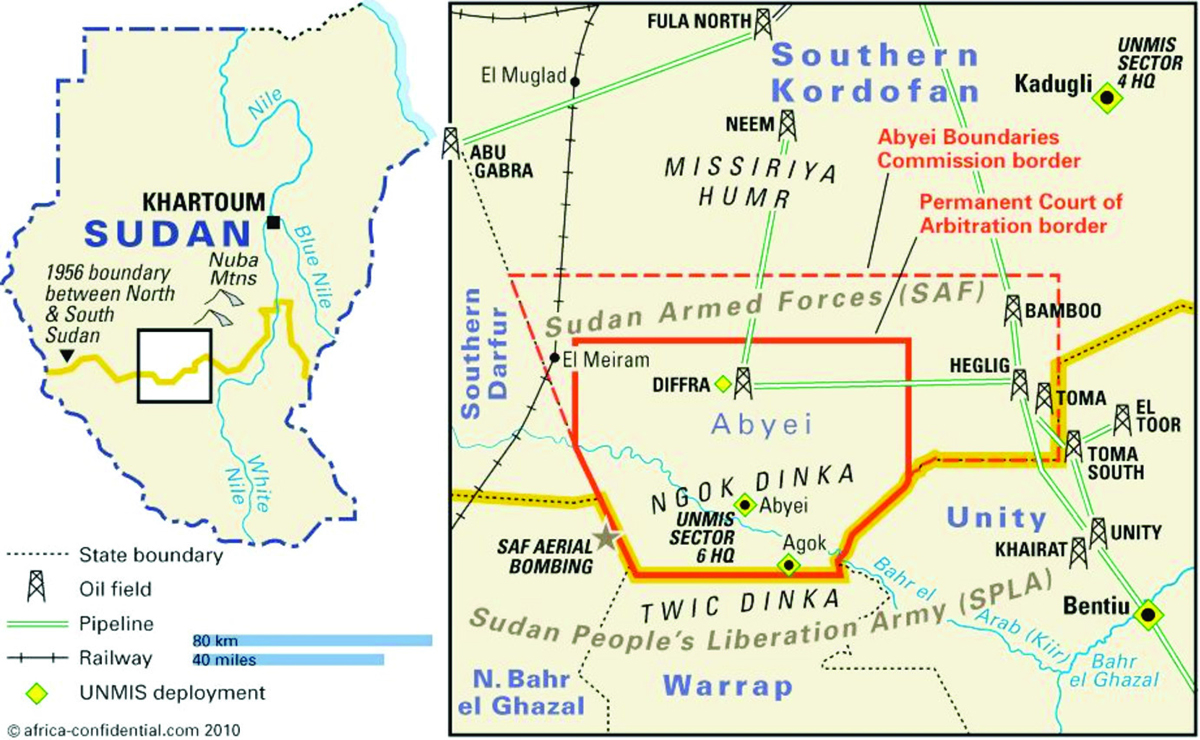
Permanent Court of Arbitration: Kordofan-Bahr el Ghazal Borderline Dispute Reviewed
The Comprehensive Peace Agreement of 2005 between the Government of Sudan (GoS) and the Sudan People’s Liberation Movement (SPLM) includes a separate protocol on the resolution of the Abyei conflict. These highlights will therefore provide details on the geographical contentions along the four compass borderlines between Kordofan and Bhar el Ghazal region. Each of these institutions mentioned above have their positions on the borderline between Kordofan and Bhar el Ghazal, which was contested by both parties, the GoS and the SPLM, and the matter was referred for arbitration proceedings and finally determined and awarded by the Permanent Court of Arbitration on 22 July 2009. At the outset, Article 5.1 of the Abyei Protocol established the Abyei Boundaries Commission (ABC) with a mandate to define and demarcate the area of the nine Ngok Dinka Chiefdoms transferred to Kordofan in 1905, known as the Abyei Area, and to subsequently submit the final report to the Presidency within two years of the interim period to allow the Presidency to put the special administrative status of Abyei Area into immediate effect. After the completion of the work by the ABC, the report was submitted to the Presidency on 14 July 2005, five days after the deadline set by the Abyei Protocol. Geographical points of contention After submission of the ABC report, it was contested by both parties: The GoS and the SPLM on the demarcation and delimitation of the Abyei Area. There were two different interpretations of the report: The GoS said what has been submitted by the ABC must be considered as opinions and recommendations, which would be studied because the ABC exceed their mandate by focusing much more on consultations with dominant members of the Ngok Dinka in the Abyei Area instead of other communities in the surrounding areas, amongst other violations of the ABC mandate. On the other hand, the members of the Ngok Dinka in the SPLM Delegation said what has been submitted is a final and binding decision, which must be implemented. This is how the disagreement between the parties over the ABC report came about. The parties therefore, as explained herein, agreed to refer the matter for arbitration. In the comparative submission of the parties’ position on thematic issue number three on “the relevance of the Kordofan/Bahr el Ghazal boundary to the delimitation of the area transferred in 1905, the Permanent Court of Arbitration (PCA) posed a question in paragraph 269 (3) (a) of the Arbitral award: “whether did Bahr el Arab (Kiir River) constituted a precise and proclaimed provincial boundary between Kordofan and Bahr el Ghazal and the northern limit of the area transferred in 1905? In answering this question, the GoS answered the question during the oral pleadings by acknowledging the existence of Bahr Al Arab (Kiir River) as a borderline between Kordofan and Bahr El Ghazal. In their exact submission as reflected in paragraph 270 of the PCA arbitral award, “the GoS argues that the Condominium administration was present in the Abyei region and explored the area before and in 1905. Despite limited and short-lived uncertainty surrounding the location of the Bahr el Arab, it is clear that there was a precise boundary between Kordofan and Bahr el Ghazal on that river before the transfer and that the highest-ranking official, who knew where the Bahr el Arab was, considered it to be both the provincial boundary and the northern limit of the transferred area in 1905”. In addition, the GoS submits that several pre-1905 documents describe the Bahr el Arab (Kiir River) as the provincial boundary between Bahr el Ghazal and Kordofan, including: Frank Lupton’s 1884 writings; and 1884 report by the Intelligence Branch of the War Office; the 1898 first edition of the 1898 Gleichen Handbook; Mardon’s 1903 revised map (first issued in 1901); the 1902 to 1904 Bahr el Ghazal Annual Reports; the 1904 Kordofan Annual Report (which states that “the Darfur Frontier […] runs southwa
How does this affect you?
Get an AI analysis of this article grounded in your jurisdictions, practice areas, and any policy documents you've uploaded to Wansom.
Finish Reading the Full Story and the Expert Analysis.
Wansom is AI and can make mistakes.