
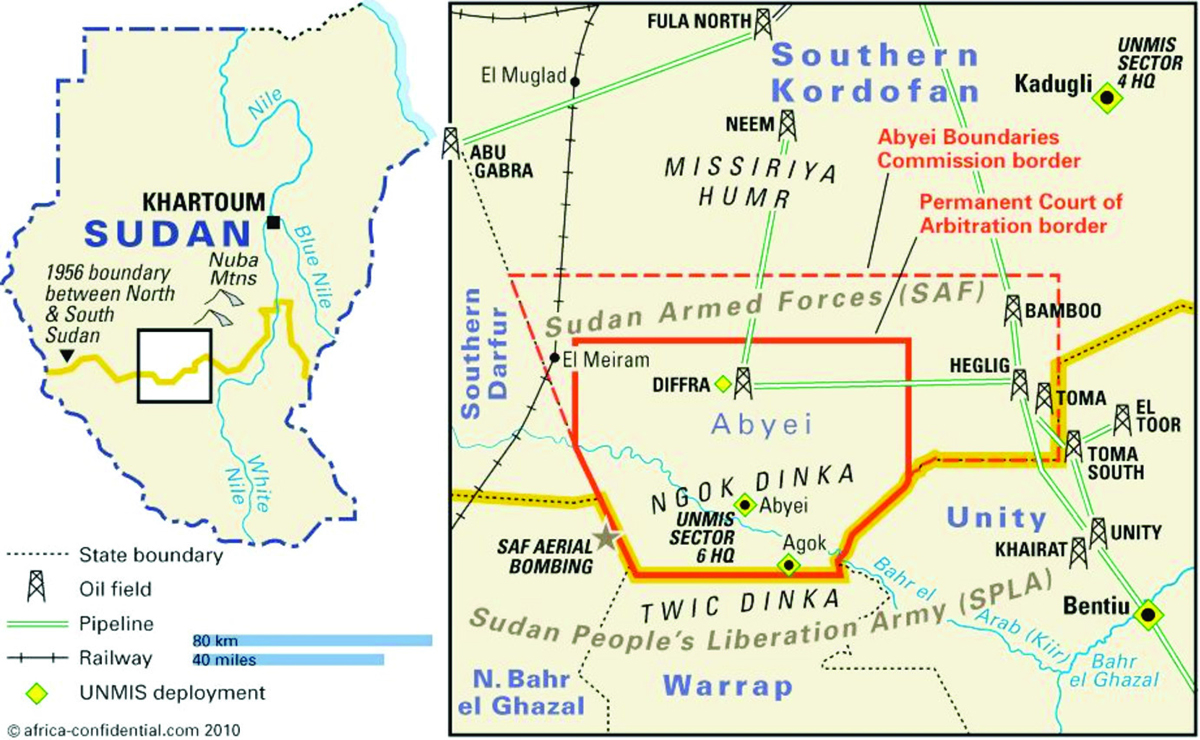
PCA: Kordofan Bahr el Ghazal Border Determination Finalized in Abyei Dispute
Summary
- The 2005 Comprehensive Peace Agreement established the Abyei Boundaries Commission (ABC) to define the Abyei Area, encompassing the nine Ngok Dinka Chiefdoms transferred in 1905.
- Disputes between the Government of Sudan and the SPLM over the ABC's report led to the matter being referred for arbitration.
- The Permanent Court of Arbitration (PCA) issued its award on July 22, 2009, addressing the contested Kordofan-Bahr el Ghazal border.
- The PCA specifically questioned whether the Bahr el Arab (Kiir River) served as a precise provincial boundary and the northern limit of the 1905 transferred area.
- During the arbitration, the Government of Sudan formally acknowledged the Bahr el Arab (Kiir River) as the existing borderline between Kordofan and Bahr el Ghazal.
Genesis of a Border Dispute
Crucially, the Government of Sudan, during its oral pleadings, formally acknowledged the Bahr el Arab (also known as the Kiir River) as the established borderline between Kordofan and Bahr el Ghazal.
The 2005 Comprehensive Peace Agreement (CPA), signed between the Government of Sudan (GoS) and the Sudan People’s Liberation Movement (SPLM), included a dedicated Abyei Protocol aimed at resolving the long-standing conflict over the Abyei region. This protocol mandated the establishment of the Abyei Boundaries Commission (ABC) with a clear objective: to define and demarcate the area encompassing the nine Ngok Dinka Chiefdoms, which had been transferred to Kordofan in 1905 and became known as the Abyei Area. The ABC was tasked with submitting its final report to the Presidency within two years of the interim period, enabling the immediate implementation of a special administrative status for Abyei.
The ABC completed its work and submitted its report to the Presidency on July 14, 2005, five days beyond the deadline stipulated by the Abyei Protocol. However, the report’s findings quickly became a point of contention between the GoS and the SPLM. The GoS argued that the ABC had exceeded its mandate by focusing predominantly on consultations with Ngok Dinka members while neglecting other communities in surrounding areas, thus rendering its submission merely advisory opinions and recommendations for further study. Conversely, the Ngok Dinka members within the SPLM delegation insisted that the report constituted a final and binding decision requiring immediate implementation. This fundamental disagreement over the ABC's findings ultimately necessitated external arbitration to resolve the Kordofan Bahr el Ghazal border dispute.
The Permanent Court of Arbitration's Intervention
Faced with an impasse, both parties agreed to refer the matter for arbitration, leading to the involvement of the Permanent Court of Arbitration (PCA). The PCA was tasked with providing a definitive determination on the geographical contentions along the Kordofan-Bahr el Ghazal border, particularly concerning the area transferred in 1905. On July 22, 2009, the Permanent Court of Arbitration Abyei delivered its arbitral award, addressing the complex boundary issues.
A central question posed by the PCA in paragraph 269 (3) (a) of its award was whether the Bahr el Arab (also known as the Kiir River) constituted a precise and officially proclaimed provincial boundary between Kordofan and Bahr el Ghazal, and simultaneously, the northern limit of the area transferred in 1905. This inquiry was critical to establishing the historical and legal basis for the contested border.
Government of Sudan's Stance on the Boundary
During the oral pleadings before the PCA, the Government of Sudan made a significant acknowledgment, confirming the existence of the Bahr el Arab (Kiir River) as a recognized borderline separating Kordofan and Bahr el Ghazal. As detailed in paragraph 270 of the PCA arbitral award, the GoS contended that the Condominium administration had thoroughly explored the Abyei region both before and during 1905. Despite some initial, brief uncertainty regarding its exact location, the GoS asserted that a precise boundary along the Bahr el Arab existed prior to the 1905 transfer. Furthermore, they argued that the highest-ranking official at the time, who was knowledgeable about the Bahr el Arab's position, considered it to be both the provincial boundary and the northern limit of the transferred area in 1905.
To bolster its position on the Bahr el Arab Kiir River boundary, the GoS presented several pre-1905 documents. These included Frank Lupton's writings from 1884, an 1884 report from the Intelligence Branch of the War Office, the first edition of the 1898 Gleichen Handbook, Mardon's 1903 revised map (originally issued in 1901), the Bahr el Ghazal Annual Reports spanning 1902 to 1904, and the 1904 Kordofan Annual Report, which notably mentioned the Darfur Frontier extending southward. These historical records were presented as evidence supporting the long-standing recognition of the Bahr el Arab as the provincial demarcation.
Why It Matters
While the PCA Kordofan Bahr el Ghazal border determination provided a critical legal precedent regarding the historical context of the Ngok Dinka Chiefdoms 1905 transfer and the definitive role of the Bahr el Arab (Kiir River) as a boundary, its practical implications for land and resource administration have been limited. Despite the ruling, the Abyei area remains a highly disputed territory with unresolved administrative boundaries, ongoing inter-communal violence, and a humanitarian crisis, as the final status referendum has not taken place.
Understanding the PCA's 2009 award and the historical evidence presented, especially the GoS's acknowledgment of the Bahr el Arab as a precise provincial boundary, is essential for any legal or compliance professional dealing with land or administrative matters in the Kordofan-Bahr el Ghazal region. The award serves as a foundational document for interpreting historical demarcations and advising on legal claims or potential disputes arising from these complex border issues.
Practical Implications
Lawyers and compliance officers involved in land, resource, or administrative matters within the Kordofan-Bahr el Ghazal region should be aware of the Permanent Court of Arbitration's 2009 award and the historical context of the Bahr el Arab (Kiir River) as a defined boundary. This precedent is crucial for advising clients on legal claims, property rights, or potential disputes arising from historical border demarcations.
Source
How does this affect you?
Get an AI analysis of this article grounded in your jurisdictions, practice areas, and any policy documents you've uploaded to Wansom.
Finish Reading the Full Story and the Expert Analysis.
Wansom is AI and can make mistakes.