
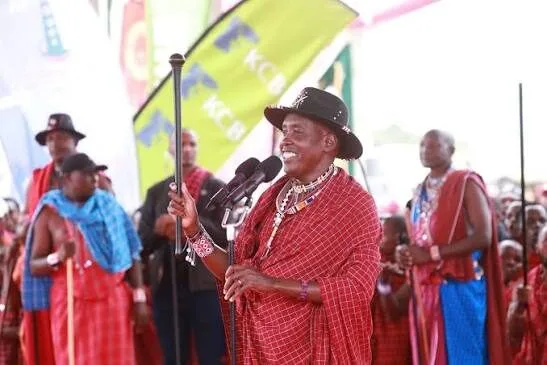
NCIC: Lenku Issued Remedial Action for Divisive Maasai Remarks
Summary
- The National Cohesion and Integration Commission (NCIC) has found Kajiado Governor Joseph Ole Lenku at fault for divisive remarks made in August 2026.
- Governor Lenku described political parties not favoring Maasai leadership as "enemies" and warned those with alternative political paths of "difficulty."
- The NCIC determined these statements promoted political exclusion, intimidated participants, and risked undermining peaceful coexistence in Kajiado County.
- Lenku's defense, citing advocacy for historical injustices and Maasai representation, was rejected by the NCIC.
- The NCIC has issued a Notice of Remedial Conciliation, requiring Governor Lenku to respond within seven days.
The Commission's Determination
This NCIC determination against a sitting governor highlights the commission's active enforcement of constitutional standards for political discourse, even for statements framed as community advocacy.
The National Cohesion and Integration Commission (NCIC) has issued a significant ruling against Kajiado Governor Joseph Ole Lenku, citing remarks he made that were deemed to promote political exclusion and threaten societal harmony. In its Determination No. 5 of 2026, the commission concluded that Governor Lenku's statements, delivered during a political gathering in Kajiado County on August 22, 2026, risked undermining peaceful coexistence within the diverse region. The inquiry by the NCIC was prompted by a video recording of the event.
Central to the commission's concerns were specific phrases used by Governor Lenku. He referred to political parties that did not allocate senior leadership roles to the Maasai community as "adui wetu," meaning "our enemies." Furthermore, he warned individuals who opted for alternative political paths that they would "utajipata taabani," or "find yourself in difficulty." The NCIC interpreted this language as introducing an element of intimidation into political participation and threatening adverse consequences for those with differing political affiliations, thus contributing to Kenya political exclusion.
The commission emphasized that these divisive remarks extended beyond legitimate advocacy for Maasai political representation. Instead, they were seen as potentially alienating other communities residing in Kajiado, a county known for its multi-ethnic population. The NCIC asserted that such statements fell short of the constitutional standard for responsible leadership and posed a tangible risk to the stability of Kajiado County.
Governor's Defense and NCIC's Stance
Governor Lenku appeared before the National Cohesion and Integration Commission on September 17, 2026, accompanied by his legal counsel and county officials, where he confirmed the accuracy of the statements attributed to him. Through his lawyers, AMA Advocates LLP, the governor presented a defense, arguing that his comments were made in his capacity as an elected leader and a spokesperson for the Maa community. His legal team contended that the remarks aimed to address historical injustices, including land dispossession, marginalisation, and the need for greater political representation for the Kajiado Maasai.
The defense maintained that the phrases "adui," "hatuna uhusiano na wewe," and "taabani" were directed at political parties and choices, rather than ethnic groups. They asserted that these expressions pertained to political association and electoral competition, and did not constitute threats of violence, incitement, or ethnic hatred. However, the NCIC rejected the argument that the political context exempted the statements from its mandate, underscoring that all political discourse must adhere to constitutional principles of national cohesion and respect for citizens' rights.
The commission further highlighted that Governor Lenku's influential position as an elected leader amplified the potential impact of his statements. It noted that such remarks could mobilize supporters and exacerbate existing divisions, making the Lenku NCIC remedial action Maasai remarks particularly critical. While acknowledging the legitimacy of demands for community representation, equitable political participation, and redress for historical grievances, the NCIC cautioned that these concerns do not justify language that intimidates or labels those with alternative political choices as adversaries.
Constitutional Imperatives and Remedial Action
In its assessment, the National Cohesion and Integration Commission referenced several key constitutional provisions. These included Article 27, which guarantees equality and freedom from discrimination; Article 33(3), which outlines the responsible exercise of freedom of expression; and Article 38, which protects the right to political participation. The commission underscored that these articles collectively establish the framework for permissible political discourse, ensuring that advocacy does not infringe upon the rights and safety of others.
Following its comprehensive findings, the NCIC issued a Notice of Remedial Conciliation to Governor Lenku. This administrative determination proposes a series of corrective, preventive, and restorative measures designed to address the concerns raised by his remarks. The governor has been granted a period of seven days from the date of the determination to formally respond in writing, indicating his acceptance of the proposed terms or suggesting any desired variations. This step emphasizes the commission's role in actively enforcing constitutional standards for political discourse.
This NCIC determination against a sitting governor highlights the commission's active enforcement of constitutional standards for political discourse, even for statements framed as community advocacy.
Practical Implications
This NCIC determination against a sitting governor highlights the commission's active enforcement of constitutional standards for political discourse, even for statements framed as community advocacy. Lawyers advising public figures or political clients must counsel extreme caution regarding language that could be perceived as promoting political exclusion or intimidation, as the NCIC's mandate extends beyond explicit hate speech to any remarks risking national cohesion, potentially leading to remedial conciliation or other administrative actions.
Source
How does this affect you?
Get an AI analysis of this article grounded in your jurisdictions, practice areas, and any policy documents you've uploaded to Wansom.
Finish Reading the Full Story and the Expert Analysis.
Get the latest legal & regulatory intelligence in Kenya
Wansom is AI and can make mistakes.