
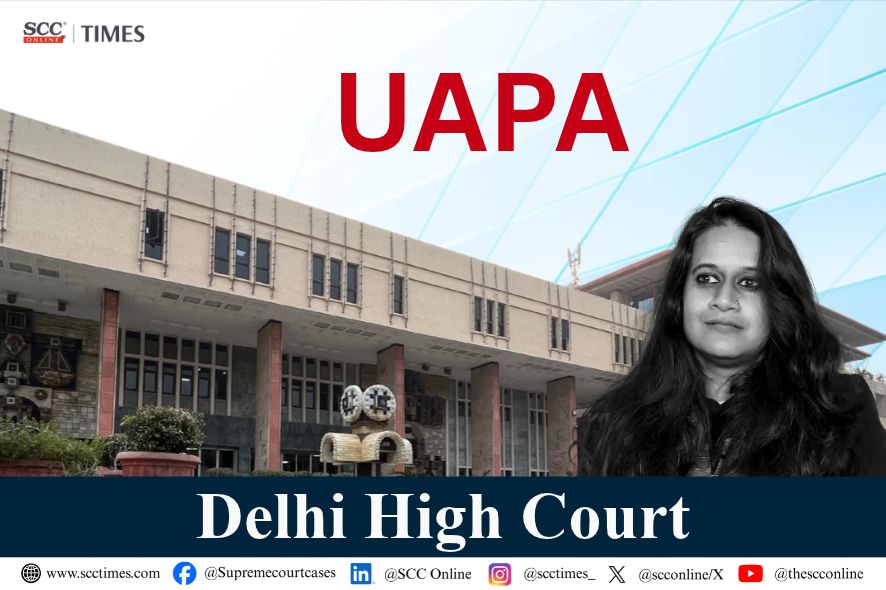
Natasha Narwal UAPA Travel Abroad: Delhi HC Allows UK Academic Trip
Summary
- The Delhi High Court allowed a petitioner accused under the UAPA to travel to the UK for academic purposes, overturning a lower court's denial.
- The petitioner, on bail since 2020 and 2021 without violations, needed to attend a conference and meet PhD supervisors at the University of Warwick.
- The court ruled that the seriousness of UAPA charges alone cannot justify a blanket prohibition on international travel.
- This decision reinforces the right to travel abroad as part of Article 21, as established in *Maneka Gandhi v. Union of India*.
- The State's concerns about extradition and virtual attendance were considered, but the court found the academic travel legitimate given the petitioner's compliance and specific needs.
What Happened
The High Court’s ruling underscored that the mere severity of charges, particularly those under the Unlawful Activities Prevention Act, cannot serve as an automatic justification to restrict an individual's right to travel internationally.
The Delhi High Court recently overturned orders from an Additional Sessions Judge, permitting a petitioner, who faces serious charges under the Unlawful Activities Prevention Act (UAPA), to travel to the United Kingdom for academic commitments. The petitioner had sought permission to travel from November 2, 2026, to December 1, 2026, a request previously denied by the lower court on October 6, 2026. This decision by a Single Judge Bench, presided over by Justice Amit Bansal, allows the individual to proceed with their international travel, albeit with specified safeguards.
The petitioner is an accused in two distinct cases, stemming from FIR No. 50/2020 and FIR No. 59/2020, the latter registered on March 6, 2020. These cases involve a range of serious allegations, including various sections of the Penal Code, 1860, the Arms Act, 1959, and the Prevention of Damage to Public Property Act, 1984. Specifically, FIR No. 59/2020 additionally invokes Sections 13, 16, 17, and 18 of the UAPA. Despite the gravity of these charges, the petitioner has been out on bail since 2020 and 2021, with no reported breaches of their bail conditions.
Legal Context
The High Court’s ruling underscored that the mere severity of charges, particularly those under the Unlawful Activities Prevention Act, cannot serve as an automatic justification to restrict an individual's right to travel internationally. This stance aligns with the fundamental right to life and personal liberty enshrined in Article 21 of the Indian Constitution, which the Supreme Court, in its landmark 1978 decision in *Maneka Gandhi v. Union of India*, affirmed includes the right to travel abroad. This right can only be curtailed through a procedure established by law, not by a blanket prohibition.
The court observed that the petitioner's trial is expected to be protracted, with charges yet to be formally framed in either case. The petitioner's passport remains deposited with the Trial Court, a condition imposed when bail was granted by a Division Bench of the High Court on June 15, 2021, for FIR No. 59/2020. Bail for FIR No. 50/2020 had been granted earlier by the Trial Court on September 17, 2020. The High Court emphasized that the circumstances of the case, including the petitioner's consistent adherence to bail terms, warranted a nuanced approach rather than an outright denial of travel.
Arguments and Rationale
The petitioner's legal representative argued that the proposed travel was strictly for academic purposes. The individual, who commenced a PhD at the School of Law, University of Warwick, UK, on October 2, 2023, was invited by their supervisors for in-person academic engagement and to present a paper titled "Gendered Carceral Labour as Social Reproduction" at an annual conference at the School of Oriental and African Studies (SOAS) in London, scheduled from November 5 to November 8, 2026. A letter from the supervisors dated September 21, 2026, supporting this invitation was presented to the court. Counsel further asserted the petitioner's strong ties to society, their commitment to return by December 2, 2026, and offered their brother, residing in Haryana, as a surety.
Conversely, the State, represented by the Additional Solicitor General, opposed the travel application. The State contended that the United Kingdom's stringent extradition laws could complicate the petitioner's return if they sought asylum there. It was also argued that the academic objectives could be fulfilled through virtual means, thereby negating the necessity for international travel. However, the High Court noted that the petitioner had already been pursuing their PhD virtually for three years at a renowned university without any prior requests for travel, implying the current request was for a specific, legitimate, and timely academic requirement. The court ultimately found the academic purpose to be genuine and compelling, outweighing the State's general objections given the petitioner's compliance history.
Practical Implications
Lawyers representing clients accused under the UAPA who are on bail and seek to travel abroad can leverage this Delhi High Court ruling. It clarifies that the seriousness of UAPA charges alone cannot justify a blanket prohibition on international travel, especially when the accused has complied with bail conditions and has a legitimate reason for travel, reinforcing the fundamental right to travel under Article 21.
Source
How does this affect you?
Get an AI analysis of this article grounded in your jurisdictions, practice areas, and any policy documents you've uploaded to Wansom.
Finish Reading the Full Story and the Expert Analysis.
Get the latest legal & regulatory intelligence in India
Wansom is AI and can make mistakes.