
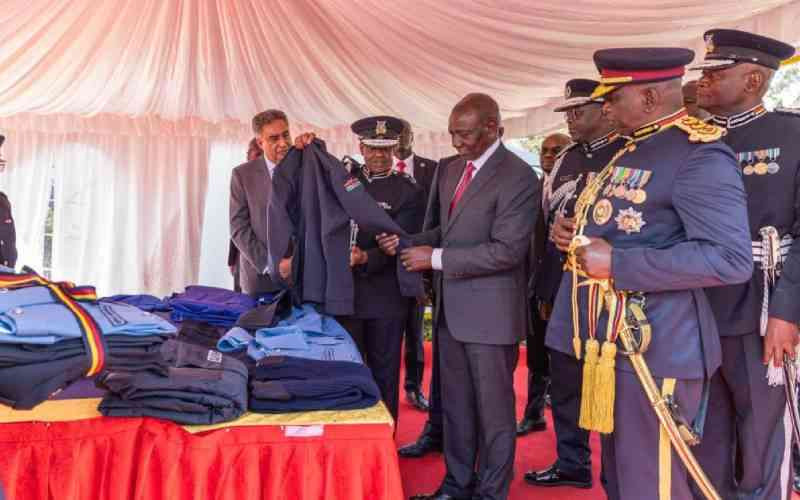
Kenya: Nalitex Limited Kenya Police Uniform Tender Alusala Link Raises Ownership Questions
Summary
- Nalitex Limited, a company involved in a Sh2.8 billion police uniform tender, has come under increased scrutiny.
- A phone number listed in Nalitex Limited's corporate records is reportedly linked to businessman Charles Tela Alusala.
- Mr. Alusala is known for his association with President William Ruto.
- These connections have deepened existing questions about Nalitex Limited's ownership and control.
- The revelations highlight ongoing concerns about transparency and potential conflicts of interest in Kenya's public procurement.
The Emerging Controversy
The unfolding situation surrounding Nalitex Limited and the police uniform tender carries significant implications for the landscape of Kenya's public procurement.
The Sh2.8 billion police uniform tender in Kenya has become the subject of intensified scrutiny following revelations connecting the supplying company, Nalitex Limited, to a prominent businessman. Corporate records for Nalitex Limited, identified as the firm involved in providing police uniforms, reportedly list a phone number that traces back to Charles Tela Alusala. This specific detail has introduced a new dimension to the ongoing inquiries surrounding the company's true ownership and operational control.
Mr. Alusala is known for his association with President William Ruto, a connection that has further fueled public and media interest in the procurement process. The discovery of this link has not only raised eyebrows but has also significantly deepened existing questions regarding the transparency and integrity of the high-value government contract. The focus now extends beyond the tender itself to the underlying structures of the companies involved in Kenya's public procurement landscape.
Scrutiny on Corporate Transparency
This development underscores a broader concern regarding corporate ownership transparency within Kenya's public sector contracts. The fresh links between Nalitex Limited and an individual associated with the head of state bring the issue of beneficial ownership into sharp relief, particularly in the context of the Sh2.8 billion police uniform tender controversy. Such connections invariably prompt questions about potential conflicts of interest and the fairness of the bidding process for significant government supplies.
The nature of these revelations suggests a growing demand for greater clarity on who ultimately benefits from and controls companies awarded lucrative state contracts. In an environment where public procurement transparency is a frequent topic of debate, the association of Charles Tela Alusala with Nalitex Limited, and his reported ties to President William Ruto, adds considerable weight to calls for robust oversight. This situation highlights the critical importance of understanding the full beneficial ownership of entities participating in tenders, especially those involving essential services like police supplies.
Implications for Public Procurement
The unfolding situation surrounding Nalitex Limited and the police uniform tender carries significant implications for the landscape of Kenya's public procurement. It signals an era of increased scrutiny on the intricate web of corporate ownership and potential conflicts of interest, particularly when high-value government tenders are at stake. The public and regulatory bodies are increasingly focused on ensuring that procurement processes are not only fair but also perceived as free from undue influence.
For legal professionals advising companies that seek to engage in state contracts, this development serves as a crucial reminder. It reinforces the necessity for rigorous due diligence processes to thoroughly identify and mitigate any risks associated with beneficial ownership and political connections. The controversy surrounding Nalitex Limited's ownership, and its link to Charles Tela Alusala, underscores the evolving expectations for transparency and accountability in Kenya's government contracting, emphasizing that even seemingly minor details in corporate records can trigger substantial public and legal inquiry.
Practical Implications
This development signals increased scrutiny on corporate ownership transparency and potential conflicts of interest in Kenya's public procurement, particularly for high-value government tenders. Lawyers advising companies bidding for state contracts should reinforce due diligence processes to identify and mitigate risks associated with beneficial ownership and political connections.
Source
How does this affect you?
Get an AI analysis of this article grounded in your jurisdictions, practice areas, and any policy documents you've uploaded to Wansom.
Finish Reading the Full Story and the Expert Analysis.
Wansom is AI and can make mistakes.