
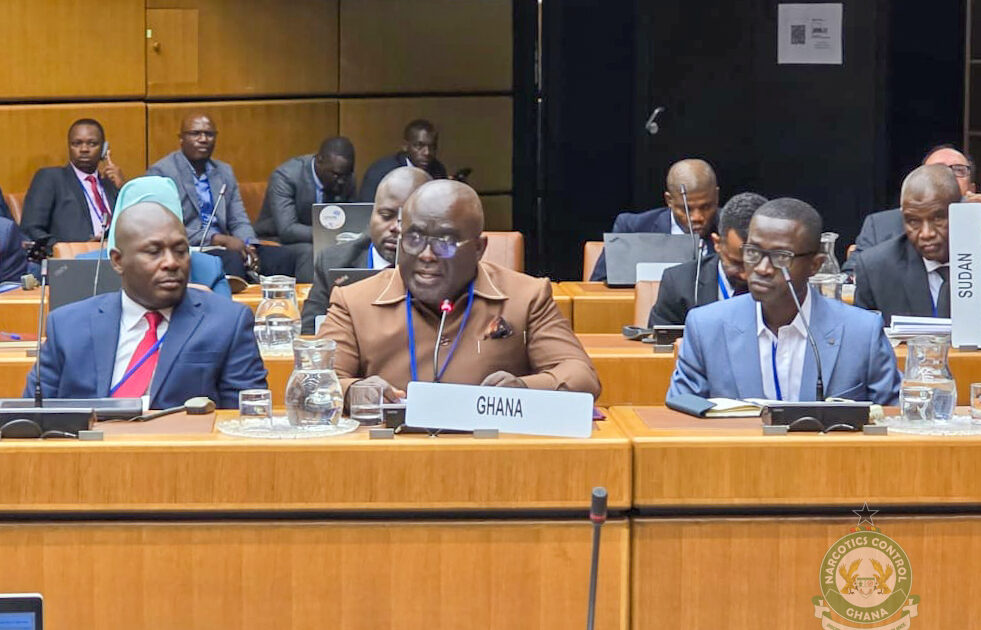
NACOC Ghana: Mantey's Cross-Border Drug Enforcement Call for Africa
Summary
- Major-General Maxwell Obuba Mantey, Director-General of NACOC, called for stronger cross-border cooperation among African nations to combat drug trafficking.
- This call was made during Ghana's statement at the 33rd Meeting of Heads of National Drug Law Enforcement Agencies, Africa (HONLEA Africa), held in Vienna, Austria, from September 8-11, 2026.
- Mantey stressed that no country can effectively combat transnational drug trafficking alone, highlighting the movement of synthetic drugs, cocaine, and illicit financial flows across borders.
- He advocated a "neighbour-to-neighbour" approach, proposing increased intelligence sharing, joint patrols, and coordinated border management.
- Ghana reaffirmed its commitment to strengthening bilateral and regional partnerships and supporting UNODC in reinforcing cooperation against the illicit drug trade.
Setting the Stage: A Call for Unified Action
He emphasized that collaboration is not merely a polite gesture to be acknowledged in closing remarks, but rather an essential operational requirement for the success of any national strategy.
The Director-General of the Narcotics Control Commission (NACOC), Major-General Maxwell Obuba Mantey, recently issued a significant call for enhanced and more practical cross-border cooperation among African nations. This urgent appeal, delivered during Ghana's statement at the close of the 33rd Meeting of Heads of National Drug Law Enforcement Agencies, Africa (HONLEA Africa), highlighted the critical need to combat the escalating threats posed by synthetic drugs, cocaine trafficking, and transnational organized crime across the continent. The high-level HONLEA Africa drug enforcement gathering, which convened in Vienna, Austria, from September 8 to 11, 2026, brought together leaders and representatives from various African drug law enforcement agencies with the shared objective of bolstering regional and subregional collaboration in addressing the global drug crisis.
Major-General Mantey underscored that the dynamic nature of the illicit drug trade necessitates a departure from isolated national responses. He emphasized that no single country, irrespective of the robustness of its law enforcement or border security systems, can effectively tackle transnational drug trafficking in isolation. The NACOC Ghana cross-border drug enforcement call stressed that criminal networks exploit jurisdictional gaps, facilitating the movement of synthetic drug precursors, cocaine, and associated illicit financial flows across multiple countries.
The Evolving Threat Landscape
The discussions at the HONLEA Africa meeting underscored the complex and evolving challenges confronting African nations. Major-General Mantey pointed out that the illicit drug trade is no longer confined to traditional routes or substances, with synthetic drugs posing a particularly growing impact on young people. This shift demands a more integrated and coordinated approach to enforcement.
Furthermore, the Director-General highlighted how organized crime and the substantial illicit financial flows generated by drug trafficking have the potential to severely undermine governance structures and state institutions. These financial aspects of drug crime are often as destabilizing as the physical movement of narcotics, requiring a comprehensive strategy that targets both the supply chain and the financial infrastructure supporting it. The interconnectedness of these threats means that a fragmented response is inherently insufficient.
Operationalizing Regional Cooperation
To counter these pervasive threats, Major-General Mantey advocated for a "neighbour-to-neighbour" approach, proposing it as a pragmatic foundation for deeper regional cooperation. This strategy involves concrete actions such as increased Ghana drug intelligence sharing, joint patrols, and coordinated border management initiatives among adjacent countries. Such direct collaboration is crucial for disrupting trafficking networks that operate seamlessly across national boundaries.
He cited existing successful models, including Ghana’s bilateral cooperation with its neighboring countries, as well as the collaborative efforts between The Gambia and Senegal, as prime examples of how direct state-to-state partnerships can pave the way for broader regional and continental endeavors. The Narcotics Control Commission Ghana, under his leadership, is actively promoting these practical steps. The relevance of these discussions was also linked to a high-level dialogue hosted in Accra in November 2025, titled "Mapping the Future of Drug Markets in West Africa – Synthetics, Cocaine, Criminal Money, and Strategic Responses," whose insights remain pertinent to current challenges.
Beyond Diplomacy: The Imperative for Practical Enforcement
Major-General Mantey's address made it clear that cooperation should transcend mere diplomatic formalities. He emphasized that collaboration is not merely a polite gesture to be acknowledged in closing remarks, but rather an essential operational requirement for the success of any national strategy. This powerful assertion encapsulates the urgent need for actionable collaboration rather than just rhetorical commitments.
He urged African countries to ensure their cooperative efforts are practical, timely, and operational, enabling intelligence gathered in one jurisdiction to directly support investigations and enforcement actions in another. This requires robust mechanisms for intelligence sharing, coordinated investigations, and joint border management to effectively identify and dismantle Africa cross-border drug trafficking networks. Ghana reaffirmed its unwavering commitment to strengthening bilateral and regional partnerships, pledging support to the United Nations Office on Drugs and Crime (UNODC) and other member states in reinforcing collective action against the illicit drug trade. Major-General Mantey concluded by cautioning that the threats discussed would not simply vanish with the meeting's end, emphasizing the imperative for participating nations to translate their commitments into tangible, concrete actions.
Practical Implications
Lawyers and compliance officers should anticipate increased scrutiny and coordinated enforcement actions across African borders concerning drug trafficking and associated illicit financial flows. This signals a need for enhanced due diligence, risk assessments, and robust compliance frameworks for clients involved in cross-border trade, logistics, or finance, as regional cooperation is expected to become more practical and operational.
Source
How does this affect you?
Get an AI analysis of this article grounded in your jurisdictions, practice areas, and any policy documents you've uploaded to Wansom.
Finish Reading the Full Story and the Expert Analysis.
Get the latest legal & regulatory intelligence in Ghana
Wansom is AI and can make mistakes.