
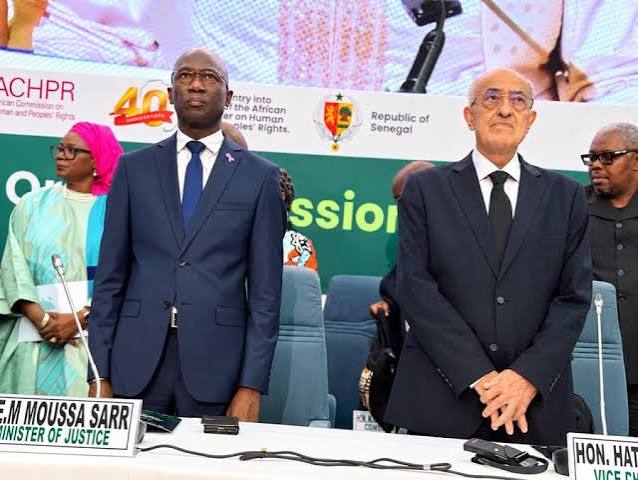
Sénégal: Moussa Sarr Pushes for Concrete Droits Humains Action
Summary
- Senegal's Minister of Justice, Moussa Sarr, urged African states to translate human rights decisions into concrete actions at the 89th ordinary meeting of the African human rights body.
- Minister Sarr, speaking for President Bassirou Diomaye Diakhar Faye, emphasized the need for more effective African human rights protection systems.
- He highlighted Senegal's historical role in conceiving the African Charter on Human and Peoples' Rights, adopted in 1981 and enforced since 1986.
- The Minister acknowledged key figures like Kéba Mbaye, Youssoupha Ndiaye, and El Hadji Guissé for their contributions to the African human rights framework.
- Moussa Sarr identified insecurity in the Sahel, conflicts in the Middle East and Ukraine, climate change, and multilateralism tensions as major obstacles to human rights application.
Call for Concrete Action on Human Rights
This call underscores a critical need for effective implementation of human rights frameworks across the continent, emphasizing the importance of moving beyond declarations to practical measures.
During the 89th ordinary meeting of the African body responsible for human rights, held on Monday, October 12, Senegal's Minister of Justice and Keeper of the Seals, Maître Moussa Sarr, issued a strong appeal to member states. Speaking on behalf of President Bassirou Diomaye Diakhar Faye, Minister Moussa Sarr urged nations to translate their policy decisions into tangible actions that directly benefit their populations. This call underscores a critical need for effective implementation of human rights frameworks across the continent, emphasizing the importance of moving beyond declarations to practical measures.
Senegal, through its Minister of Justice Moussa Sarr, also championed the enhancement of the efficacy of existing African systems designed for human rights protection. This advocacy highlights a commitment to strengthening the mechanisms that safeguard fundamental freedoms and ensure accountability. The focus on concrete action and improved system effectiveness is central to Senegal's current stance on human rights, aiming to foster a more robust and responsive environment for citizens.
Senegal's Enduring Contribution to African Human Rights Law
Minister Moussa Sarr's address also served as a reminder of Senegal's foundational role in the development of the African Charter on Human and Peoples' Rights. He specifically referenced the nation's historical contribution to the very conception of this pivotal document. The African Charter, a cornerstone of application droits humains Afrique, was formally adopted in Nairobi on June 27, 1981, and subsequently entered into force on October 21, 1986.
The upcoming years mark significant anniversaries for the Charte africaine des droits de l'homme, with 2026 commemorating 45 years since its adoption and the 40th anniversary of its implementation approaching. Senegal's deep involvement dates back to the preliminary draft stage, where African experts, under the guidance of magistrate Kéba Mbaye, prepared the initial text in Dakar between November 28 and December 8, 1979. Furthermore, Minister Sarr acknowledged the vital contributions of magistrates Youssoupha Ndiaye and El Hadji Guissé to the ongoing construction and evolution of the African human rights system, reinforcing the nation's long-standing commitment to the application droits humains Afrique and the efficacy systèmes africains droits humains.
Addressing Global Challenges to Human Rights Application
Beyond advocating for greater efficacy in African human rights systems, Minister Moussa Sarr also candidly identified several significant obstacles impeding the full application of human rights today. These challenges include the pervasive insecurity in the Sahel region, ongoing conflicts in the Middle East and Ukraine, and the far-reaching effects of climate change. Each of these factors presents unique difficulties for ensuring the protection and promotion of human rights across various populations.
Additionally, Minister Sarr pointed to the tensions currently impacting multilateralism as another barrier to effective human rights implementation. These global and regional issues underscore the complex environment in which the application droits humains Afrique must operate, necessitating concerted efforts and concrete action from states to overcome these impediments and fulfill their obligations to their citizens.
Practical Implications
Lawyers and compliance officers should monitor legislative and policy developments in Senegal and other African states following Minister Sarr's call for concrete action on human rights, as this may lead to new national strategies, stricter enforcement, or increased scrutiny of corporate and governmental human rights compliance.
Source
How does this affect you?
Get an AI analysis of this article grounded in your jurisdictions, practice areas, and any policy documents you've uploaded to Wansom.
Finish Reading the Full Story and the Expert Analysis.
Get the latest legal & regulatory intelligence in Senegal
Wansom is AI and can make mistakes.