
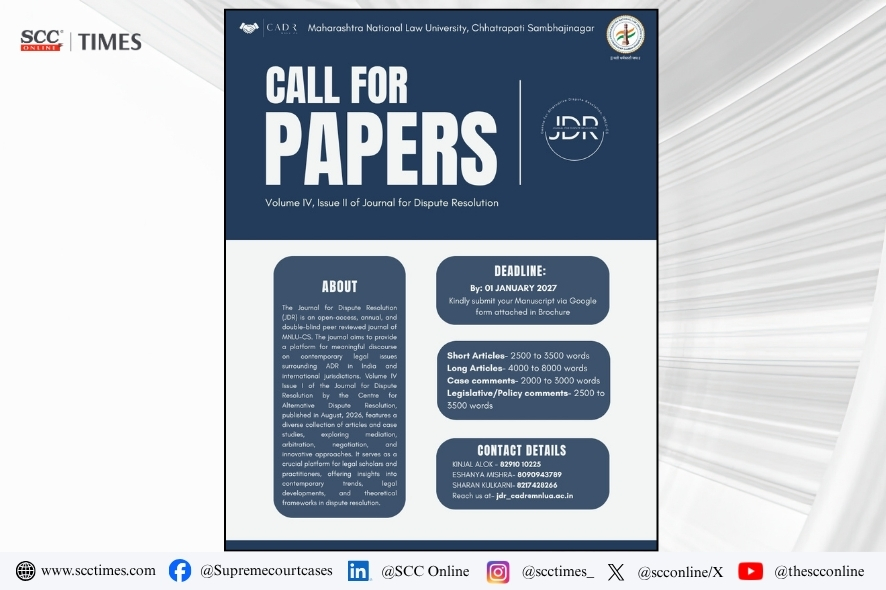
MNLU-CS Journal Issues Call for Papers on Pluralism in Dispute Resolution
The Maharashtra National Law University, Mumbai – Centre for Studies in Arbitration and Conciliation (MNLU-CS) has issued a call for papers for Volume IV Issue II of its Journal for Dispute Resolution, focusing on the theme of “Pluralism in Dispute Resolution: Bridging Individual Rights, Community Interests, and Corporate Governance.” This initiative invites scholarly contributions to a critical area of legal study and practice.
This call for papers signifies the academic and practical importance of exploring the evolving landscape of dispute resolution mechanisms in India and globally. The chosen theme, "Pluralism in Dispute Resolution," highlights the increasing recognition that traditional adversarial litigation may not always be the most effective or appropriate method for resolving all types of disputes, especially those involving complex intersections of individual rights, community interests, and corporate governance. It encourages scholarly contributions that can inform policy, practice, and the development of more nuanced and context-sensitive dispute resolution approaches, moving beyond a singular focus on court-based litigation.
The legal context for dispute resolution in India is multifaceted, encompassing the Arbitration and Conciliation Act, 1996 (as amended), the Code of Civil Procedure, 1908 (which includes provisions for mediation and conciliation), and various sector-specific tribunals and ombudsman schemes. The concept of "pluralism" in this context refers to the co-existence and integration of various Alternative Dispute Resolution (ADR) methods – such as arbitration, mediation, conciliation, negotiation, and even traditional community-based mechanisms – alongside formal court processes. The theme's focus on individual rights, community interests, and corporate governance points to areas where ADR can offer more flexible, efficient, and culturally appropriate solutions than conventional litigation, addressing the unique sensitivities of these domains.
The key parties involved in this initiative are the Maharashtra National Law University, Mumbai – Centre for Studies in Arbitration and Conciliation (MNLU-CS), which is the organizer and publisher of the journal, and legal scholars, practitioners, and researchers who are the potential contributors to the volume. The excerpt does not report any specific legal ruling or outcome, but rather an academic call for submissions.
For legal professionals, this call for papers underscores the growing emphasis on and sophistication of Alternative Dispute Resolution (ADR) in India. Attorneys should stay abreast of developments in ADR, not only as a subject of academic inquiry but also as a practical tool for their clients. Understanding the nuances of pluralistic approaches to dispute resolution, particularly in areas touching individual rights, community dynamics, and corporate governance, can provide a competitive edge in offering comprehensive legal solutions. Practitioners are encouraged to engage with scholarly discourse, perhaps even contributing to such journals, to deepen their understanding and application of diverse dispute resolution strategies, which are increasingly preferred for their efficiency and ability to preserve relationships and foster sustainable outcomes.
How does this affect you?
Get an AI analysis of this article grounded in your jurisdictions, practice areas, and any policy documents you've uploaded to Wansom.
Finish Reading the Full Story and the Expert Analysis.
Get the latest legal & regulatory intelligence in India
Wansom is AI and can make mistakes.