
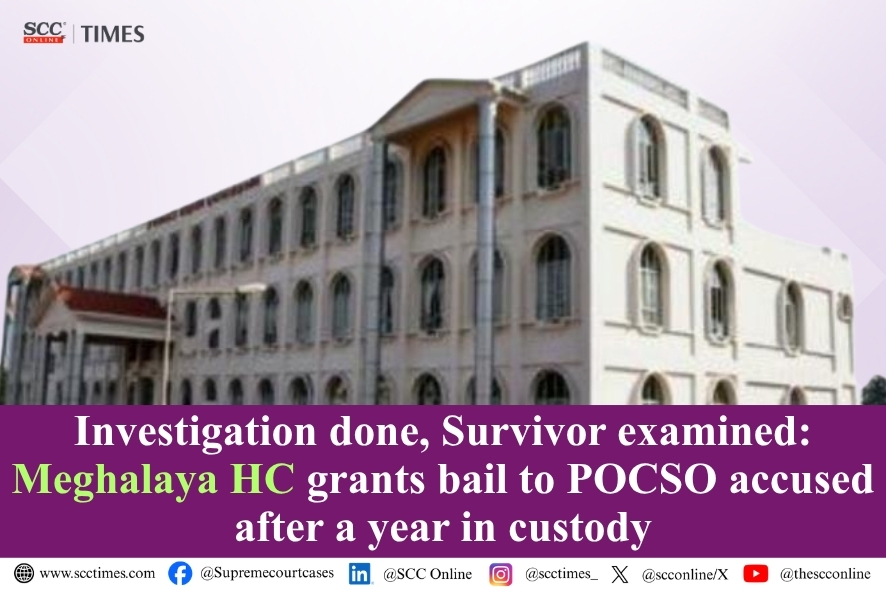
Meghalaya HC: POCSO Bail Granted After Prolonged Custody
Summary
- The Meghalaya High Court granted bail to an individual accused under the POCSO Act.
- The accused had spent one year in judicial custody prior to the bail grant.
- The court weighed the duration of custody against the seriousness of the allegations.
- Strict conditions were imposed, including a complete prohibition on contact with the survivor.
- This decision highlights the consideration of prolonged detention as a factor in bail applications for serious offenses.
Court Grants Bail After Year-Long Detention
This ruling by the Meghalaya High Court POCSO bail decision sets an important precedent, particularly for lawyers navigating POCSO accused one year custody bail scenarios.
The Meghalaya High Court recently issued a significant ruling, granting bail to an individual accused under the Protection of Children from Sexual Offences (POCSO) Act. This decision came after the accused had spent a full year in judicial custody, a duration that played a crucial role in the court's deliberation. The court carefully weighed the extensive period of incarceration against the serious nature of the allegations leveled against the individual.
In its order, the High Court stipulated a series of stringent conditions accompanying the bail grant. These conditions are designed to ensure the safety and well-being of the survivor and to prevent any potential interference with the ongoing legal process. Among the specific directives issued by the court was an absolute prohibition on the accused having any form of contact with the survivor of the alleged offense. This measure underscores the judiciary's commitment to protecting vulnerable individuals while also considering the rights of the accused.
Legal Framework for Prolonged Custody Bail
The granting of bail in cases involving serious offenses, particularly under the POCSO Act, often involves a delicate balancing act for Indian courts. While the gravity of the alleged crime is a primary consideration, the duration of pre-trial detention also holds significant weight. This particular ruling from the Meghalaya High Court exemplifies how prolonged custody can become a decisive factor in bail applications, even when dealing with serious allegations.
Under the broader legal principles governing bail in India, and specifically within the context of the POCSO Act, courts are empowered to consider various factors. Section 35 of the POCSO Act, for instance, outlines procedures for trials and emphasizes expeditious disposal, indirectly supporting the idea that indefinite detention without trial is undesirable. When an accused has been held for an extended period, such as the one year in this instance, and the investigation is complete, courts may lean towards granting bail, provided strict safeguards are put in place. This approach acknowledges the fundamental right to liberty while ensuring justice is served.
Stringent Conditions to Ensure Safety
A key aspect of the Meghalaya High Court's decision was the imposition of rigorous conditions, reflecting the sensitive nature of cases under the POCSO Act. The court mandated a complete prohibition on the accused from making any form of contact with the survivor. This no contact survivor bail condition is a standard yet critical safeguard employed by courts across India to protect victims from intimidation, harassment, or further trauma.
Such India bail conditions POCSO cases are not uncommon, as courts strive to mitigate risks associated with releasing individuals accused of serious offenses. Beyond the explicit no-contact order, other strict conditions typically include requirements for regular reporting to law enforcement, restrictions on travel, and prohibitions against tampering with evidence or influencing witnesses. These measures collectively aim to balance the accused's right to liberty with the paramount need for survivor protection and the integrity of the judicial process.
Implications for POCSO Bail Jurisprudence
This ruling by the Meghalaya High Court POCSO bail decision sets an important precedent, particularly for lawyers navigating POCSO accused one year custody bail scenarios. It underscores that even in grave matters under the Protection of Children from Sexual Offences Act, prolonged pre-trial detention, specifically a year in custody, can be a compelling ground for bail. The court’s emphasis on weighing the period of incarceration against the seriousness of the allegations provides a clear pathway for future arguments.
The decision offers valuable guidance on factors influencing bail grants in such sensitive matters, reinforcing the principle that justice delayed can be justice denied, even for the accused. It highlights the judiciary's role in ensuring that while serious allegations are thoroughly investigated and prosecuted, individuals are not subjected to indefinite detention without trial. This approach, considering Meghalaya HC POCSO bail prolonged custody, will likely inform future legal strategies and judicial considerations in similar cases across the country.
Practical Implications
This ruling provides a precedent for lawyers arguing bail in POCSO cases where the accused has undergone prolonged custody, even for serious allegations, highlighting the court's consideration of custody duration under Section 35 of the POCSO Act. It offers guidance on factors influencing bail grants in such sensitive matters.
Source
Source: Original reporting via SCC Times
How does this affect you?
Get an AI analysis of this article grounded in your jurisdictions, practice areas, and any policy documents you've uploaded to Wansom.
Wansom is AI and can make mistakes.