
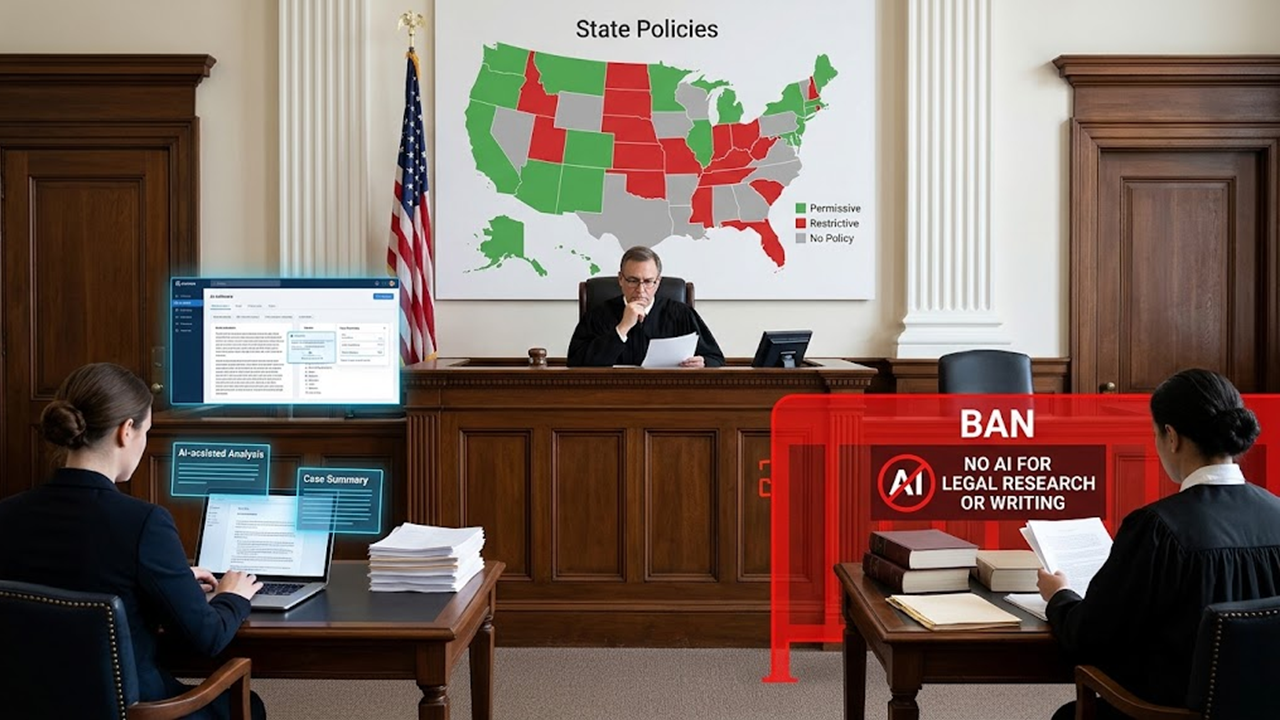
Massachusetts: Nation's Strictest Judicial AI Ban Implemented
Summary
- Clio is actively developing AI tools for the judiciary and has acquired a specialized AI startup.
- A 50-state survey reveals highly varied state judicial AI policies, with no national consensus.
- Massachusetts has the most restrictive policy, banning generative AI for legal research, writing, and other legal work for all court staff.
- New York permits approved AI tools under specific conditions, including for summarizing transcripts.
- All state policies universally prohibit judges from delegating their judicial judgment to AI, maintaining human responsibility.
Industry Developments and a Divided Landscape
Lawyers and compliance officers must be acutely aware of the specific state-level policies governing AI use by judges and court staff, as these variations can profoundly impact how legal professionals interact with the judiciary or advise on technology adoption within the legal sector.
Legal technology firm Clio is actively pursuing the integration of artificial intelligence into judicial operations, aiming to streamline judges' work through advanced AI tools. The company has even secured a trademark for the term "judiciary-grade AI" to underscore its commitment to this specialized sector. To bolster its efforts, Clio has made significant strategic hires, including Pablo Arredondo, co-founder of Casetext, who now serves as senior vice president for the judiciary, spearheading the development of court-focused technology. Bridget M. McCormack, former chief justice of the Michigan Supreme Court and former president of the American Arbitration Association, has also joined as general manager for the judiciary, tasked with leading market and commercial strategy. Furthermore, Clio expanded its capabilities by acquiring Learned Hand, a startup dedicated to building AI solutions exclusively for judges and courts, which already has products deployed in various courthouses.
Despite these substantial investments and strategic moves by companies like Clio, the reception of AI within the judiciary remains highly inconsistent across the United States. A comprehensive survey of all 50 states reveals a fragmented landscape regarding AI use by judicial personnel. While some jurisdictions exhibit more open guidelines or have yet to establish any formal policies, at least one state has implemented an outright prohibition on AI use by its judges. This stark variation presents a complex environment for technology providers and judicial systems alike, highlighting the absence of a unified national approach to the adoption of artificial intelligence in courtrooms.
The Massachusetts Precedent
Among the diverse array of state judicial AI policies, Massachusetts stands out for its exceptionally stringent stance, implementing what is considered the most restrictive policy nationwide. The Massachusetts judicial AI ban explicitly prohibits the use of artificial intelligence for critical legal tasks, including legal research, legal writing, and any other form of legal work. This comprehensive prohibition extends beyond judges themselves to encompass a wide range of court personnel, including clerks, law clerks, interns, and all other court employees and contractors.
The Massachusetts Supreme Judicial Court formally adopted these "Interim Guidelines for use of Generative AI" in November 2025. These generative AI court guidelines, while permitting AI for administrative functions, clearly state that they are subject to future refinement and modification as understanding of generative AI evolves. However, a recent verification confirmed that these guidelines have not undergone any changes since their initial adoption, reinforcing the state's current strict limitations on AI use by judges Massachusetts and associated staff in core legal duties.
A Spectrum of State Responses
The national survey underscores that there is no singular, cohesive approach to AI use by judges across the United States; instead, policies exist along a broad spectrum. While Massachusetts represents the most restrictive end, completely forbidding generative AI for legal research, writing, and other legal work, other states have adopted more nuanced or permissive stances. For instance, New York judicial AI policies offer a more accommodating framework, allowing the use of approved AI tools under specific conditions. An August 2026 ethics opinion from New York explicitly acknowledges the permissibility of employing private AI to summarize transcripts of judicial proceedings, indicating a willingness to integrate certain AI functionalities.
Conversely, Rhode Island exemplifies an approach centered on judicial ethics AI considerations. Its detailed guidance delves into specific challenges posed by artificial intelligence, yet the state's Supreme Court has deliberately designated these guidelines as advisory rather than binding. Despite these significant differences in state judicial AI policies, a fundamental principle unites all jurisdictions: the unwavering prohibition against judges delegating their ultimate judgment to artificial intelligence. While AI may serve as an assistive tool, it is universally agreed that it cannot function as the final decision-maker in legal matters. Even when policies permit AI-generated research, summaries, or drafting, judges retain the full responsibility for independently comprehending the case record and accurately applying the law.
Implications for Judicial Integrity and Practice
The significant divergence in state judicial AI policies creates a complex compliance landscape for legal professionals, technology providers, and the judiciary itself. Lawyers and compliance officers must be acutely aware of the specific state-level policies governing AI use by judges and court staff, as these variations can profoundly impact how legal professionals interact with the judiciary or advise on technology adoption within the legal sector. The strict Massachusetts judicial AI ban, for example, establishes a precedent for severe limitations that could influence other jurisdictions or generate substantial compliance risks for legal technology companies developing tools for court use.
This fragmented regulatory environment also highlights the ongoing debate surrounding judicial ethics AI and the appropriate boundaries for technological integration in the justice system. The universal agreement that judicial judgment cannot be delegated to AI underscores a core ethical tenet, yet the methods and extent to which AI can assist in the judicial process remain a subject of varied interpretation and regulation. As generative AI court guidelines continue to evolve, understanding these distinct state-level approaches becomes crucial for ensuring ethical practice and navigating the future of legal technology.
Practical Implications
Lawyers and compliance officers must be acutely aware of the specific state-level policies governing AI use by judges and court staff, as these vary significantly and can impact how legal professionals interact with the judiciary or advise on technology adoption within the legal sector. The Massachusetts ban, for instance, sets a precedent for strict limitations that could influence other jurisdictions or create compliance risks for legal tech providers.
Source
How does this affect you?
Get an AI analysis of this article grounded in your jurisdictions, practice areas, and any policy documents you've uploaded to Wansom.
Finish Reading the Full Story and the Expert Analysis.
Get the latest legal & regulatory intelligence in United States
Wansom is AI and can make mistakes.