
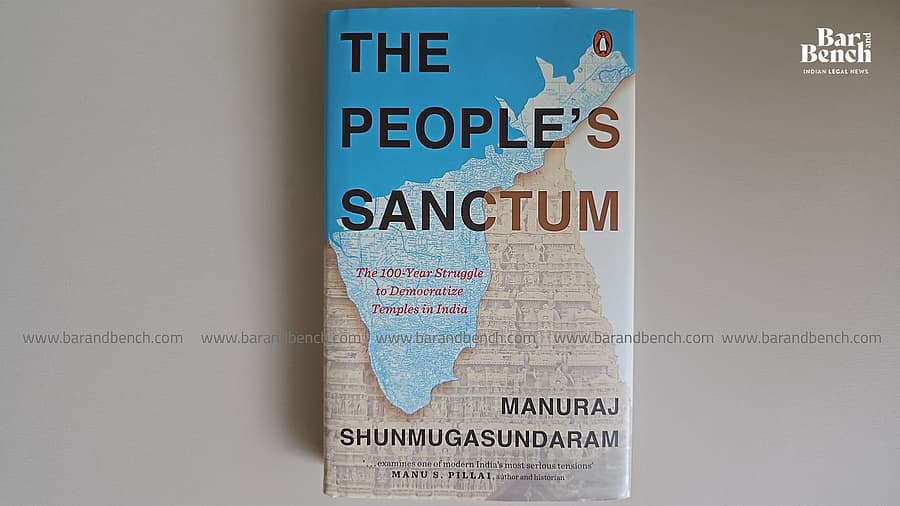
Manuraj Shanmughasundaram The People's Sanctum Review: India Temple Law History
Summary
- Manuraj Shanmughasundaram's 2026 book, "The People's Sanctum," chronicles a century-long struggle for temple democratization by depressed classes in South India.
- The book details efforts to secure road access around temples, the appointment of archakas, and the right to public religious office.
- It examines legislative measures for state control over religious endowments, judicial approaches to customs, and the political forces driving reforms.
- The text traces the impact of the Vaikom agitation, the rise of the Dravidian movement, and Tamil Nadu's pioneering role in temple reforms.
- As an advocate and DMK spokesperson, Shanmughasundaram offers a unique perspective on these historical and legal developments.
Overview of 'The People's Sanctum'
This forthcoming publication offers a comprehensive look at the legislative measures, judicial interpretations, and political forces that have shaped the landscape of religious freedom and social justice in the region.
Manuraj Shanmughasundaram's forthcoming book, "The People's Sanctum," slated for publication by Penguin in 2026, delves into a significant century-long struggle for temple democratization in South India. This seminal work chronicles the persistent efforts of the depressed classes to secure fundamental rights within religious institutions, ranging from the basic demand for road access around temples to the more profound aspiration for appointment as archakas, or temple priests. The narrative meticulously traces the evolution of these movements, highlighting the inherent right to hold public religious office that underpins these historical battles.
The book's central thesis revolves around several interconnected themes: the legislative frameworks enacted to facilitate state control over religious endowments, the judiciary's evolving stance on traditional customs and denominational rights, and the overarching constitutional morality that has guided these legal interpretations. Furthermore, it examines the political impetus that has driven this transformative journey, providing a holistic understanding of the forces at play. This comprehensive approach positions "The People's Sanctum" as a crucial resource for understanding the complex interplay between law, society, and religion in India.
Historical and Legal Context
Shanmughasundaram's analysis begins by dissecting the historical prevalence of caste-based exclusionary practices within temple administration and access, illustrating how these were perpetuated by a specific social class. A pivotal moment in this struggle, as detailed in the book, was a local agitation in Vaikom, Kerala, which served as a catalyst for broader social reform. This event ignited the self-respect movement in Tamil Nadu, ultimately giving rise to the influential Dravidian political ideology that reshaped the region's socio-political landscape.
The narrative then progresses to examine the critical interventions made by constitutional courts, which played a significant role in adjudicating disputes and interpreting laws related to temple entry and administration. These judicial pronouncements, coupled with the decisive actions of political leadership, are presented as key factors that propelled Tamil Nadu to the forefront of temple reforms in India. The book thus offers a detailed account of how legal battles and political will converged to challenge entrenched discriminatory practices, contributing to India temple democratization legal history.
Author's Perspective and Dravidian Movement
The author's unique background lends a distinct perspective to "The People's Sanctum." Manuraj Shanmughasundaram, a practicing advocate at the Madras High Court and a spokesperson for the Dravida Munnetra Kazhagam (DMK), brings an insider's understanding to the subject matter. His professional and political affiliations naturally align with the book's focus on legal challenges and the Dravidian movement's role in temple reforms, particularly concerning archaka appointment legal challenges.
Within the chapter titled "Centenary of Self-Respect," the book provides an in-depth exploration of the Dravidian movement, including the early ideological differences between its credited father, Periyar, and the DMK, which stands as the oldest surviving Dravidian political party. One of the book's notable strengths lies in its ability to offer a ringside view of the DMK's political journey and its profound impact on the democratization of religious institutions. This perspective is invaluable for understanding the intricate dynamics of Dravidian movement temple reforms and their lasting legacy.
Significance for Temple Reforms
This forthcoming publication offers a comprehensive look at the legislative measures, judicial interpretations, and political forces that have shaped the landscape of religious freedom and social justice in the region. By meticulously documenting the century-long struggle, "The People's Sanctum" underscores the enduring relevance of constitutional law in India concerning religious endowments and the rights of marginalized communities. The book's detailed account of the Vaikom Satyagraha legal impact and subsequent reforms provides crucial insights into how societal pressures and legal frameworks can drive significant change.
For legal scholars and practitioners, particularly those engaged in constitutional law or public interest litigation in India, this work serves as an essential reference. It illuminates the historical legal battles and legislative reforms that have defined temple democratization, offering valuable context for contemporary issues related to religious endowments constitutional law India. The book's exploration of the political impetus behind these changes, coupled with its analysis of judicial approaches to customs and denominational rights, makes it a vital contribution to the discourse on religious freedom and equality.
Practical Implications
For lawyers practicing constitutional law or public interest litigation in India, this book offers a deep dive into the historical legal battles and legislative reforms concerning temple democratization and religious freedom, informing arguments on similar contemporary issues.
Source
How does this affect you?
Get an AI analysis of this article grounded in your jurisdictions, practice areas, and any policy documents you've uploaded to Wansom.
Finish Reading the Full Story and the Expert Analysis.
Wansom is AI and can make mistakes.