
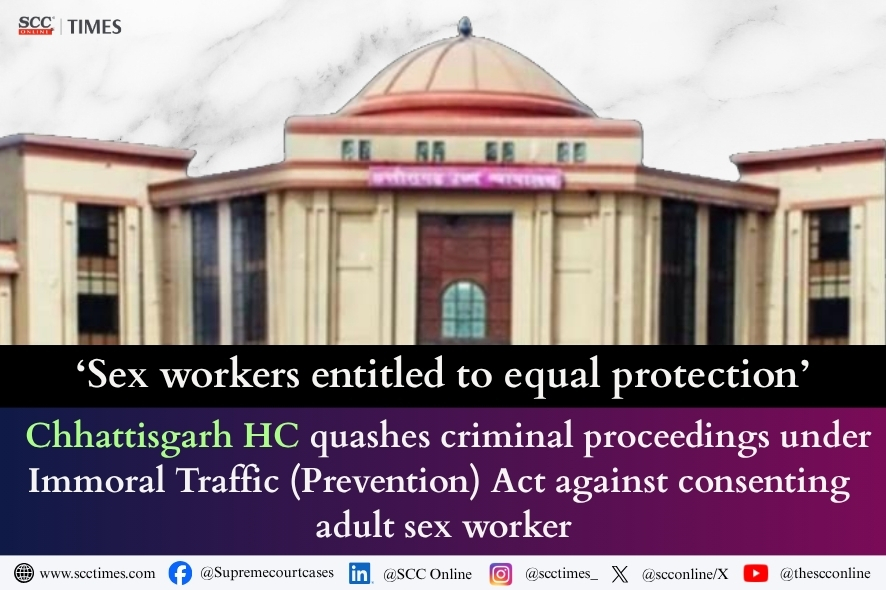
Chhattisgarh High Court: Quashes Immoral Traffic Act Sex Worker Proceedings
Summary
- The Chhattisgarh High Court quashed criminal proceedings against an adult sex worker under the Immoral Traffic (Prevention) Act, 1956.
- The court ruled that continuing the proceedings would constitute an abuse of the legal process.
- This decision was based on the lack of material disclosing specific acts that would constitute the alleged offenses.
- The judgment affirmed that sex workers are entitled to equal protection under the law in India.
The Court's Ruling
This significant ruling underscored the principle that sex workers are entitled to equal protection under the law, a crucial affirmation in the context of India's legal framework.
The Chhattisgarh High Court recently intervened in a case involving an adult woman, identified as a sex worker, by quashing ongoing criminal proceedings against her. This significant decision, which directly addresses the application of the Immoral Traffic (Prevention) Act, 1956, highlights the judiciary's role in safeguarding individual liberties and preventing the misuse of legal statutes. The court determined that allowing the criminal proceedings to continue would amount to an abuse of the legal process, given the specific circumstances of the case.
The proceedings had been initiated under the Immoral Traffic (Prevention) Act, 1956, a key piece of legislation governing aspects of sex work in India. However, the High Court found that the material presented did not adequately disclose any specific acts that would constitute the alleged offenses under this Act. This lack of concrete evidence was central to the court's decision to halt the prosecution, emphasizing the necessity for substantive grounds in criminal accusations.
This ruling by the Chhattisgarh High Court effectively quashes the Immoral Traffic Act sex worker proceedings, providing relief to the individual concerned. The judgment underscores a critical legal principle: that even in cases involving sensitive social issues, the legal process must adhere strictly to evidentiary standards and avoid arbitrary application, especially when dealing with consenting adult sex workers in India.
Legal Framework and Rationale
The Immoral Traffic (Prevention) Act, 1956 (ITP Act) is the primary legislation in India that aims to combat human trafficking for the purpose of sexual exploitation. While the Act targets organized prostitution and trafficking, its application can sometimes extend to individual sex workers, leading to complex legal challenges. In this particular instance, the Chhattisgarh High Court meticulously examined the basis of the criminal proceedings against the adult woman.
The court's rationale for quashing the ITP Act criminal proceedings was rooted in the absence of specific, demonstrable acts that would legally constitute an offense under the statute. It was noted that the available material failed to provide the necessary details or evidence to support the allegations. This judicial scrutiny ensures that individuals are not subjected to prolonged legal harassment without a clear and substantiated case against them.
By deeming the continuation of proceedings an 'abuse of the process of law,' the High Court reinforced the principle that the justice system should not be used to pursue cases lacking merit or sufficient evidence. This decision serves as a crucial reminder that while laws exist to maintain social order, their enforcement must always be balanced with the protection of individual rights and due process, particularly for vulnerable populations.
Broader Implications
This Chhattisgarh High Court judgment carries significant implications for the rights and legal standing of sex workers in India. The court's underlying message, as highlighted in its decision, is that sex workers are entitled to equal protection under the law, a fundamental tenet of justice that applies to all citizens regardless of their profession. This affirmation challenges prevailing societal stigmas and reinforces the idea that legal safeguards must extend universally.
The ruling contributes to a growing body of jurisprudence that seeks to ensure fair treatment and prevent the arbitrary criminalization of consenting adult sex workers. It underscores the importance of focusing on exploitation and trafficking, which are the true targets of the ITP Act, rather than penalizing individuals for their consensual activities in the absence of specific criminal acts. The Chhattisgarh High Court's stance provides a vital precedent for how similar cases might be approached in the future.
Ultimately, this judgment reinforces the judiciary's role in upholding constitutional principles and protecting fundamental rights. By quashing proceedings that lacked substantive evidence and were deemed an abuse of process, the court has sent a clear message about the need for rigorous legal standards and the imperative to ensure sex worker equal protection India-wide, fostering a more equitable application of justice.
Source
Source: Original reporting via SCC Times
How does this affect you?
Get an AI analysis of this article grounded in your jurisdictions, practice areas, and any policy documents you've uploaded to Wansom.
Finish Reading the Full Story and the Expert Analysis.
Wansom is AI and can make mistakes.