
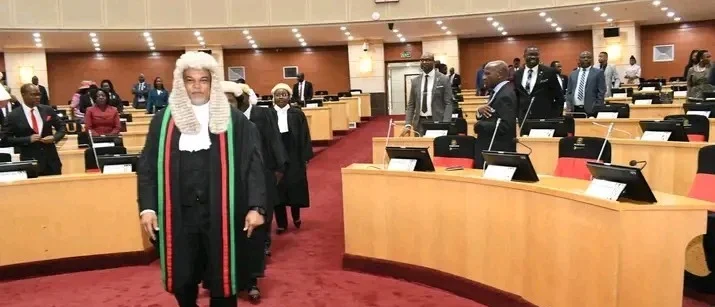
Malawi Speaker Suleman: Formed Perceived Illegal Committees
Summary
- Malawi Speaker Sameer Suleman unilaterally formed 12 joint ad hoc committees, bypassing established legislative procedures.
- Critics argue this action violates Malawi Section 56(6) of the Constitution and parliamentary standing orders, which require collective parliamentary ratification for committee creation.
- The controversy highlights a significant constitutional challenge to legislative procedure in Malawi concerning committee formation.
- High Court Judge Allan Muhome Malawi has reportedly granted a measure related to the ongoing dispute.
- The High Court's ruling is anticipated to clarify legal boundaries for parliamentary committee formation and judicial review over legislative actions.
Legislative Procedure Under Scrutiny
Lawyers and constitutional scholars will be closely monitoring the High Court's ruling on Judge Muhome's grant, as it is expected to clarify the legal boundaries for parliamentary committee formation and the scope of judicial review over legislative actions.
Speaker Sameer Suleman of the Malawian Parliament has recently drawn considerable attention for his actions concerning the formation of legislative bodies. He reportedly bypassed established parliamentary procedures when he unilaterally established twelve joint ad hoc committees. This move immediately triggered strong objections from various commentators, who highlighted the constitutional and procedural irregularities involved. The formation of these committees by Malawi Speaker Suleman is widely perceived as illegal, sparking a debate over the proper conduct of legislative affairs.
The controversy centers on the method of committee creation, which critics argue deviates from the prescribed norms designed to ensure collective parliamentary oversight. The unilateral nature of the Speaker's decision has raised fundamental questions about adherence to democratic principles within the legislative branch. This situation underscores a significant tension between executive action within the legislature and the collective will of elected representatives, as enshrined in the nation's legal framework.
Constitutional and Procedural Challenges
The core of the legal challenge against Speaker Suleman's actions rests on specific provisions within Malawi's legal framework. Critics have pointed directly to Malawi Section 56(6) of the Constitution, alongside the Malawi parliamentary standing orders, as the foundational documents that govern the establishment of such committees. These legal instruments explicitly mandate that the creation of parliamentary committees requires collective parliamentary ratification, a process designed to ensure broad consensus and adherence to established legislative protocols.
The alleged circumvention of these rules for Malawi legislative committee formation represents a significant departure from standard practice. The requirement for Malawi parliamentary ratification is not merely a formality; it serves as a crucial safeguard against the concentration of power and ensures that important legislative functions are undertaken with the collective approval of the elected body. The current dispute therefore highlights a critical constitutional challenge to legislative procedure in Malawi, specifically concerning the formation of parliamentary committees.
Judicial Intervention and Future Implications
Amidst the unfolding controversy surrounding the Malawi Speaker Suleman perceived illegal committees, the matter has escalated to the judicial realm, with High Court Judge Allan Muhome Malawi now involved. The judge has reportedly granted a measure related to the ongoing dispute, though the specific nature of this grant is not detailed in initial reports. This judicial intervention signifies the gravity of the constitutional questions raised by the Speaker's actions and the perceived procedural irregularities.
The High Court's engagement underscores the judiciary's vital role in interpreting and upholding the Constitution, particularly when legislative procedures are called into question. Lawyers and constitutional scholars will be closely monitoring the High Court's ruling on Judge Muhome's grant, as it is expected to clarify the legal boundaries for parliamentary committee formation and the scope of judicial review over legislative actions. This decision could have far-reaching implications, potentially impacting the validity of future legislative outputs or providing grounds for challenging them based on procedural irregularities, thereby shaping the future of legislative governance in Malawi.
Practical Implications
This development highlights a significant constitutional challenge to legislative procedure in Malawi, specifically concerning the formation of parliamentary committees. Lawyers should monitor the High Court's ruling on Judge Muhome's grant, as it will clarify the legal boundaries for parliamentary committee formation and the scope of judicial review over legislative actions, potentially impacting the validity of future legislative outputs or providing grounds for challenging them based on procedural irregularities.
Source
How does this affect you?
Get an AI analysis of this article grounded in your jurisdictions, practice areas, and any policy documents you've uploaded to Wansom.
Finish Reading the Full Story and the Expert Analysis.
Get the latest legal & regulatory intelligence in Malawi
Wansom is AI and can make mistakes.