
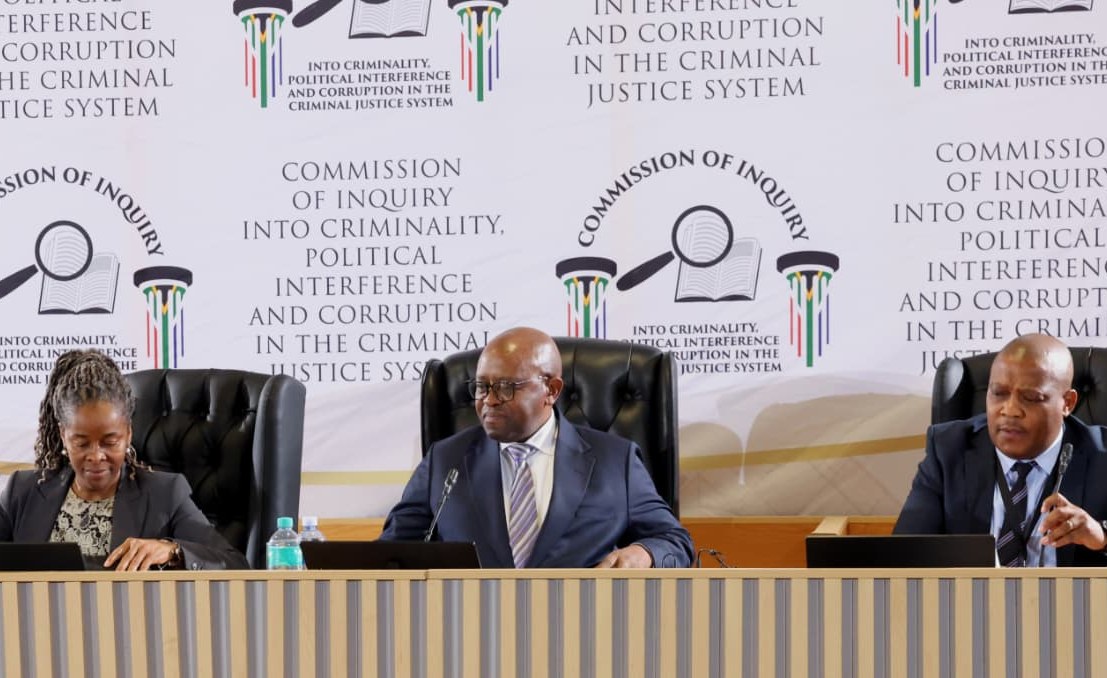
Madlanga Commission: Naicker Drug Ring Allegations Heard
South Africa's legal and political landscape saw significant developments on November 27, 2026, with the Madlanga Commission hearing fresh allegations of drug trafficking against Durban businessman Clive Naicker, the Johannesburg City Council preparing to elect a new executive mayor, and the Senzo Meyiwa murder trial resuming in the High Court in Pretoria. The Madlanga Commission received testimony from Witness T alleging that Clive Naicker utilized his legitimate businesses, including towing, panel-beating, and taxi operations, to facilitate drug distribution, specifically hunga capsules and crack cocaine, and to launder the proceeds, reportedly using tow trucks to evade police detection. Naicker has denied these allegations. Concurrently, the Johannesburg City Council was set to elect a new executive mayor following coalition negotiations involving the African National Congress (ANC), ActionSA, and Economic Freedom Fighters (EFF), with Herman Mashaba expected to be nominated for the position. Similar political shifts were noted in Ekurhuleni and Tshwane. Furthermore, the high-profile Senzo Meyiwa murder trial resumed at the High Court in Pretoria, where defence witness and former police officer Malesela Teffo concluded his evidence-in-chief, acknowledging under cross-examination by prosecutor Ronnie Sibanda that he lacked personal knowledge of the events at Tembisa Police Station in 2014. Five men are currently standing trial for the murder. The outcomes of the commission's findings, the mayoral elections, and the Meyiwa trial are not yet reported.
These diverse developments carry substantial legal and public significance across different domains. The allegations before the Madlanga Commission underscore the persistent challenge of organised crime, particularly drug trafficking and money laundering, and highlight the role of judicial commissions in investigating complex criminal networks that often exploit legitimate business structures. For practitioners, this signals a continued focus on anti-money laundering compliance and the potential for increased scrutiny on businesses in vulnerable sectors. The mayoral elections in key Gauteng metros reflect the dynamic and often volatile nature of coalition politics in South African local government, which directly impacts policy formulation, service delivery, and the regulatory environment for businesses and residents alike. The resumption of the Meyiwa murder trial, a case of immense public interest, reaffirms the commitment of the criminal justice system to pursue justice in high-profile matters, providing a critical test of evidentiary rules and procedural fairness.
The legal context for these events is multifaceted. The Madlanga Commission operates under specific enabling legislation, likely the Commissions Act 8 of 1947 or similar provincial statutes, granting it powers to investigate and make recommendations. The allegations against Naicker implicate serious offences under the Prevention of Organised Crime Act (POCA) 121 of 1998, which targets racketeering, money laundering, and criminal gang activities, as well as the Drugs and Drug Trafficking Act 140 of 1992. The municipal mayoral elections are governed by the Municipal Structures Act 117 of 1998 and the Constitution of South Africa, which define the powers and procedures for local government. The Senzo Meyiwa murder trial is being conducted under the Criminal Procedure Act 51 of 1977 in the High Court, a superior court with jurisdiction over serious criminal matters, adhering to established rules of evidence and criminal procedure.
Key parties involved in these reports include the Madlanga Commission, Durban businessman Clive Naicker, and Witness T in the drug allegations; the Johannesburg City Council, the African National Congress (ANC), ActionSA, the Economic Freedom Fighters (EFF), Herman Mashaba, Mziyanda Mketsu, Nasiphi Moya, Omphile Maotwe, and the Democratic Alliance (DA) in the political developments; and the High Court in Pretoria, the late Senzo Meyiwa, defence witness Malesela Teffo, prosecutor Ronnie Sibanda, and the five accused individuals in the murder trial.
Attorneys should advise clients on several fronts. For businesses, particularly those in transport, logistics, or cash-intensive sectors, the Naicker allegations serve as a stark reminder of the need for robust anti-money laundering compliance frameworks and enhanced due diligence to mitigate the risk of being unwittingly implicated in illicit activities. Legal professionals advising businesses operating in Gauteng's metros must closely monitor the policy shifts and regulatory changes that may emerge from the newly formed municipal coalitions and leadership, as these could impact procurement, licensing, and local economic development. Criminal law practitioners should continue to follow the Meyiwa trial for insights into complex evidentiary challenges, witness credibility assessments, and the application of criminal procedure in high-profile, multi-accused cases, which can offer valuable precedents and practical lessons for trial strategy.
How does this affect you?
Get an AI analysis of this article grounded in your jurisdictions, practice areas, and any policy documents you've uploaded to Wansom.
Finish Reading the Full Story and the Expert Analysis.
Get the latest legal & regulatory intelligence in South Africa
Wansom is AI and can make mistakes.