
Madagascar HCC Decision N10-HCC/D3: Interim President Confirmed
Summary
- Widespread public protests in Madagascar, fueled by social grievances and government repression, escalated into a political crisis in late 2025.
- President Andry Rajoelina departed the country after the military refused to suppress demonstrators, leading to a presidential vacancy.
- On October 14, 2025, the Haute Cour Constitutionnelle (HCC) issued decision n10-HCC/D3, declaring a presidential vacancy due to "passive abandonment of power."
- The HCC's decision n10-HCC/D3 invited Colonel Michaël Randrianirina to assume the functions of Head of State, installing him as interim president.
- A subsequent HCC decision, n11-HCC/D3 on October 22, confirmed that no further ruling was needed on the former president's impediment, as the vacancy was already established.
The Genesis of Unrest
The Haute Cour Constitutionnelle of Madagascar issued a pivotal ruling, decision n10-HCC/D3, in response to a request for a resolution to the political impasse.
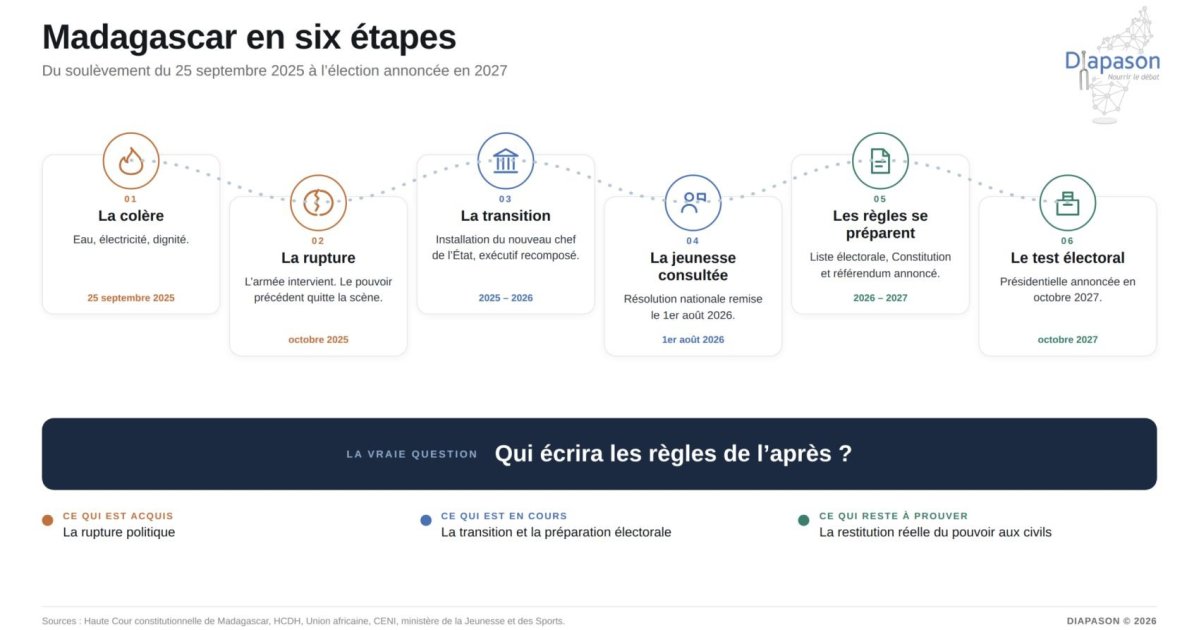
The political landscape in Madagascar underwent a significant upheaval in late 2025, sparked by widespread public discontent that rapidly escalated into a full-blown constitutional crisis. Beginning on September 25, 2025, initial protests in Antananarivo were triggered by the arrest of two municipal councilors, Alban Rakotoarisoa and Clémence Raharinirina, who had sought permission to organize a demonstration. While this incident served as an immediate catalyst, the underlying frustrations ran deeper, rooted in persistent issues such as frequent water and electricity outages, pervasive corruption, a culture of impunity, and a prevailing sense of a bleak future for the populace.
The initial demands of the movement were fundamentally social, focusing on basic necessities like reliable utilities, dignity, justice, and the prospect of a better tomorrow. However, the government's response, characterized by repression of these early gatherings, quickly transformed the social grievances into a potent political challenge. Between September 25 and September 29, 2025, the mobilization gained rapid momentum, amplified by the swift dissemination of images and messages across social media platforms. The decentralized nature of the movement, lacking a singular leadership, made it challenging for authorities to neutralize, though it also limited its capacity to formulate a cohesive post-crisis strategy.
The human toll of this initial phase was substantial. By September 29, 2025, the United Nations High Commissioner for Human Rights reported at least 22 fatalities and over 100 injuries, figures that were subsequently disputed by the then-incumbent government but remain crucial for understanding the severity of the repression. As the protests broadened, they evolved beyond calls for improved services to encompass a rejection of corruption, a denunciation of impunity, and a fundamental questioning of the government's legitimacy. The turning point arrived on October 11 and 12, 2025, when the CAPSAT brigade notably refused to open fire on demonstrators, effectively positioning the military as a critical arbiter in the escalating crisis.
Constitutional Intervention and Interim Leadership
The unfolding crisis culminated in the departure of then-President Andry Rajoelina from the country, paving the way for a controlled transition orchestrated by actors with direct access to state apparatus. On October 14, 2025, the Haute Cour Constitutionnelle (HCC) of Madagascar issued a pivotal ruling, decision n10-HCC/D3, in response to a request for a resolution to the political impasse. This landmark decision formally acknowledged a presidential vacancy, alongside a vacancy in the Senate presidency, and critically, recognized the inability of the existing government to fulfill presidential duties.
Article 3 of the n10-HCC/D3 decision explicitly called upon Colonel Michaël Randrianirina, identified as the competent military authority, to assume the functions of Head of State. The Court justified its stance by citing Andry Rajoelina's absence from national territory, characterizing it as a "passive abandonment of power." Importantly, the decision stipulated that all other constitutional institutions and bodies were to continue exercising their regular powers, ensuring a degree of continuity amidst the leadership change. Consequently, Colonel Michaël Randrianirina was installed as the "President of the Refoundation of the Republic of Madagascar" on October 14, 2025.
Legal Sequencing and Precedent
A notable aspect of this transition was the timing of Colonel Randrianirina's installation, which occurred on October 14, 2025, *before* any formal procedure for a definitive impediment against the incumbent president had been fully examined. This sequencing was further clarified by the HCC's subsequent decision n11-HCC/D3, issued on October 22, 2025. In this ruling, the Court declared that there was no longer a need to deliberate on the motion for definitive impediment, given that the presidential vacancy had already been conclusively established by the earlier n10-HCC/D3 decision of October 14.
This institutional order, where the establishment of a new head of state preceded the formal closure of proceedings against the former president, set a significant precedent. The decisions, particularly Madagascar HCC decision n10-HCC/D3 and Madagascar decision n11-HCC/D3, effectively outlined a legal framework for addressing a presidential vacancy under extraordinary circumstances, highlighting the HCC's role in navigating a constitutional crisis. The n10-HCC/D3 decision itself would later become the subject of further legal scrutiny and interpretation, with at least two subsequent interpretations, including decision n13-HCC/D3 on November 6.
Implications for Constitutional Governance
The events of late 2025, culminating in the Madagascar presidential vacancy 2025 and the subsequent appointment of an interim leader, underscore a critical period in the nation's constitutional history. The ousting of Andry Rajoelina and the military's pivotal role in the transition, following its refusal to engage in repression, illustrate how popular unrest can precipitate a rapid shift in power dynamics. The Haute Cour Constitutionnelle Madagascar, through its decisive rulings, played a central role in legitimizing this transition and establishing a framework for interim governance.
This episode, characterized as a Madagascar constitutional crisis, provides a compelling case study in how a nation's highest court can interpret constitutional provisions to address unforeseen political vacuums. The specific mechanisms employed, such as the declaration of "passive abandonment of power" and the direct invitation to a military figure to assume presidential functions, offer insights into the flexibility and limits of constitutional interpretation during periods of extreme instability. The precedent set by these decisions, particularly regarding the process of succession and the role of the judiciary in validating such transitions, will undoubtedly influence future political risk assessments and the understanding of constitutional continuity in Madagascar.
Practical Implications
This article details the specific High Constitutional Court decisions (n10-HCC/D3, n11-HCC/D3) that established the legal framework for a presidential vacancy and the appointment of an interim head of state in Madagascar. Lawyers and compliance officers should scrutinize these decisions for their precedent-setting implications on constitutional law, political risk assessment, and the continuity of legal frameworks under a new transitional government.
Source
Source: Original reporting via Diapason
How does this affect you?
Get an AI analysis of this article grounded in your jurisdictions, practice areas, and any policy documents you've uploaded to Wansom.
Finish Reading the Full Story and the Expert Analysis.
Get the latest legal & regulatory intelligence in Madagascar
Wansom is AI and can make mistakes.