
Madagascar HCC: Issues Constitutional Referendum Opinion
Summary
- On November 4, 2026, Madagascar's Haute Cour Constitutionnelle issued an opinion permitting a constitutional referendum to precede presidential elections.
- This decision, in response to requests from Colonel Michaël Randrianirina, distinguished between revising the existing constitution and adopting an entirely new one.
- The Court ruled that adopting a new constitution constitutes an exercise of original constituent power, not a revision, thus not contradicting a prior 2025 decision.
- Madagascar has been under an exceptional regime since October 14, 2025, with Colonel Randrianirina serving as interim Head of State following HCC decisions n10-HCC/D3 and n13-HCC/D3.
- The November 4 opinion allows for a constituent phase to precede presidential elections, potentially extending the transitional period and reshaping the political timeline.
The HCC's Landmark Constitutional Opinion
This ruling provides a legal pathway for significant constitutional changes prior to presidential elections, potentially extending the interim government's mandate and altering the regulatory landscape.
On November 4, 2026, Madagascar's Haute Cour Constitutionnelle (HCC) issued a significant opinion, responding to two separate requests from Colonel Michaël Randrianirina, who serves as the President of the Refoundation. These requests were submitted on October 8 and October 19, prompting the HCC to clarify the legal framework surrounding a potential constitutional referendum.
The HCC determined that a constitutional referendum could legitimately take place before a presidential election. This conclusion was reached without contradicting a prior decision issued by the Court on October 14, 2025. The key to this ruling lies in a crucial distinction: while the 2025 decision prohibited the revision of the Fourth Republic's existing Constitution, it did not preclude the adoption of an entirely new constitutional text. The Court articulated that when the populace is called upon to vote on a complete and novel document, they are not merely revising an existing framework but are, in fact, exercising their original constituent power.
This nuanced interpretation by the Haute Cour Constitutionnelle of Madagascar, concerning the constitutional referendum, is far from trivial. It is important to note that this November 4 opinion, often referred to as the Madagascar HCC constitutional referendum opinion or the Haute Cour Constitutionnelle Madagascar avis, was a direct response to the requests made by the current governing authority, rather than an unsolicited initiative from the Court itself. This context underscores the political significance of the ruling.
Legal Framework of the Interim Government
Madagascar has been operating under an exceptional regime since October 14, 2025, a status defined by Article 53 of its Constitution and further elaborated by two pivotal HCC decisions. The first, décision n10-HCC/D3, formally recognized the vacancy in both the presidency of the Republic and the presidency of the Senate. Consequently, it designated Colonel Randrianirina, as the competent military authority, to assume the functions of Head of State. This decision's ninth consideration explicitly mandated the organization of elections within sixty days of its notification, referencing Article 53, which provides a window of thirty to sixty days for such electoral processes.
Three weeks later, décision n13-HCC/D3 was issued, affirming that other state institutions would continue to function according to their established legal frameworks. Crucially, this decision introduced the possibility of postponing the presidential election, provided such a delay occurred under the direct supervision of the HCC. Any such postponement would necessitate an objective evaluation of prevailing political, security, financial, and technical conditions, ensuring that any future election would be free, transparent, and broadly accepted. A year after the initial sixty-day deadline for elections, it is evident that this period has been significantly surpassed.
While décision n13-HCC/D3 established the mechanism for election postponements under HCC oversight, the available information does not specify whether formal postponements have been enacted since 2025, how many, or if each adhered strictly to the criteria set forth in décision n13-HCC/D3. This ambiguity raises questions about the interim power's adherence to the framework established by Article 53 and the HCC's decisions over the past year. The original decisions themselves did not explicitly define Colonel Michaël Randrianirina's mission in terms of merely managing current affairs; décision n10-HCC/D3 assigned him Head of State functions, described as strictly necessary and limited, with a clear directive for swift elections, while décision n13-HCC/D3 allowed for controlled delays.
Implications for Madagascar's Constitutional Transition
The November 4 opinion, while not formally extending the interim mandate of Colonel Randrianirina, significantly alters the temporal horizon for Madagascar's transition constitutionnelle. By permitting a constituent phase to precede the presidential election, it introduces a new stage into the political timeline. This distinction between revising an existing constitution and adopting an entirely new one is paramount, as it provides a legal pathway for significant constitutional changes prior to presidential elections, potentially extending the interim government's mandate and altering the regulatory landscape.
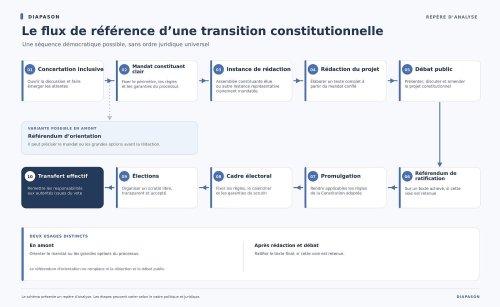
This decision could set a precedent for future constitutional processes during transitional periods in Madagascar. Typically, a robust constitutional transition involves several key stages, though these are not universally prescriptive. These stages often include broad public consultation on the terms of the debate, the granting of a clear mandate for a constituent process, the drafting of the new text by a representative assembly, extensive public debate on the proposed document, and its eventual ratification through a referendum, if that method is chosen. Following promulgation, the establishment of a new electoral framework would then pave the way for general elections, marking the culmination of the transition. The HCC's recent avis allows for this constituent step to unfold before the nation heads to the polls for a new president.
Practical Implications
Lawyers and compliance officers in Madagascar should closely monitor the legal implications of the HCC's distinction between constitutional revision and the adoption of a new constitution, as this ruling provides a legal pathway for significant constitutional changes prior to presidential elections, potentially extending the interim government's mandate and altering the regulatory landscape. This decision could set a precedent for future constitutional processes during transitional periods.
Source
Source: Original reporting via Diapason
How does this affect you?
Get an AI analysis of this article grounded in your jurisdictions, practice areas, and any policy documents you've uploaded to Wansom.
Wansom is AI and can make mistakes.